

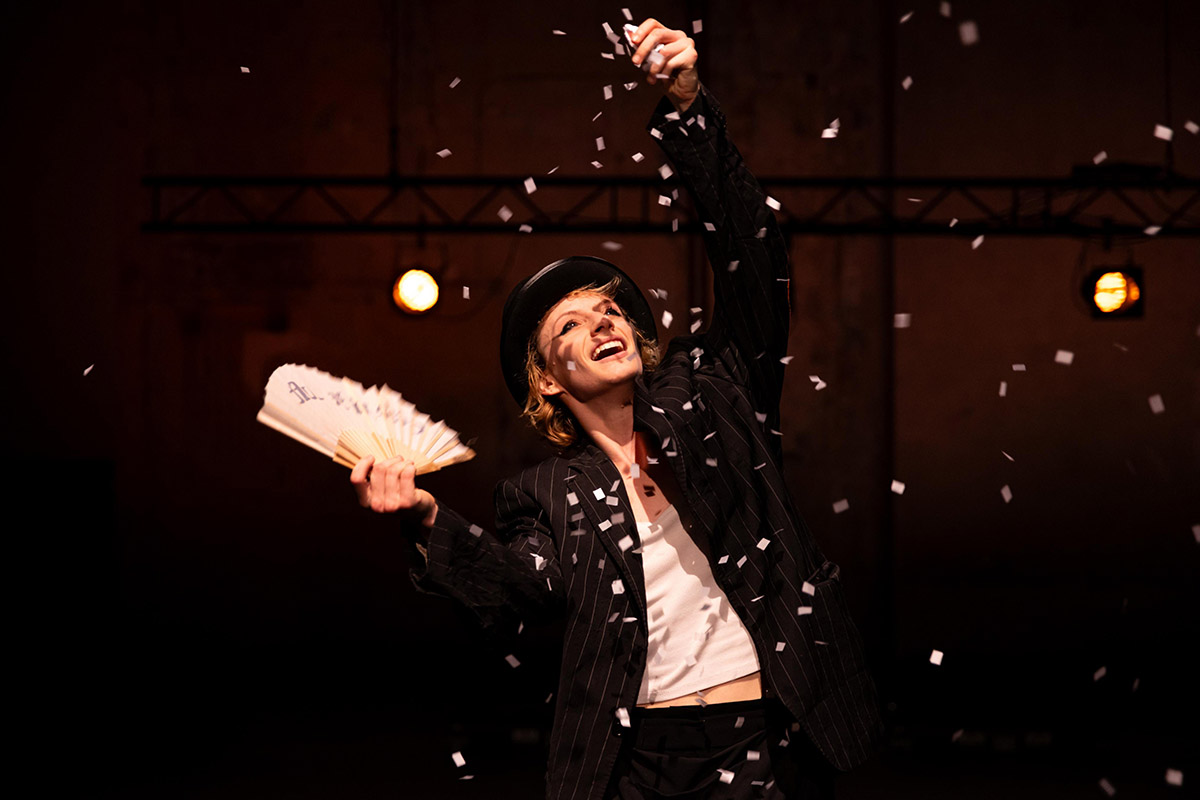
This year, Berlin’s Tanztage hit a dual milestone: celebrating its 35th anniversary amidst the 30th season of its home base, Sophiensaele. For over three decades, the festival has acted as a vital pulse-check for the city’s independent dance scene – a launchpad for generations of Berlin-based choreographers and a source of friction and awe for its audiences.
Often viewed as a grittier, more rebellious sibling to the more polished and versatile Tanz im August festival, Tanztage has recently been forced to contend with a harsh reality of severe budget cuts. For his seventh edition, curator Mateusz Szymanówka opted for resilience over retreat. He maintained the festival’s usual volume of new productions, but the aesthetic shift was undeniable: sparse sets, tighter artistic teams, and short, two-week rehearsal times for new productions. ‘Do more with less’ goes the old neoliberal adage, and fittingly, the (im)material means of production became the season’s central theme. What does it take to create art when you run out of fuel? To dance when you run out of money? To celebrate when you run out of mind? Or to rehearse when you run out of rent? —EB
jee chan, ratu
In Javanese, ratu denotes absolute authority – a title stripped of its gendered western ‘Queen’ and restored to its epicene roots. This serves as the catalyst for jee chan and Naniek K. to stage a dual manifestation of power and memory that feels both solemn and urgently fashionable. Structured as five runway tableaux on a triangular catwalk, the piece collides ceremonial masks, whips and archbows with high-fashion silhouettes, backed by a live trio blending Gamelan with thumping electronica. Naniek K., an 81-year-old court dancer turned runway veteran, is the magnetic centre. Oscillating between the clinical precision of a palace apprentice and the sharp, rhythmic snap of a West Berlin model, she exudes a quiet, formidable authority: with arms akimbo, she commands the space through the mere tilt of her chin. Beside her, chan moves in long, breathless strides in restless contrast to Naniek’s regal poise. Together, they meld their stories into a living archive of movement, blending nostalgia with cheer.
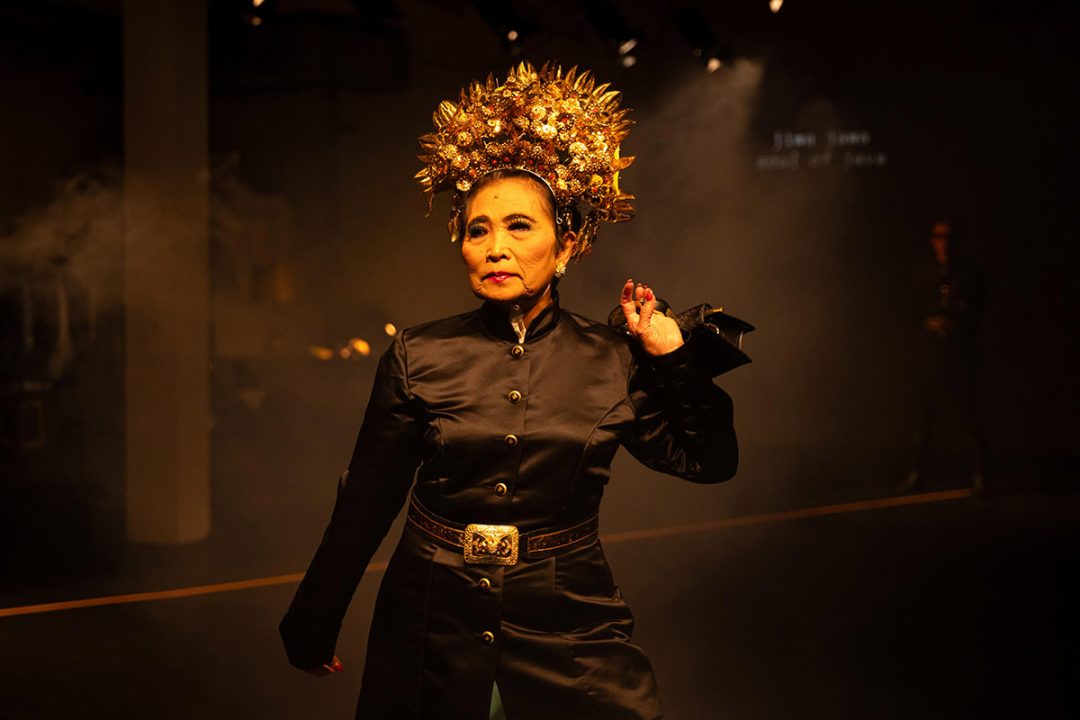
Between these processions, the pair retreats to a cosily lit corner to assist with one another’s costume changes. While this display of mutual care lays the show’s structure bare, these tender intervals linger, momentarily cooling the pace. Ultimately, ratu skims its stories like a stone over water. Though the overabundance of media (poetry, singing, archival stills, and projected video) occasionally scatters the focus, it seems born of a generous ambition to tell a story too vast for the stage. And the piece feels like a fleeting fragment of a larger, perhaps ungraspable conversation – ending just as the audience surrenders to it completely. —EB
Alvin Collantes, Bibingka
There’s no denying that Alvin Collantes is a charming performer. It’s impossible not to feel the infectious joy as they present their drag alter ego, Bibingka, pumping their chest, rolling their hips, and flicking a long ponytail while lip-syncing flawlessly to a series of driving pop tracks.
Over time, Bibingka’s layers are stripped back to reveal what lies beneath their flamboyant persona. In breaks between songs, they deliver confessional monologues on everything from heartbreak to growing up queer in the Philippines and their experiences as an immigrant in Canada. It’s particularly touching when Collantes lip syncs to a Tagalog love song, the first they ever performed as a drag queen in their native language. The message they deliver about how ‘no matter how far you’ve been away, you can always return to a place you called home’, surely resonates with many audience members.
‘
The moments of collective pleasure Collantes does generate are not ones I’ll forget in a hurry
Yet despite flashes of relatability, Bibingka largely remains rooted in Collantes’ idiosyncratic experience. It’s a piece that works best delivered to a home crowd – their account of being invited to perform at the Berlin queer rave night Lunchbox Candy induced knowing cheers from one section of the audience – and at times it feels overly self-referential. The closing solo, while impressive, prioritises introspective indulgence in the endless possibilities of Collantes’ languid limbs over sustaining the connection established with the audience.
Nevertheless, the moments of collective pleasure Collantes does generate are not ones I’ll forget in a hurry. Bibingka coaxing the crowd into dancing along to a German version of a Filipino ’90s novelty song, with the room erupting into synchronised twerking, was undoubtedly a highlight of my Tanztage. —EM
Dominique McDougal & Carro Sharkey, Did4Luv
An orange spotlight slowly illuminates an indistinguishable silhouette. ‘What I Did for Love’ from the renowned musical A Chorus Line echoes soulfully through the auditorium. The figure casts a mournful shadow across the stage floor. Is it a human? Too tall. The Cookie Monster? Too red. It’s a performer in an Elmo suit.
Eyes vacant and mouth agape, Elmo cuts a comical visage, yet their movements tell a different story. Raising their hands in surrender and cowering behind a metal pillar to an increasingly distorted soundtrack, they beg the question: who or what has hurt this beloved character? Dance, and the ecosystem that surrounds it, seems to be the answer, as they demonstrate cartwheels, breakdance, jazzy drag runs, and Fosse-style hip rolls in desperate attempts to entertain, each movement like a fragmented memory of a gruelling gig. Their efforts culminate in an anguished, open-armed stance, a plea for an applause that never comes.
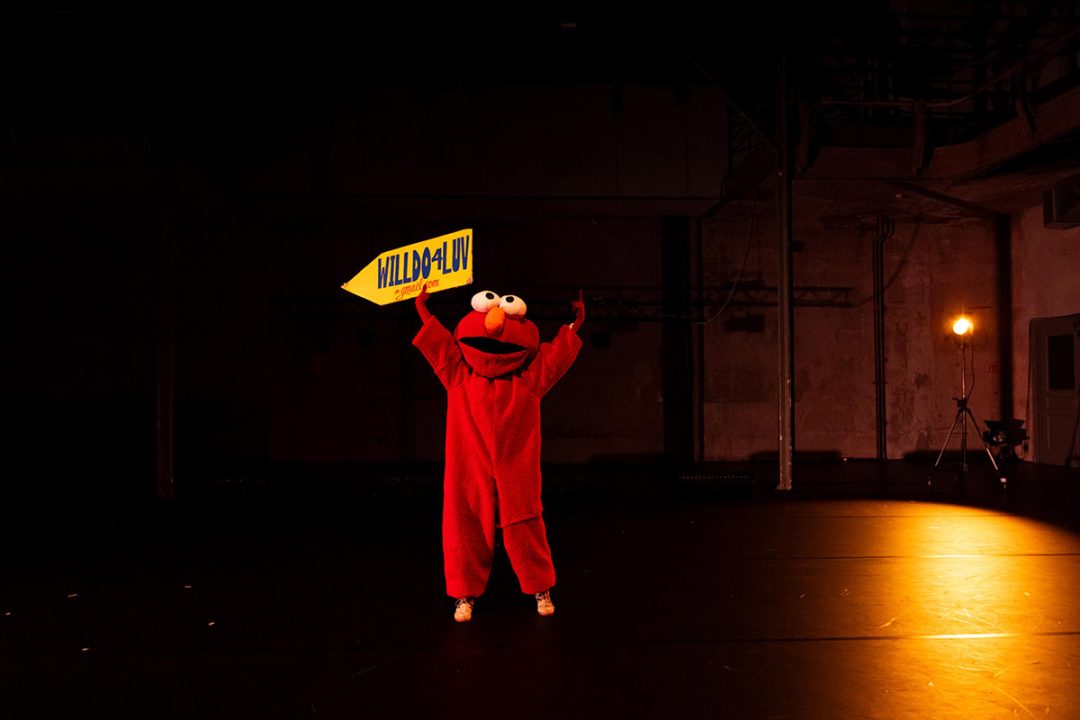
Eventually, the suit comes off to reveal Carro Sharkey, who continues demonstrating the eclectic skills they’ve acquired to survive in the dance industry – everything from impressive magic tricks to pole dance acrobatics. There are some moments of direct address to the audience, as Sharkey picks a (staged?) fight with an iPhone wielding audience member. Yet for the most part, Did4Luv uses the very art form it critiques to craft a timely, tragicomic exploration of what performers endure for the love of their craft. ‘If today were the day you had to stop dancing, how would you feel?’ a voiceover repeats as Elmo/Sharkey sweeps, leaps, and stumbles across the stage. If this show is anything to go by, the answer may be relief. —EM
bottom up productions & Isabela Fernandes Santana, O Que Resta do Fogo
Berlin-based bottom up productions functions as a curatorial experiment in horizontal creation, inviting a new guest choreographer for every new work. This time, the invitee is Isabela Fernandes Santana, and the thematic target is charcoal-burning – a premise that, in execution, offers a classic case of high-octane movement vocabulary applied to a story of meager ambition. Three dancers relentlessly deploy a manual of interpretive gestures: they heap and pile, tug and pull invisible stacks of wood, sacks of coal, and mounds of ashes. They blow, whistle, grimace and contort; they drag, carry and haul each other across the stage with the grim determination of labourers. There is no respite even when the movement becomes more abstract and less frantic. When left alone, they are virtually never restless, jolting, twisting, leaning and crawling through a dense thicket of choreography. Yet all loose references to manual labour can hardly sustain a narrative arc, let alone build an emotional space. And the work loses its grip and focus almost as soon as it establishes it.
While the dancers’ skills are unquestionable, their intention is not and I couldn’t escape the nagging sensation that incessant movements fail to actually stick to the bodies performing them. It’s as if Santana’s choreography only skims through the dancers’ skin instead of emanating from their core. This odd gap between effort and essence feels unreflected and unmoored, and ultimately creates a distance that even the quieter and more thoughtful last half of the show fails to bridge. —EB
PELUSIA, Psycho Buddha
Participatory performances like Psycho Buddha can induce scepticism. I myself am reluctant to rise from my beer crate seat when, after handing out sunflower and pumpkin seeds and narrating a list of future memories (‘I remember when I will hear your political views and find them disappointing…’), performer Mateo Argerich asks the audience to mill around and recite our own imagined recollections. Yet it’s surprisingly liberating. The hum of others muttering to themselves reassures me that I’m not the centre of attention, and fiddling with my seed like a prayer bead is a meditative distraction from lingering anxieties.
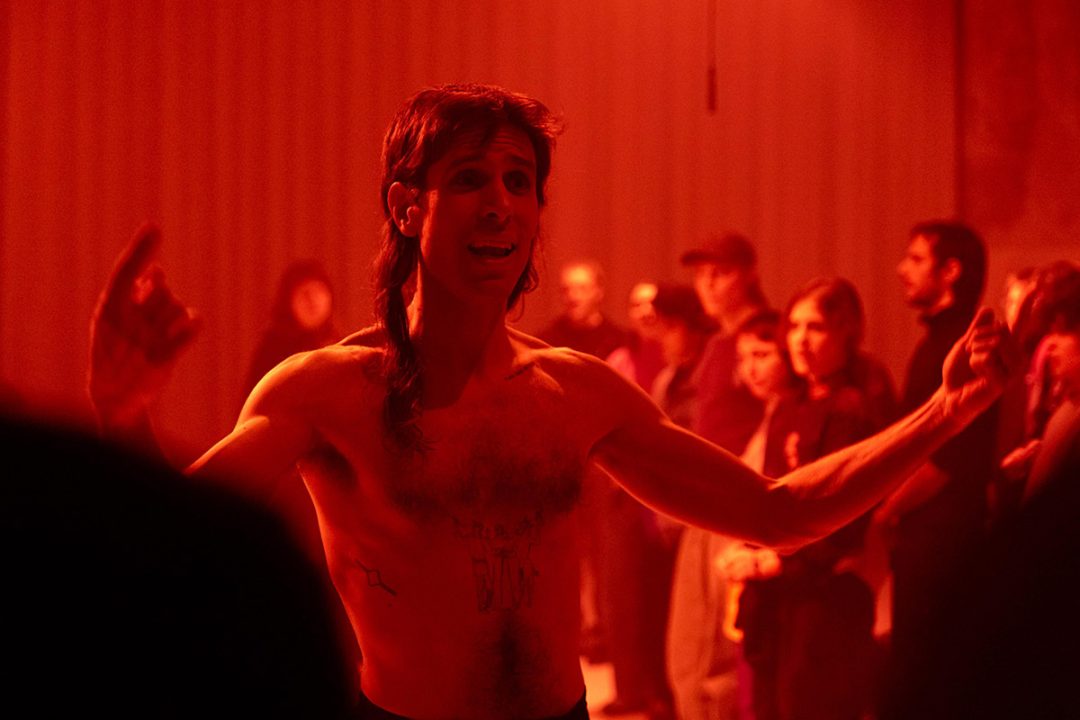
Tasks such as this are interspersed with solo movement sections from Argerich. Supplicatory palms, folkdancey skips, and defiant stamps are performed in a loose, improvised manner, as if emerging from deep within. As such, Argerich establishes themselves as a calm yet confident presence, creating a safe space for the audience to engage in increasingly intensive activities. There’s no shortage of people running to scream, rap, and wail what makes them feel uncomfortable into microphones when invited, their voices looping and overlapping in a cacophonic soundscape. And when Argerich conducts the audience in a choir of rounds, most participants stick faithfully to their group’s prescribed melodic mantras, even when left to their own devices.
In an age when we barely look one another in the eye, it is remarkable that Argerich manages to bond a group of strangers so intensely in just 60 minutes – a feat far more powerful than their lengthy closing speech on sharing, collectivity and revolution. Without prescribing exactly what we should be raising our voices for, Psycho Buddha provides us with the tools to do so when we choose. —EM
Dominique Tegho, the intimacy of collision
Dominique Tegho’s latest work has emerged as a clear cornerstone of this year’s Tanztage. Alongside Anthony Nakhlé, Tegho dissects the western orientalist gaze on ‘Middle Eastern folk dances’ and strips the decorative varnish from dabke and baladi, dance forms frequently displaced by decorative exoticisation. The show’s pulsating structure breathes through loops of ebb and flow, supported by Tegho’s own vocals and poetry. Nakhlé’s baladi is a masterclass in internal gravity; their torso undulates with a heavy grace while complex hip isolations and arm sweeps pull the audience into a rhythmic trance. Just as you are lulled into this fluidity, the rapture is fractured by the staccato energy of dabke that emerges like a distant tide until it eventually swells and saturates the space. The dancers now move elbow-locked, drawing ample eight-shaped patterns, stomping, bouncing and prancing with a mathematical precision that never eclipses their joy.
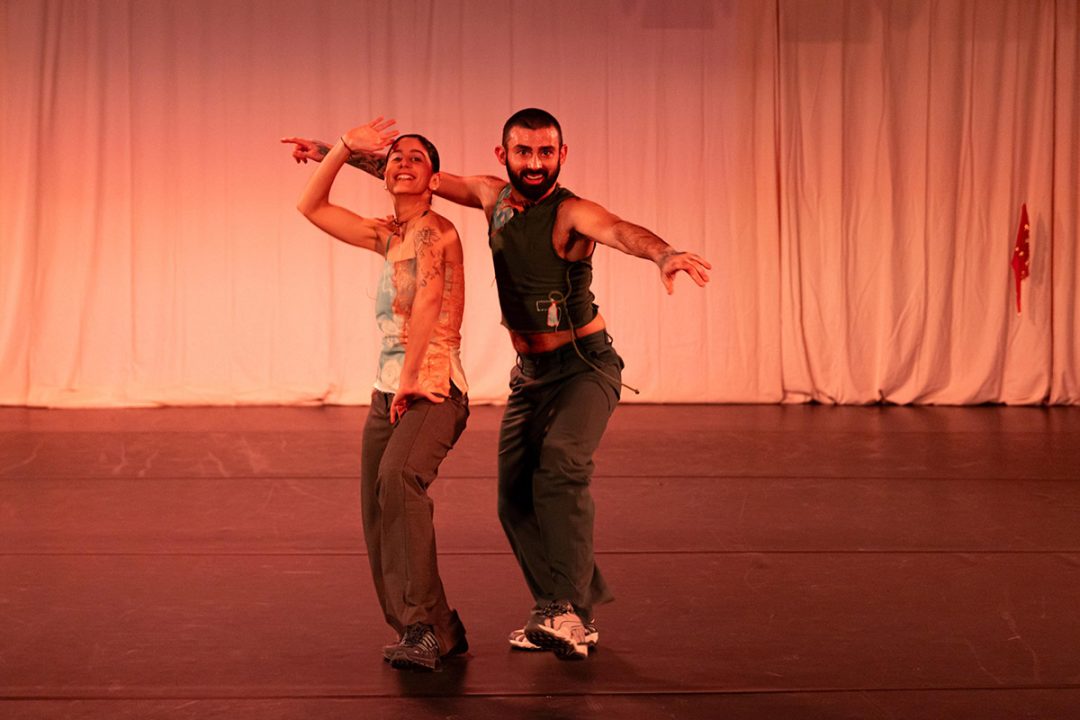
The performance takes a bold turn when an AI-generated ‘Dance of the Seven Veils’, the ultimate eroticised cliché, appears on the wall. It is neutralised by the superposed video of Berlin drag queen Hassandra nonchalantly eating fruit, a move that destabilises the male gaze with total indifference. When Hassandra also joins the stage, what begins as a visceral exercise in ululation (a vocal technique also often misread by a western ear that too easily conflates intensity with grief and trauma) quickly evolves into the raw energy of a rock gig. Tegho ends by setting the ‘folkloric’ ablaze in a riotous reclamation of identity – an unsettling and joyful critique delivered with authority and panache. —EB
Colleen Ndemeh Fitzgerald, I Want Revenge, Grandma
Colleen Ndemeh Fitzgerald evidently wants to send a clear message to the predominantly white audience of I Want Revenge, Grandma. Yet instead of addressing it directly to us, she delivers it through an imagined conversation with one of her Kpelle (the largest ethnic group in Liberia) ancestors. ‘Do you remember when they [German mining companies] made Africans slaves in their own land, Grandma?’ she asks, her words falling into an impassioned, rhythmic cadence. Her hands thump her chest and scoop soil from a centre-stage earthen mound, fingers parting and letting the granules slip through them like sand in an hourglass. ‘Did you imagine wrapping your wrinkled fingers around the white man’s neck when you saw what he did to the mountain?’ she continues, miming strangulation with unnerving vigour.
Even though Fitzgerald intimates she would happily throttle audience members linked to Germany’s colonial history in Liberia, the effect of her performance is less fear than understanding and reflection. By cleverly framing her speech as a private outpouring rather than a direct reprimand, viewers are more likely to appreciate why she doesn’t ‘want to be the bigger person’, especially after being presented with archival footage of intensive iron ore extraction by the Bong Mining Company in the 1960s, of luxurious white life in Liberia, and African artifacts now flaunted in Berlin museums.
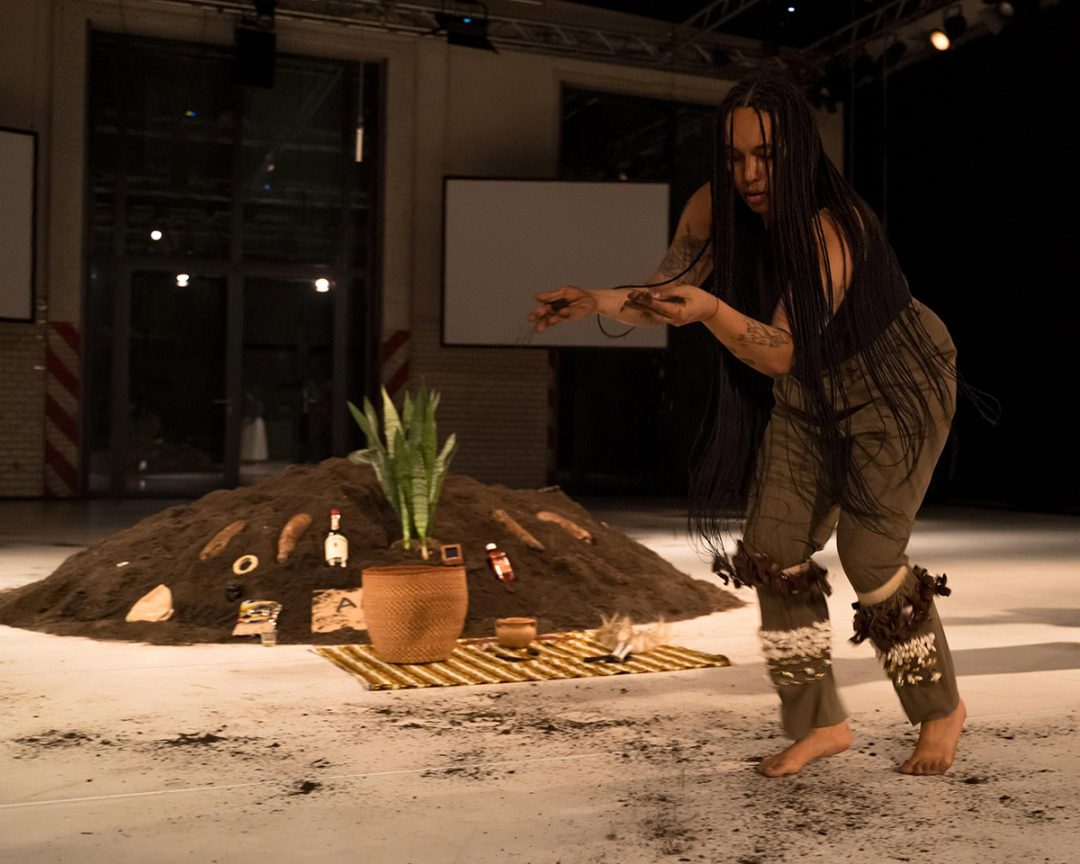
Later, Fitzgerald caps her anger, invites us all on stage, and performs a Kpelle dance of torso undulations, rippling arms, and shoulder shrugs to rapid drumming. Her jaw juts and eyebrows raise – an expression of restrained frustration, perhaps? To conclude, she neutrally explains that the most direct form of atonement for the crimes she’s detailed is paying reparations, asking those who have benefited most from colonialism to collect some money from their bags, and bury it in the mound of soil. It’s a beautiful suggestion – the symbolic gesture of returning value to the earth an acknowledgement that not only people, but nature too suffers under colonisation.
A short, awkward silence and stillness follows. Will the audience, who have nodded along so far, put their money where their mouths are? After seconds that feel like hours, most of us do. The willingness to atone is a testament to the nuanced journey Fitzgerald has taken us on. —EM
Pamela Moraga, Gig
Pamela Moraga’s Gig preaches to the converted. There are hums and sad snickers of recognition in the audience as she details the struggles of working as a freelance dance artist in Berlin, directly addressing us in increasingly desperate tones about intensive application processes, slashed funding, and the multitudinous side-jobs she maintains to support her artistic career. ‘I just wanted to dance,’ Moraga laments, rallying against a computerised voice ordering her to dictate her biography and artistic statement in 1500 characters or less. It’s surprising then, that despite having the stage to do so, she doesn’t seize the opportunity to ‘just dance’ at Tanztage, instead prioritising expository text over the nuanced language of movement.
There are some dance-focused sections, though they lack deep physical exploration. Moraga executes classical ballet exercises and throws punches to the Rocky theme, as though bracing herself for a battle against German arts bureaucracy. Eventually, she succumbs to a voiceover urging her to exploit her Chilean heritage’s ‘sauce’ and ‘flavour’ by blending Reggaeton with contemporary dance. This critique of exoticisation and the commodification of identity is arguably the most compelling part of Gig. Yet as the audience screams, claps, and films her closing solo of exaggerated hip thrusts, sensual body caresses and tongue-bites, it feels like a painful confirmation of Moraga’s fears. She’s performing the stereotype she’s been told people want, and they’re lapping it up. —EM
Elena Francalanci, Lento Violento
Writing about dance offers the sweet, perilous privilege of being entirely subjective. At this year’s Tanztage, there have been funnier shows, sharper shows, and shows with more airtight pacing or ambitious storyline. But Elena Francalanci’s Lento Violento was the only one that bypassed my analytical brain entirely and sent a shiver straight down my spine.
Alongside Eva Dziarnowska, and set to Andrea Bambini’s minimalist, sentimental score, Francalanci traces the messy friction of desire. Together, they draw the private and public cycles of a couple: the jealousy, the uneven admiration, the long-distance longing, the euphoric solo highs, and the cold-blooded love twists. It is all there: the many embraces, the stolen kisses, and the hazy energy of a night out. But why did this spiralling, cinematic work hit so hard?
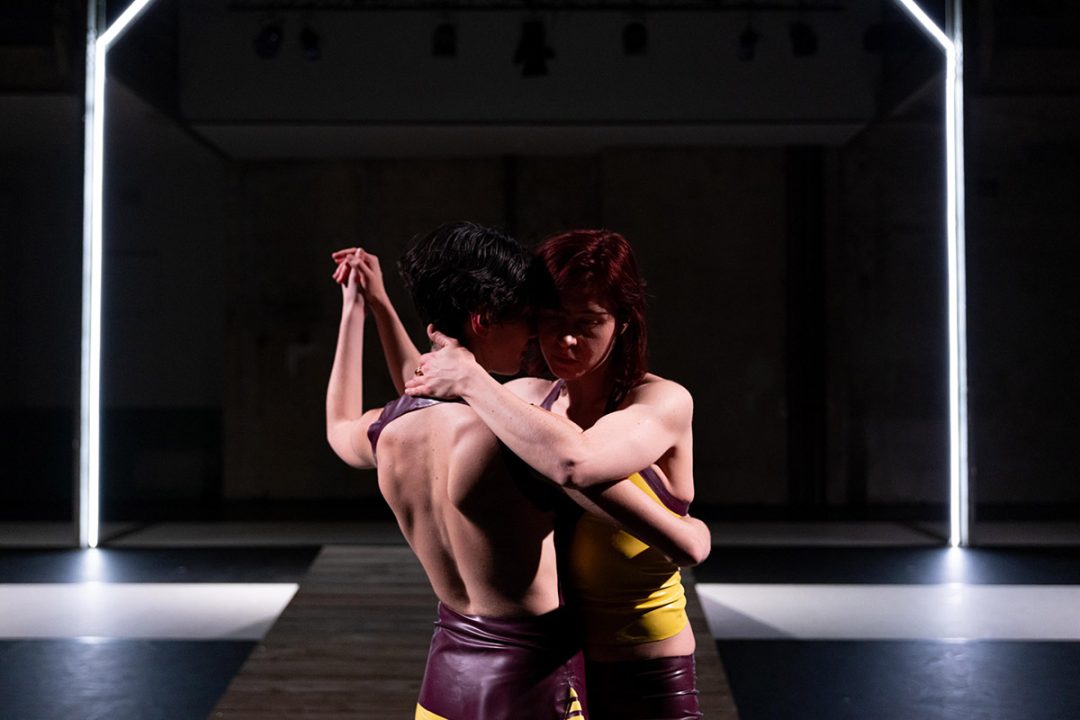
Was it the rarity of seeing liscio and other couple dances back on a contemporary stage? Was it the performers’ dangerously alluring magnetism: Francalanci’s glinting mischief clashing with Dziarnowska’s guarded, coiled flirtation? Was it the sudden swell of 10cc’s ‘I’m Not In Love’? Was it that striking image of the pair prancing atop a wooden ramp (a roof peak, perhaps?) casting giant, Felliniesque shadows against the theatre walls? Was it the final, lingering slow-dance to a melancholic EDM pulse, as the pair drifted through spotlights and shared delicate shoulder kisses before vanishing under the neon outline of a church? Perhaps it was the way the show’s calculated narrative collided with the sheer warmth the two dancers exuded. What is certain is that Lento Violento felt like a warm, clumsy embrace – one of those magical moments where dance manages to say exactly what words cannot. —EB
Pooyesh Frozandeh, Saving Flowers
There is a rare, haunted honesty in Pooyesh Frozandeh’s short solo for Kiana Rezvani, where every quiet gesture feels pulled from a private, personal territory – a score that fits them like a second skin. Under a fluttering white paper sculpture, a structure reminiscent of a collapsing roof or a pulverised cloud, Rezvani starts by confessing their blindness: ‘I looked up. I lost my eyes.’ And what follows feels less like a dance or poem than a meticulous excavation of memory splinters and shards.
Rezvani’s stage presence is commanding yet porous. They don’t merely occupy space; they scan, probe and interrogate it. ‘But the house is endless,’ they say, while their fingers endlessly trace and stroke the phantom contours of a house described in the poem, moulding the void until the very air acquires the heavy weight of her grief. There is a vibrating melancholy distilled in the dancer’s cautious and precise arm sweeps and restless, broken step patterns and jolts: this quest feels doomed, but remains desperately urgent. The architecture itself joins the show. The lights pivot upward, scouring the Sophiensaele’s cracking ceiling and rickety balcony, until colourful fissures begin to bleed across the walls and the paper sky – like a mind cracking under the pressure of its own history. The conclusion is a cold, dramatic mercy. As Rezvani crawls through the space, the white paper sculpture falls on them like a shroud as if sealing away their turmoil. The memoryscape is closed, leaving a long, heavy silence that is fully deserved. —EB
08–24.01.2026, Sophiensaele, Berlin, Germany