


Watching Sati Veyrunes perform is like experiencing an uncategorisable weather event – perhaps a tempest, or a flood, but undoubtedly an event that reshapes the chemistry of the present. Known for her ferocity of feeling, she is widely recognised as the current performer of Oona Doherty’s firecracker Hope Hunt and the Ascension into Lazarus, as well as Benjamin Kahn’s 2023 work Bless the sound that saved a witch like me. Both of these works are solos, a form which Veyrunes has chosen to plumb for her first project, Motor Unit. Two different choreographers – Budapest-based Adrienn Hód, and Reykjavík’s Erna Ómarsdóttir – have each been invited by Veyrunes to transmit a solo based on their existing body of work, now seen side by side through the prism of Veyrunes’ singular craft. I spoke with Veyrunes when she was deep in the well of process, preparing for the premiere of Motor Unit at the Ménagerie de Verre in Paris, 12–14 March. Our conversation has been edited and condensed for clarity, and translated from the original French.
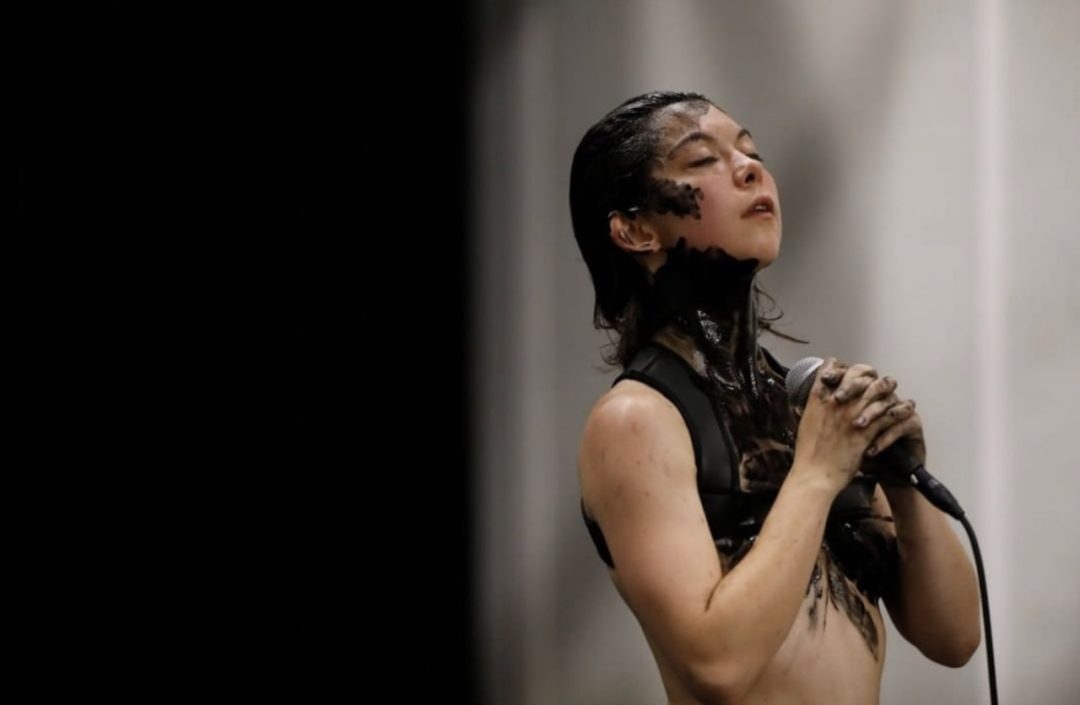
I thought to begin by asking you about the particular situation of being alone on stage. Usually we call it a solo, and it’s something you’ve often experienced in your work as a dancer.
Yes, but in fact I never feel alone. There is always an encounter, and it’s precisely this encounter that is the source of my love for dance. Love in the active sense: the encounter as a thing that transforms me, that transforms my dancing. There is always a dialogue: between myself, the material, the choreographer, and the audience.
I think of choreographies as skins to inhabit, and the dialogue as the process that sews these skins from the inside out. In learning a new piece I search for its skin, and the way it stretches my body and its different layers of memory and feeling.
In order to survive the form of the solo, I actively displace my focus [away from myself] and towards the practice, towards something outside of myself.
At the end of the day though, it’s on you to keep the piece alive, right? When there’s one person onstage, only one person to keep the work going, is it a different rhythm for the performer?
Absolutely. There is a struggle with stamina, with effort. For her work IBM 1401, A User’s Manual, which I’ll perform in Motor Unit, Erna told me not to hide the struggle. Don’t demonstrate it for the public, but don’t hide it either. You have to find moments of rest within, to integrate rest into your interior space.
Motor Unit was born from discussions with the team at the Ménagerie de Verre, which was at the time under the directorship of Philippe Quesne. Philippe invited me for a coffee to talk about how, as a venue, they normally invite choreographers in order to discover works of choreography. The Ménagerie were interested to see what would happen if, instead of inviting a choreographer, a venue would invite a dancer. And through the work of that dancer, the audience would discover works of choreography. So Motor Unit came about through the inversion of a paradigm. Motor Unit places the dancer, and her work, as the project’s heart – its motor unit.
Philippe asked me what I might be interested in doing, and I confessed to a desire to push the idea of endurance, to ask: can I hold two different choreographies, one after the other, that contain their own worlds and methods?
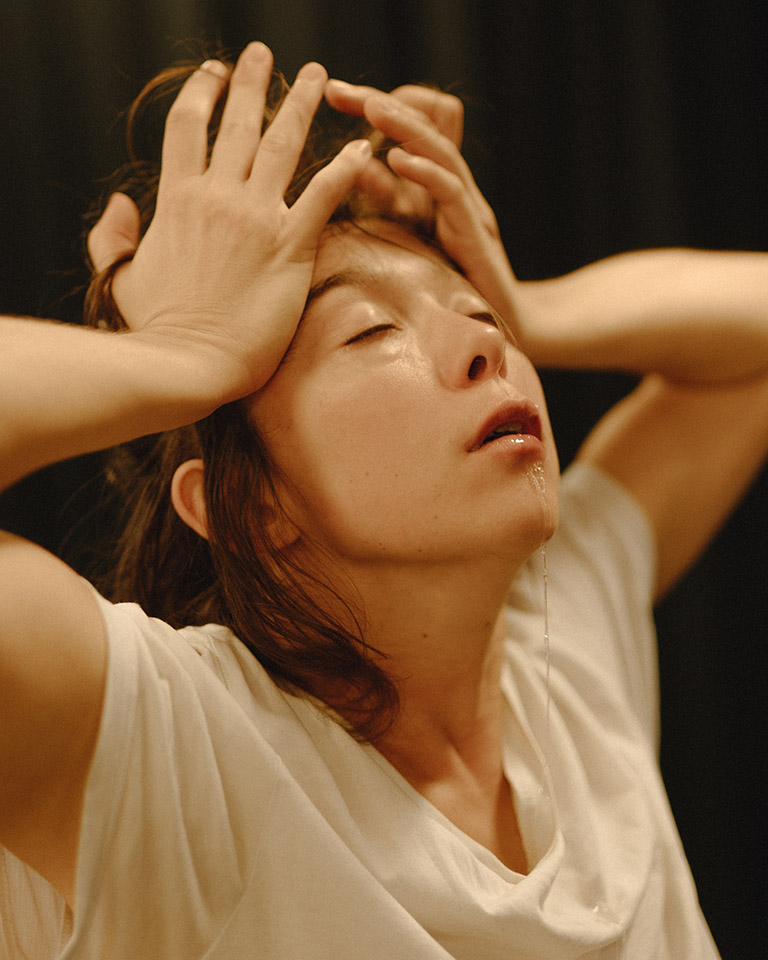
Has this paradigm inversion informed the relationship you have with Erna and Adrienn? In the studio, on the daily, could you sense anything different?
I feel a magnificent trust with both of them. I first discovered Adrienn’s work in Heidelberg – she was presenting a piece at the same time I was dancing in Oona’s Hope Hunt, and we went to each other’s shows. Immediately after the fact, we began a correspondence by email for over two years, and discovered we see many things in the same light. From the beginning with Adrienn, there was a horizontality in the relationship, and when I proposed this project to her, she was immediately enthusiastic, because I think the autonomy of the dancer is extremely important to Adrienn’s work.
‘
I try to do something, knowing that it cannot be done
Adrienn asks the dancer to confront impossibility. She layers different tasks simultaneously in order to arrive at an overload of information, a space where the body can’t hold it all. Inevitably, there is a moment where you have to choose: what do I let go, and what do I hold on to? She asks the performer to swim inside the dilemma.
For the piece I will perform in Motor Unit, which is an adapted extract from Adrienn’s 2023 work Voice of Power, I have an objective which is clear to everyone, including the audience. Yet the objective is impossible, and so I work in a mode where I try to do something, knowing that it cannot be done. Immediately, Adrienn’s work places the dancer in a game of adaptation. As a performer, it brings you to an enormous place of self-reflection: do I choose to fight, within what I feel? How do I cling onto the value of hope?
And Erna? How did you meet each other?
I met Erna in 2019, in my last year at SEAD in Salzburg. For our final exam, we had to contact a choreographer, and learn a ten-minute extract from one of their pieces. I stumbled upon a video of Erna’s work on YouTube. It was a terrible, extremely blurry recording, but I had a visceral reaction to it. So I wrote her a declaration of love.
Learning IBM 1401, A User’s Manual from Erna has also been about a certain relationship to memory, and to time. She created the piece in 2002 on herself, and though she continued performing it this is the first time she’s agreed to transmit it to someone else – I have no idea why she said yes.
From the outset, she didn’t want us to watch or work from any recordings. Twenty-four years after the fact, there are things in the pieces that physically, she can no longer do. It was beautiful, being in the studio with the gaps, the holes, the forgettings. She didn’t want me to try to emulate her 2002 self. She wanted us to get through this together, to traverse the process of reconstruction as partners.
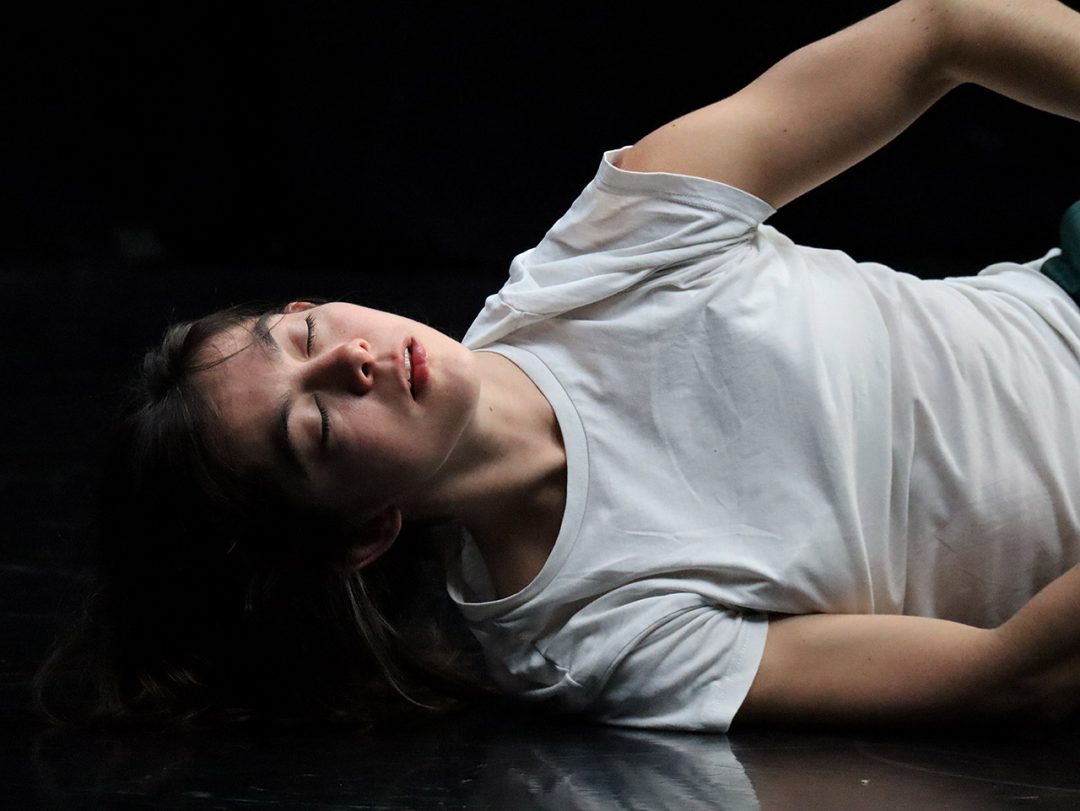
What do you feel when you’re inside these two works? If, as you said, choreographies are skin, how would you describe the two that make up Motor Unit?
With Adrienn, the work feels very concrete. I am here, in the room, with you. It’s okay if you get bored. What has struck me most is a relationship to forgetting. Not forgetting something, but a forgetting that grows from an enlargement of my presence and perception, that displaces me from myself.
With Erna, my senses are sharpened, my senses are thicker. There is a dialogue between the interior and the exterior; I know there is something inside of me that wants out. The feeling is organic in the sense of an organ, of a membrane. The skin is elastic. I am an infant that has been alive for decades.
Adrienn’s piece confronts me with the feeling of error, of judgement. Since there is a task I can never complete, it’s confronting. As dancers we are used to arriving on stage with more known than not. Adrienn’s goal is that I come onstage with the opposite – not-knowing more than I know. To be in that state in front of an audience is confronting. Dance education and even the space of the theatre at large, often assume a mastery within the body of the performer.
You’re seeing me in a moment when I don’t know fully what will happen. With Adrienn, I try to look at ‘error’ as a feeling. Failure as a feeling. Once that feeling passes, what is left? What other kind of space can open? ●
Motor Unit opens 12–14.03.2026 at La Ménagerie de Verre, Paris, France:
menageriedeverre.com/les-inaccoutumes/les-inaccoutumes-printemps-2026/motor-unit-sati-veyrunes#dates-horaires
Further dates:
20–21.03.2026, KLAP, Marseille, France: kelemenis.fr/fr/les-spectacles/1652/motor-unit
June 2026 (details tbc) Festival La Maison, Uzès, France