

I did not see everything. Thirteen works presented in Bern from 11 to 14 February 2026, spread across several institutions and framed by professional meetings and public discussions: Swiss Dance Days compresses, within a few days, a landscape the jury describes as plural, fluid and porous. An ambitious undertaking.
In their statement, the jury calls for moving beyond the classical inheritances that long dictated what a body should be and do on stage. The reflection extends beyond aesthetics to the very frameworks of visibility. Who recognises themselves in ‘Swiss dance’? Who gains access to it?
Every platform frames; that is inevitable. Yet it can also shift parameters. This edition appears intent on holding that balance, to present, to question, to broaden.
One question nevertheless lingers, posed without drama. Are we witnessing a national identity, or a temporary meeting point between trajectories that are already, to a large extent, globalised?
Jolie Ngemi – MBOK’ELENGI
We enter from upstage as if the theatre were an extension of the outside world. A street takes shape, or rather its evocation: a sausage stand, a hair salon, a battery seller, layers of wax fabric creating colourful depth. The immersion is immediate. The soundscape conjures Kinshasa. We are elsewhere, decidedly not in Bern. The emphatic costumes signal the journey without ambiguity.
Seated within the institutional whiteness of the venue, the audience observes this staged alterity. The question of the gaze arises even before the dancing begins.
When the performance properly starts, frontality is fully embraced. Pantomime, exaggeration, grimaces. Upbeat music, wide smiles, open torsos. Joy is projected like a manifesto. The five bodies move through sequences whose origins remain unclear: crafted choreography, quotations from Congolese dances, TikTok circulations? The indeterminacy could be productive, yet the dramaturgy juxtaposes rather than transforms.
Then the costumes fall away. The bodies become more exposed, movements tightening around the pelvis, friction and repetition. The raw material is presented as the reality. Scenes follow one another without real progression.
A poem evokes the harshness of life in Kinshasa. The bodies strike the floor forcefully, yet the anger lacks a clear structure. A didactic sequence shows a TikTok video celebrating Congolese heritage. The intention is generous, but the critical distance remains limited.
The piece closes with a celebration of SAPE. Costumes return, the dance becomes jubilant once more, and the audience is invited to join the reconstructed street.
What lingers is a sense of unease. The energy is undeniable, the performers powerful. Yet the choreographic object struggles to shift the gaze. Between political claim and readily recognisable imagery, the promised subversion never fully crystallises. As if the street remained a set, and the manifesto on the surface.
Catol Teixeira – ODE
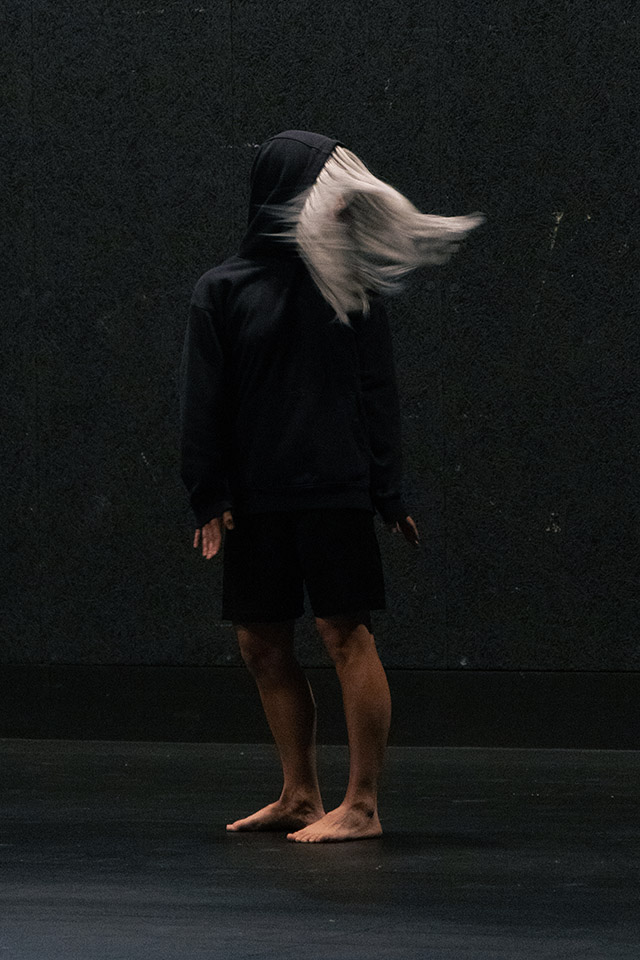
In a tri-frontal setting, thick smoke encloses the space. A silhouette emerges, dark hoodie pulled low, long white hair obscuring the face. The music is infra, almost subterranean, threaded with murmurs. We enter a mental space rather than a theatrical one, a state of inner tension.
The body is contained, concentric. Each gesture appears negotiated with itself. Demi-pointe rises surface like anomalies within this grounded physicality. The hair becomes choreographic material, whipping through the air, concealing and revealing. The dance unfolds through micro-variations, repetitive yet never identical. Something strives to emerge without fully declaring itself.
Then a shift. The hood drops. Another presence appears, short blond hair, bare chest. The body opens, expands. Rotations sharpen, almost virtuosic. One senses agility, clarity of support. The movement resembles a cry without a slogan, a manifesto not articulated but embodied.
The tri-frontal configuration intensifies exposure. With each turn, one gaze is met, another lost. Hiding becomes impossible. Silence falls. The sound of rain on the theatre roof reintroduces the outside world.
Teixeira pours sand, or perhaps salt, along the edges of the space. A gesture of protection, of demarcation. Then a harness appears. Suspended, the body tips into imbalance, skimming the floor, caught in hypnotic rotation. The action is slow and precise, yet driven by an invisible velocity.
The ending stretches, almost unsteady. Movements thin out, as after vertigo. Dramaturgically, something loosens. Yet what remains is the intoxication of a body in transition, both trace and apparition.
We leave with the sensation of having shared an unstable, fragile, intensely embodied space. And that is enough.
Mélissa Guex – DOWN (full album)
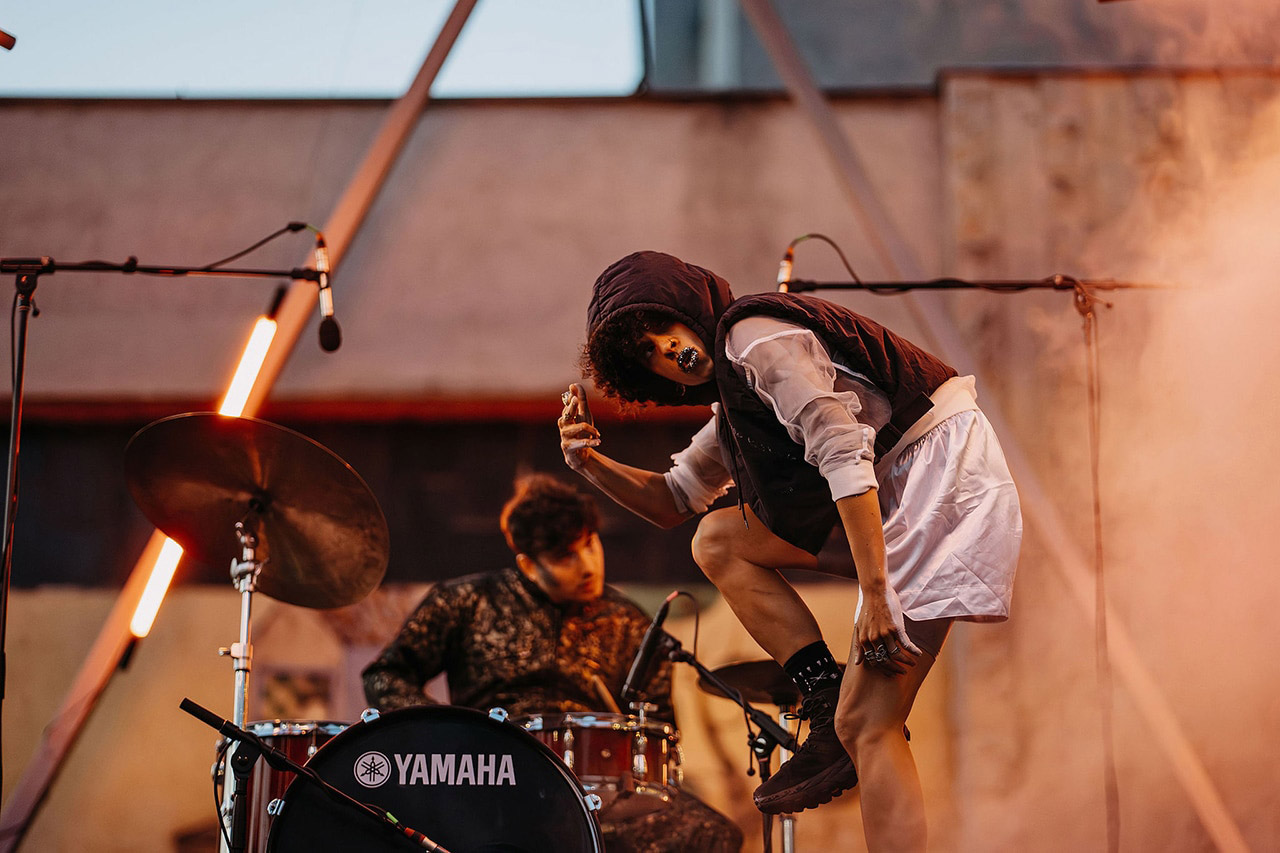
Exposed neon lights, movable bleachers, a drum kit at the centre. The set-up feels familiar, almost overly so: another announced immersion, another dance-and-music duo promising collective trance. A certain scepticism surfaces.
The space is dark. Dressed in black, Mélissa Guex could dissolve into the shadows. Yet her glittered lips, the tension in her face and, above all, the density of her presence prevent any disappearance. She commands attention without asking for it. Clément Grin is firmly rooted behind his drum kit. Between them, an immediate charge.
‘
She does not follow the rhythm, she attacks it
She begins low, in the legs, almost imperceptibly. She searches for the pulse in the ground before allowing it to travel upwards through the torso. She does not follow the rhythm, she attacks it. Very quickly, the space becomes a site of confrontation and alliance. The music does not accompany the dance, it challenges it.
The vocabulary is composite: attacks reminiscent of krump, isolations echoing popping, an insistent rhythmic trance. Yet nothing feels like quotation. Everything seems to emerge from a state. Jaws tighten, shoulders vibrate, a fixed gaze pierces through the audience. At one point, with a sharp gesture, she asks spectators to move. No one resists. The territory is already hers.
Repetition functions like drilling. It carves an internal pulse into those watching. The beat settles in the ribcage. Seated bodies tense. What initially appeared predictable gradually becomes necessary.
Then the performance spills beyond the theatre. The audience is invited outside. Night air, coloured smoke, the coolness of the street extend the experience. The shift alters perception: what we assumed to be a performance reveals itself as a shared state.
When the pulse resumes inside, there is no resolution, only recommencement. DOWN does not aim for closure. It asserts persistence. The ‘down’ is not a fall but a passage, something traversed and replayed. We leave with a vibration lingering in the chest, as if the piece continues without us.
Joseph Baan and Luc Häfliger – BI0Wn
Pearly mist, spectral silhouettes, reworked Victorian costumes. From the outset, the image is meticulously crafted. One hesitates between gothic cabaret and post-expressionist music video. A spotlight cuts through the haze, reveals a face, erases it again. It is beautiful, mysterious, controlled. The universe is undeniably seductive.
In a corner, vases await their fate. The dance begins as a slowed ceremonial round. Wrists curl, fingers stylise, somewhere between pop irony and an imagined eastern European ritual. Possible references surface without ever being confirmed. The ambiguity works. Illegibility intrigues.
An English text threads through the soundtrack. Should one follow the discourse or watch the bodies? The dilemma is real. I choose the bodies: they already speak volumes.
A vase is lifted, sand poured onto the floor. Ritual, territorial, symbolic. One senses the outline of a construction. Then, without warning, the audience is asked to turn on their phones and play music simultaneously. Sonic chaos erupts. The incoherence may be intentional, but it is also abruptly disruptive. The momentum frays. We shift from gothic mist to participatory karaoke with little transition.
A smashed vase opens yet another chapter. We move to a new space. Yellowish light, an almost solarium-like atmosphere. The performers reappear bare-chested in white underwear while infra-bass travels through the body, no longer something we hear but something we endure.
The bodybuilding sequence is arguably the strongest. Extreme contractions, frozen poses, muscles displayed and concealed. Bodybuilding becomes choreographic writing. Here, something genuinely tightens. The obsessive control of the body reveals an unexpected vulnerability. A clear line finally emerges.
And perhaps that is the crux of the matter. BI0Wn assembles several compelling universes without fully allowing them to converse. Mist-laden cabaret, chaotic participation, quasi-clinical physical display – each could stand as a work in its own right. Together, they coexist more than they resonate.
Incoherence is claimed as method. But fragmentation needs to generate tension, not just accumulation. Here, it often results in segmentation. I genuinely appreciate the aesthetic world – the images are strong, the performers committed – yet the dramaturgy seems to chase its own ideas, as if each direction were too enticing to relinquish.
One leaves stimulated, slightly frustrated, with the sense of having witnessed three promising proposals compressed into a single piece.
Baptiste Cazaux – GIMME A BREAK !!!
Quadrifrontal. Baptiste Cazaux is already there as we enter. Sitting among his speakers, in underwear and shirt, he resembles a post-capitalist Droopy. Tired before anything has begun. The premise is clear: exhaustion as a precondition.
He moves the loudspeakers with care. Each seems to possess a personality, or at least that is the suggestion. He adjusts, calibrates, orchestrates. The apparatus gradually takes up more space than the body. It quickly becomes evident that the machine will be a central partner, perhaps even the main protagonist.
Silence appears, reclaimed in a low voice. Whispers, micro-movements, deliberate minimalism. Slowness settles in. A repetitive score begins: the torso thrust forward, again and again. The motif returns, shifts slightly, repeats. Radically repetitive, to the point of becoming almost doctrinal.
Green light enhances the overall pallor. The promised letting go resembles more an indefinite suspension. One waits for rupture; it does not quite arrive.
Then the microphone enters the scene. Reverb swells. Movements sharpen, more incisive. At last, a degree of friction. The sound ricochets, the body attempts to pierce through the technical set-up. For a moment, it seems something might give, but the escalation remains contained. The edge is approached, never crossed.
The anti-capitalist stance is clearly articulated. Letting go as a survival strategy in the face of productivity’s relentless demands. Fair enough. Yet the paradox is glaring: we are inside a professional platform, in front of programmers, surrounded by a substantial technical infrastructure. Speakers, spatialisation, microphone, lighting. The critique of the system is delivered through the very tools the system affords.
One might ask, perhaps with a touch of bad faith, whether true radicality would have required stripping everything away. No technology. No sophisticated reverb. Just the body confronting its own fatigue. Something might have genuinely trembled there.
Here, the body often seems overshadowed by the machinery it seeks to divert. The announced duet with the speakers becomes an uneven power dynamic. Resistance feels stated more than experienced.
This is not to say the piece is devoid of intensity. There are flashes of real tension, particularly in those sharper sonic attacks where the body seems on the verge of breaking through. Yet the vital surge promised in the programme remains suspended, as though the work hesitates to fully inhabit its own discomfort.
GIMME A BREAK !!! ultimately feels like a controlled refusal. A pause that does not entirely sever what it critiques. Perhaps that is the point. Perhaps not. As it stands, the piece interrogates the desire for rupture more than it enacts one.
And one leaves with a lingering question: is asking for a break enough to shift the system, or does transformation sometimes require an actual fall?
Bast Hippocrate – Joyaux lourdement sous-estimés
The space is octagonal. At its centre, a platform barely fifty centimetres in diameter. Two men stand facing each other upon it. The structure rotates slowly. A shop-window effect. Time suspended.
One thinks of that precise moment when a gaze locks with yours in a club. The world slows down. The atmosphere is homoerotic, assumed without emphasis. A muffled slow track accompanies their bodies as they brush against one another, merge, withdraw in slow motion. Temporality stretches. The effect is almost cinematic.

Contact is microscopic. A cheek resting on a shoulder. An arm encircling a waist. Shared breath. Their feet remain anchored to this tiny territory. The rotation enforces proximity. Intimacy becomes architecture. We observe this closed ecosystem as voyeurs of a relationship in formation.
A beam of light sculpts their bodies. A lift appears, almost unreal. The relationship seems ideal, suspended outside the world. Then the slowness fractures. The dancers step off the platform. A white, frontal light replaces the glow. Time regains its brutality.
A sequence of falls begins. One lets himself drop, the other catches him, then releases. The impact resonates. Fantasy turns into friction. Their gazes search and evade each other. We are now witnesses to a confined drama.
The piece shifts from imagined idyll to a more ambivalent dynamic, where desire and dependency intertwine. I nonetheless retain a slight reservation regarding moments when theatricality becomes more pronounced. The bodies were already articulating a great deal; at times, heightened expression underlines a tension that was already present.
When Berlin club music surges in, temporality accelerates. The bodies explode into space, now more individual, almost fleeing one another. Irresistible attraction coupled with the impossibility of endurance.
Joyaux lourdement sous-estimés fractures the polished image of contemporary love. It exposes micro-violences, silences, contradictory impulses. One leaves with the feeling of having witnessed not a moral lesson, but a relationship unfolding in real time, fragile and complex.
The Swiss Dance Days offer a glimpse of a scene in motion, at times uneven, often stimulating. Some works genuinely shift perspectives; others reveal the tensions inherent in any attempt at expansion. Perhaps this is precisely the function of a platform: to condense such contrasts, to expose both the momentum and the limitations of an ecosystem.
Rather than presenting a definitive portrait of ‘Swiss dance’, the festival provides a provisional snapshot. We encounter bodies shaped by multiple influences, operating within a specific institutional framework yet oriented outward. The experience is dense, occasionally disorienting, but it has the merit of making visible the questions currently shaping the choreographic field: inclusion, circulation, legitimacy, context.
Ultimately, the value of such an event may not lie in its ability to define an identity, but in its capacity to unsettle one. To compel the gaze to shift. To remind us that dance is continually redefining itself, not through assertion, but through friction.
We leave Bern with more questions than certainties. And perhaps that is where critical work truly begins. ●
Robin Lamothe’s trip was provided by Swiss Dance Days
11–14.02.2026, Bern, Switzerland