

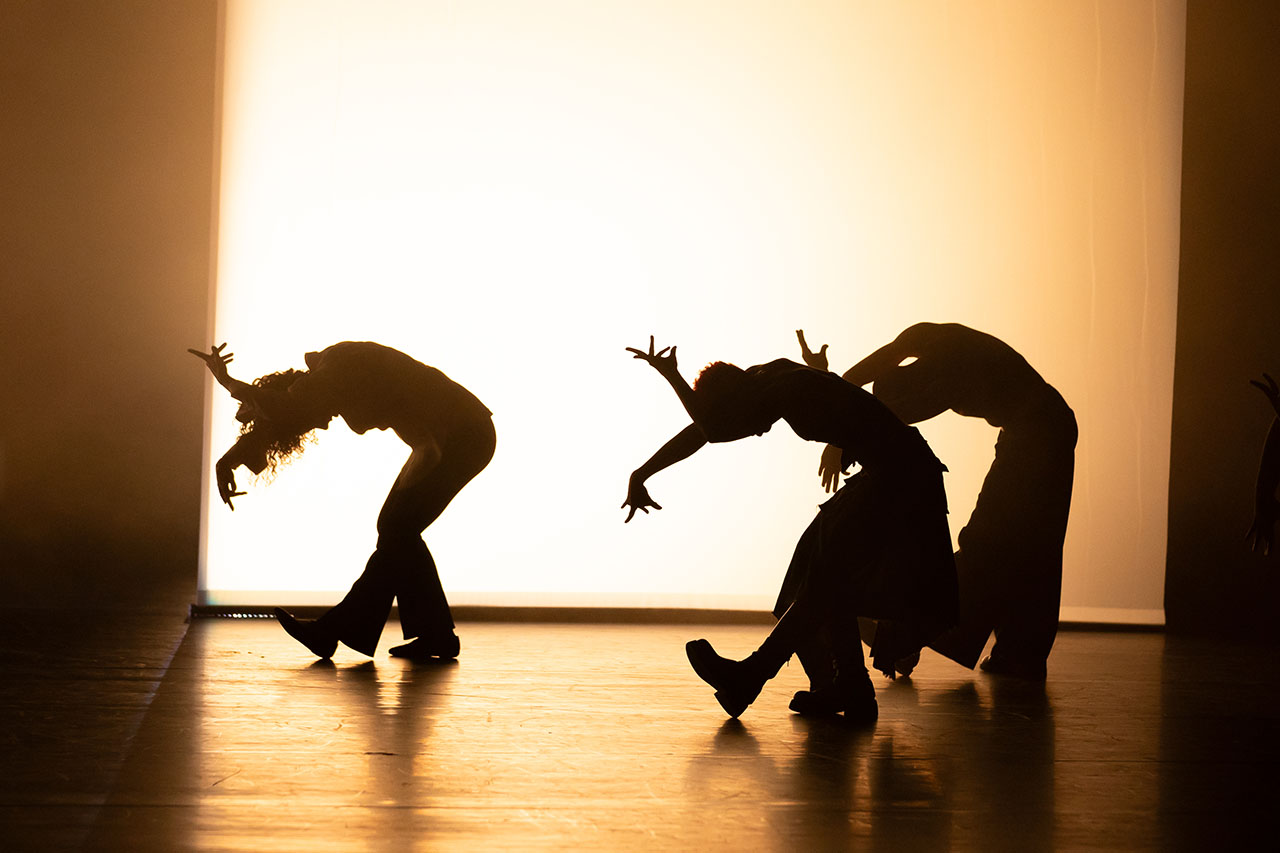
The annual Side Step Festival in Helsinki continues its curatorial interest in diverse global dance traditions, reconsidered through the lens of contemporary realities. Rather than presenting ‘contemporary dance’ as a recognisable technical style, the programme invites us to look at how choreographers engage with inherited movement cultures, traditions, and subcultures.
This year’s programme brings together five performances that reference medieval folk, flamenco, butoh, African ritual practices, and a full-scale work built around waacking.
Harald Beharie, Sweet Spot
Sweet Spot is a lengthy performance for five dancers and one violinist that blends folk dances and music with playful design objects and practices of collective joy. The work unfolds through a sequence of short scenes that are at once seductive and self-ironic. It begins with the appearance of the enigmatic Amie Mbye, opening a mouth – almost a maw – from which a thin, trembling sound escapes: a strange creaking laughter reminiscent of dolphins ‘talking,’ eventually accompanied by dripping saliva.
Gradually, other figures enter the stage. At times they face the audience in provocative poses, seemingly enjoying self-objectification; at other moments they assemble into odd alliances, forming awkward and humorous constellations, catching one another only to collapse again. Many are marked by a clear queer presence, and nearly all are fully naked, save for kneepads, occasional gloves, and – most strikingly – lavish designer boots. Indeed, Sweet Spot places strong emphasis on aesthetics: beautiful bodies, meticulous attention to footwear and accessories, and scenography where objects recall contemporary fashion design inspired by ancient ironwork.

What stands out most is the curious layering of dance styles and historical references. Elements of physical theatre and western performance art coexist with voguing, street dance, and contemporary dance techniques. Much of this unfolds in silence, punctuated by physiological sounds or distorted, haunting melodies played live by Norwegian fiddler Ester Thunander. Medieval folk music, performed by a topless violinist wearing immensely long boots, becomes a visceral and symbolic backdrop for the unfolding choreography.
Despite the apparent tension between these elements, their coexistence feels surprisingly non-confrontational. Under the same melody, pleasure-driven street dance and contemporary movement appear side by side without producing a sense of cultural clash. Compared to the first work of Beharie’s trilogy – the widely toured solo Batty Bwoy (2022), built on direct confrontation with the audience and an exploration of mythologies of the Black queer body – Sweet Spot appears markedly conciliatory. It is lighter, more aestheticised, and oriented toward harmonising cultural and historical layers. One of the shared foundations here is rhythm – emerging not as a fixed structure but as something generated through collective dynamics. Rhythm appears partly as inherited cultural material, partly as a search for commonality, and partly as an expression of togetherness that grows organically from the work rather than being imposed through strict formal prescription.
Shown early in the festival programme, Sweet Spot seems to set a thematic tone that later performances develop in different ways.
Alma Söderberg, Infinétude
Infinétude is an unusually human and touching performance, weaving abstract choreography together with emotional warmth and sincerity.
The combination of minimalism and flamenco may seem unexpected, yet it is grounded in a careful search for intersections between these two traditions – above all through the primacy of rhythm. This dialogue reflects Alma Söderberg’s own artistic path: she studied flamenco from the age of sixteen and later, after several years of contemporary dance training, entered the Dutch school SNDO, which she recalls as a place where musicality in dance was largely absent at the time.
The title Infinétude, a fusion of ‘infinity’ and ‘étude,’ aptly describes both the dramaturgical approach and the overall impression of the work. As Söderberg explains, ‘We improvised and searched for moments where we could practise what we were doing again and again, as if we could go on endlessly.’
Here, flamenco is stripped of its conventional gender roles, costumes, and heightened theatrical drama. Aesthetically, the performance resembles a minimalist concert: black costumes, practical wooden chairs, and warm, simple lighting. Instead of instruments, however, the performers rely solely on their bodies – and on a remarkable sense of mutual attunement.
From flamenco, the work borrows deep listening, polyrhythm, and the presence of voice, gradually shifting from almost popular singing toward more expressive flamenco-style vocals. From minimalism comes the ability to evoke strong emotion while remaining relatively restrained outwardly, contained within a strict yet flexible score that leaves room for interpretation and improvisation. As a result, the work truly breathes and lives.
Emotional intensity surfaces several times through rhythmic escalation or vocalisation, reaching a climax at the end, when two performers, Anja Müller and Alen Nsambu, step toward the audience, shouting: ‘I… with myself, with the people I like… Let’s go… let go!’ These seemingly fragmented phrases function as a quiet manifesto for the piece: joy in collectivity, attentiveness to oneself and to a shared rhythm almost as a political statement, playfulness, and care – enough to embark on a sensual journey and to invite the audience along.
Kidows Kim, High Gear
High Gear stands apart from the rest of the festival programme, first of all in being a solo work – slow, enigmatic, and infused with distinctly Asian references within an otherwise largely Western-oriented context.
The stage is almost empty, marked only by minimalist objects: a strip composed of welded thin metal pieces and a skull-like form suspended just above the floor. Kim appears on all fours, back to the audience, and begins moving slowly toward the seats, eventually entering the auditorium itself. Dressed in shredded clothing and slippers, the figure resembles something between a monk and a Berlin raver.

According to the programme notes, the structure of the performance follows that of traditional manga, unfolding through four stages: birth, eating, working, and death. The Korean performer, trained at ICI–CCN in Montpellier, apparently also draws inspiration from Japanese butoh whose impact is clearly present. This is evident in the meditative pace of the work, the emphasis on inner states, and the demand placed on the audience to attune to the performer’s concentration.
One of the most striking moments occurs when Kim gathers the long iron strip from the floor – resembling a segmented metal snake – lifts it onto their shoulders, approaches the suspended skull-like object, and begins to vocalise into it. Suddenly, the space fills with an infernal, post-apocalyptic soundscape. The sound design dramatically expands both the sensory field and the perceived scale of the performance: what began as something minimal and inward suddenly becomes vast and otherworldly.
At the same time, the work remains difficult to fully grasp without familiarity with its cultural references and contexts, which may limit the audience’s access to its symbolic logic.
Mounia Nassangar, STUCK
STUCK is a dense, high-energy waacking performance for five dancers and arguably the most immediately accessible and entertaining work in the programme. Technically, it is strong – both in terms of movement and in its integration of music and lighting. Pulsating house tracks, driving beats, and precise lighting design featuring zoning and cinematic references effectively hold the audience’s attention.
Although the choreography is clearly set and authored by Nassangar, it leaves space for individual expression. The dancers differ markedly from one another, both physically and in terms of stage presence. Dramaturgically, however, the symbolic structure of the work remains difficult to read.
Nassangar describes each scene as symbolic and connected to the idea of being ‘stuck’ – a specific physical and psychological state. The choreography explores frustration, tension, the accumulation of energy, and strategies for staying with this state while eventually finding release and transformation. Personally, I found this symbolism hard to decipher. The work does not seem particularly invested in creating conditions for interpretation or sustained reflection on the experience of deadlock – whether internal or external – despite the fact that the project originated during the pandemic.
As a result, STUCK relies on skilful control of audience attention, strong technique, and intense stage presence. In practice, this proves sufficient to generate catharsis – something that, according to the artist talk, many audience members indeed experienced.
Zora Snake, L’Opéra du Villageois
As stated in the description, L’Opéra du Villageois is both a burial and a liberation ritual. It denounces European museums that house looted art, and conjures the spirits of stolen objects. This performance directly addresses the legacy of the colonial western museum, where objects function as trophies taken from plundered lands, severed from their original contexts of use and meaning – and thus stripped of their value. As Zora Snake, originally from Cameroon, explains, in many African cultures the very notion of an ‘object’ does not exist. Objects are understood as beings inhabited by spirits – effectively as subjects – that actively participate in community life.
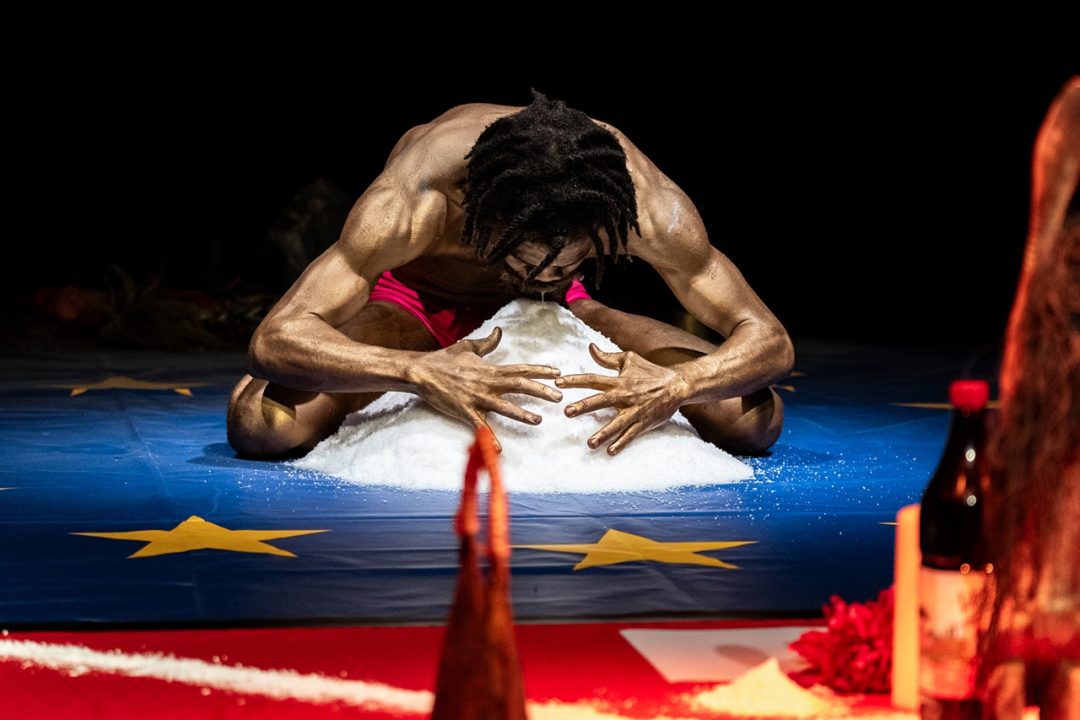
Formally, the work combines ritual (the return of a soul to an object), dance as spiritual action, postcolonial critique, and elements of western performance art with its emphasis on symbolism and declarative gestures. Among these are Snake being carried into the space by assistants – appearing simultaneously as a throne and a stolen artefact – placards reading ‘I am not an object,’ wrapping himself in the French flag, underwear printed with ‘I love Helsinki,’ and the symbolic burial of his body in soil spread across a floor printed with the EU flag.
I found the ritual dimension of the performance difficult to follow, as the internal cultural language remains inaccessible. What becomes clear, however, is precisely this lack of access – mirroring the opacity of the museum objects themselves. Although Snake emphasised, during the artist talk, that his work does not operate in terms of accusation or moral binaries, the most legible message remains a strong critique of European colonial powers and their networks of complicity.
Within the festival programme, L’Opéra du Villageois stands out as the only work that carries an explicitly sharp critical charge. While other performances focus on coexistence, hybridisation, and resonance between traditions, Snake’s work takes a clear position on cultural appropriation – not through movement practices, but through the violent histories of stolen sacred objects.
Across the programme, we encounter very little of what might conventionally be labelled ‘contemporary dance technique’ – whatever that term may signify today. Instead, the festival foregrounds traditional dances, movement cultures, and subcultural practices, all filtered through varying degrees of critical distance depending on the choreographers’ relationships to the material they engage with.
One recurring thread connecting many of the works is a strong emphasis on rhythm – as a link to dance histories with their distinct rhythmic structures, and perhaps even to prehistorical forms of collective movement, where rhythm functioned as a social, ritual, and sacred force. In recent Nordic curatorial contexts, this focus on rhythm seems increasingly prominent, possibly reflecting a desire for new modes of coexistence and presence – forms of synchronisation and de-synchronisation that enable attentive co-presence while resisting the dominant rhythms of militarisation, marching, and organised violence.
At the same time, the programme leaves open the question of an overarching curatorial proposition. Does dance here function as a space of reconciliation? As a tool for smoothing over tensions? Or simply as a site where multiple, sometimes incompatible histories are allowed to coexist without being resolved? Rather than offering a definitive answer, the festival seems to invite the audience to sit with these questions – even if the conversation itself remains somewhat understated. ●
30.01-07.02.2026, Zodiak, Helsinki, Finland