

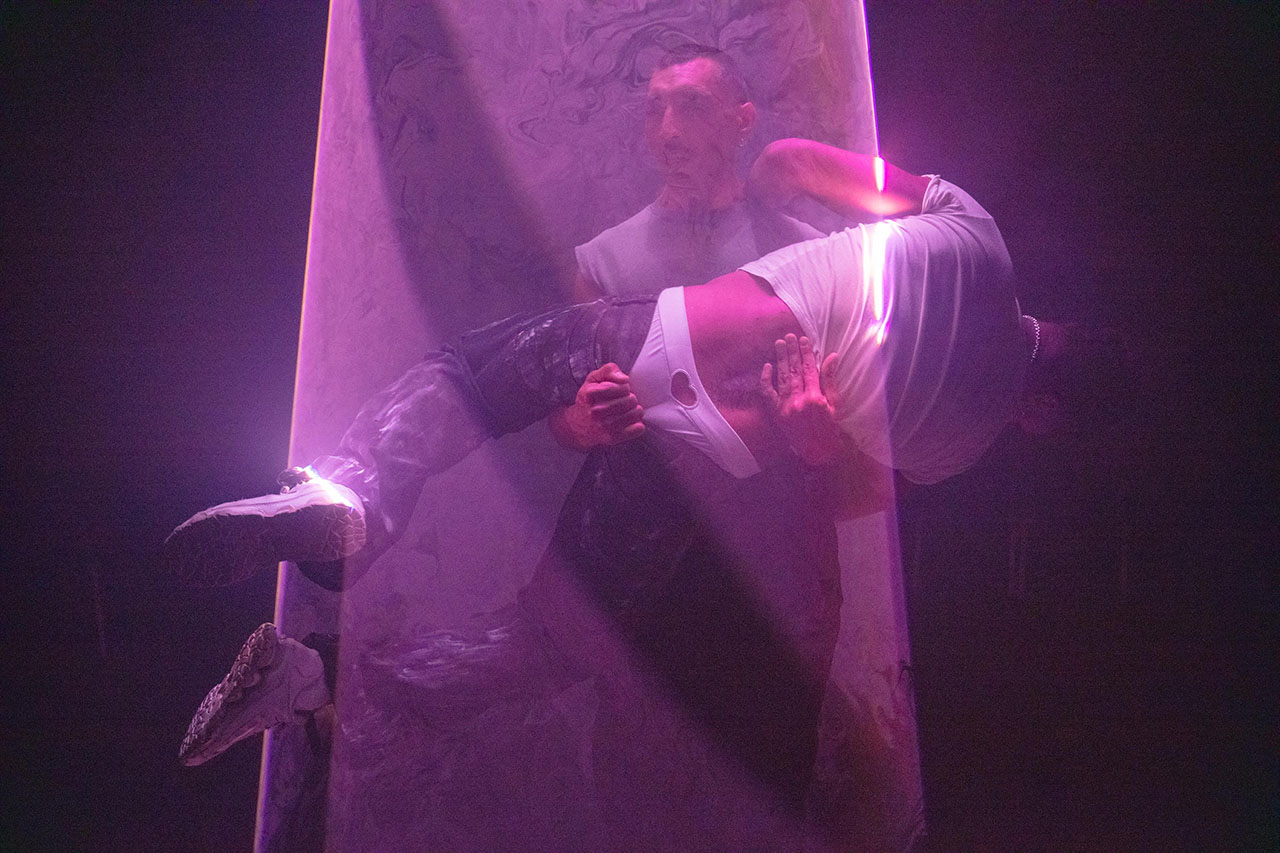
Under a haze of smoke, on a rotating structure, two men face each other, entwined, cheek to cheek. Hyper-aware of their surroundings, they seem to look at us. Or perhaps it is we who are intruding? In Joyaux Lourdement sous-estimé, the audience scrutinises duo Marcos Arriola and Bast Hippocrate from all sides.
Beneath the pulsing bass, hands grip shoulders and trace backs. Bodies brush against each other, and eager lips hover just centimeters away from a kiss. In the darkness, light slices iridescent beams, magnifying their entanglements and sculptural lifts.
Then comes the crash. They reject one another through an interplay of weight and counterweight. Hurling themselves to the ground, their grip yells a harsher physical language.
Gradually, they slip into playful spins, seducing each other once more. And the cycle resets. Though these ‘largely underestimated jewels’ (as the French title translates) could have revealed further facets of gay desire, it’s a performance of sincere, rare beauty.
Poised in a static embrace on a slowly rotating circular platform, Bast Hippocrate and William Cardoso are already in the space as we enter. A Bowie song pulses inside four speakers hung above them, smoke twisting through the dimly-lit hall. It feels as if we have entered a club where time has stopped and the two men are suspended, caught inside a moment of lust.
Joyaux Lourdement Sous-estimés begins as a slow, dream-like negotiation of queer intimacy. At first the dancers interlace, bodies clinging tightly as the circle turns. Later, as the pair start slamming each other repeatedly into the hard wooden floor, this tenderness shatters. Hit after hit, executed at times with ambivalence, you wonder if they feel anything at all.
This urgent and unsettling performance captures a darker side of queer relationships where desire is disintegrating, leaving only the bare mechanics of pleasure. Yet through it all, Hippocrate’s jaded t-shirt still reads ‘It’s A Match’
On a slowly rotating platform, two performers communicate primarily through touch, tasting each other, building an intense physical relationship based on proximity, shifting weight, and bodily response. Their gaze often reaches elsewhere, as if vision itself were secondary to contact.
In Joyaux Lourdement Sous-estimés, Cie Bast Hippocrate draws on the aesthetics of 1980s queer club culture, through synth-pop music and a minimal visual setting. The piece is strongest in moments of silence. When our attention shifts toward effort, tension and subtle changes in movement, the lyrical soundtrack frequently shapes the atmosphere, leaving less room for interpretation.
Once Hippocrate and William Cardoso leave the circle, the choreography becomes increasingly unpredictable; body-slams performed dangerously close to the audience create immediacy, intensity and a palpable sense of risk. Although the final vogue-inspired segment demonstrates the dancers’ technical skill, it interrupts the intimate dynamic. By shifting the focus outward toward spectacle, the ending weakens the emotional and physical tension established earlier.
First comes intimacy; the delicate interlacing of hands, a finger drawn sensually along a forearm. Standing on a small revolving platform, performers Bast Hippocrate and William Cardoso are in the first throes of love. Exploring each other’s bodies and minds, hungry to know more, they seek out the electricity of skin-on-skin contact. Limbs are tightly bound, faces press together in a quest to shake off solitude.
But the turntable at the centre of Joyaux Lourdement Sous-estimés is a safe haven bathed in protective light, quickly lost when the men step away. Their movement, once tender, becomes wild and unmoored. Spines are slammed against the floor with a sickening thud, as they navigate this painful new stage in their relationship.
Arguably, there’s not a single wasted second in this powerful duet, but watching Hippocrate and Cardoso freestyle (as they find themselves, in relation to the other) takes it to a whole new, mesmerising level.
Audience seats are displaced forming a squared area. Inside, Bast Hippocrate and William Cardoso stand on a rotating platform, feet barely fitting, bodies unavoidably close. Four speakers above their heads play out amorous lyrics, while the pair smell each other’s necks, eye-gaze, curl up, take turns holding one another. A coloured light bathes their bodies, tentatively drawing a full circle on the floor.
Breaking from the platform’s constraint, their bodies’ tension is now released in meticulously choreographed contact: the bruising sound of their backs slamming against the floor in a pendular movement of push and pull, a naughty smile when one leg locks onto the other’s hips. Moving through an electronic beat, the peacocks’ mating dance restarts: bouncing, swigging, flirting, arms and chest open. Projected light eventually reads ‘To be continued….’, a homoerotic fable of two gems, heavily undervalued.