

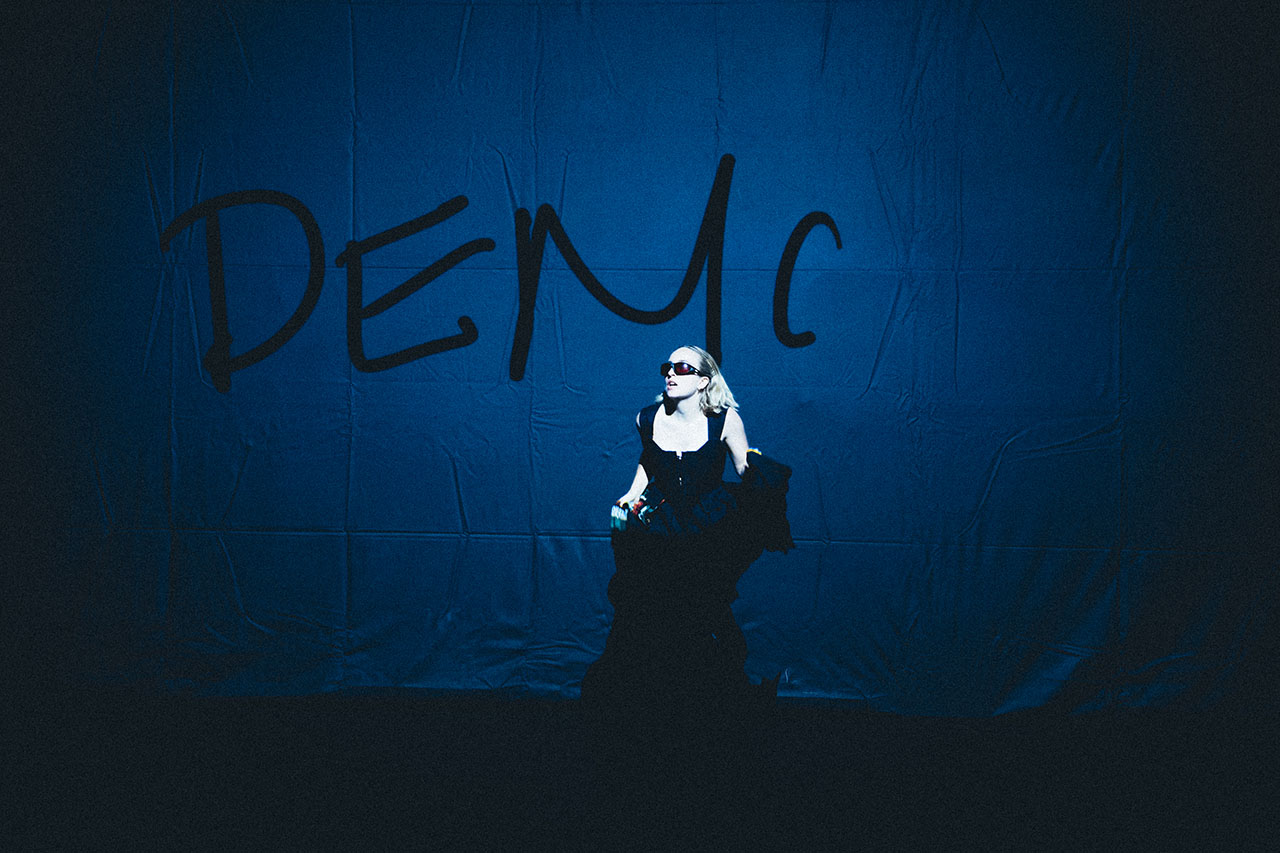
Inka Romaní is haunted by Fandango of Ayora, a traditional dance from the Valencian region. Merging movement with performative lecture, Romaní explores her inability to perform the dance, for decades suppressed under the Francoist regime. Instead, she evokes other choreographies that have either constrained the female body – the disciplinary Sección Femenina – or liberated it, like contemporary rave.
What really haunts the performance is the performance’s overreliance on text. The essay displayed above the stage is playfully self-referential, a pointed critique of fascist afterlives, misogyny, and even the dance industry. But rather than merely illustrative, the text draws away attention from the body on stage and how it confronts its history.
Volvamos al baile struggles to escape from easy solutions, and the climax – a blending of castanets with a techno rendition of folk – does not cast a new interpretative perspective. The performance doesn’t return to dance – rather, it nests in textuality. Still, maybe we need a bit of didactic explicitness with fascism once again knocking on Europe’s door.
What does fascism do to bodies? Spanish Civil War fascism to Spanish women´s bodies? In her unadorned piece Volvamos al baile, Inka Romaní carries this question from a haunted past. Wearing sunglasses, a black balloon blouse, a skirt falling straight down the back, white socks up to her knees and in each arm a long red lace, Romaní performs movements which only resemble Fandango: wide bolero steps, long yoga arms, some hops.
Censored during 30 years of Franco regime, the traditional Fandango de Ayora dance archive is used by Romaní to inhabit history’s contradictions, which we are told about through text and video images of women´s bodies arrayed in political parades. The research material is interesting, although dramaturgically the piece is somehow misplaced.
A place of empowerment, her own body is kindled each time she goes back to the dance: dressing a red bra, she plays the castanets history didn’t take from her.