

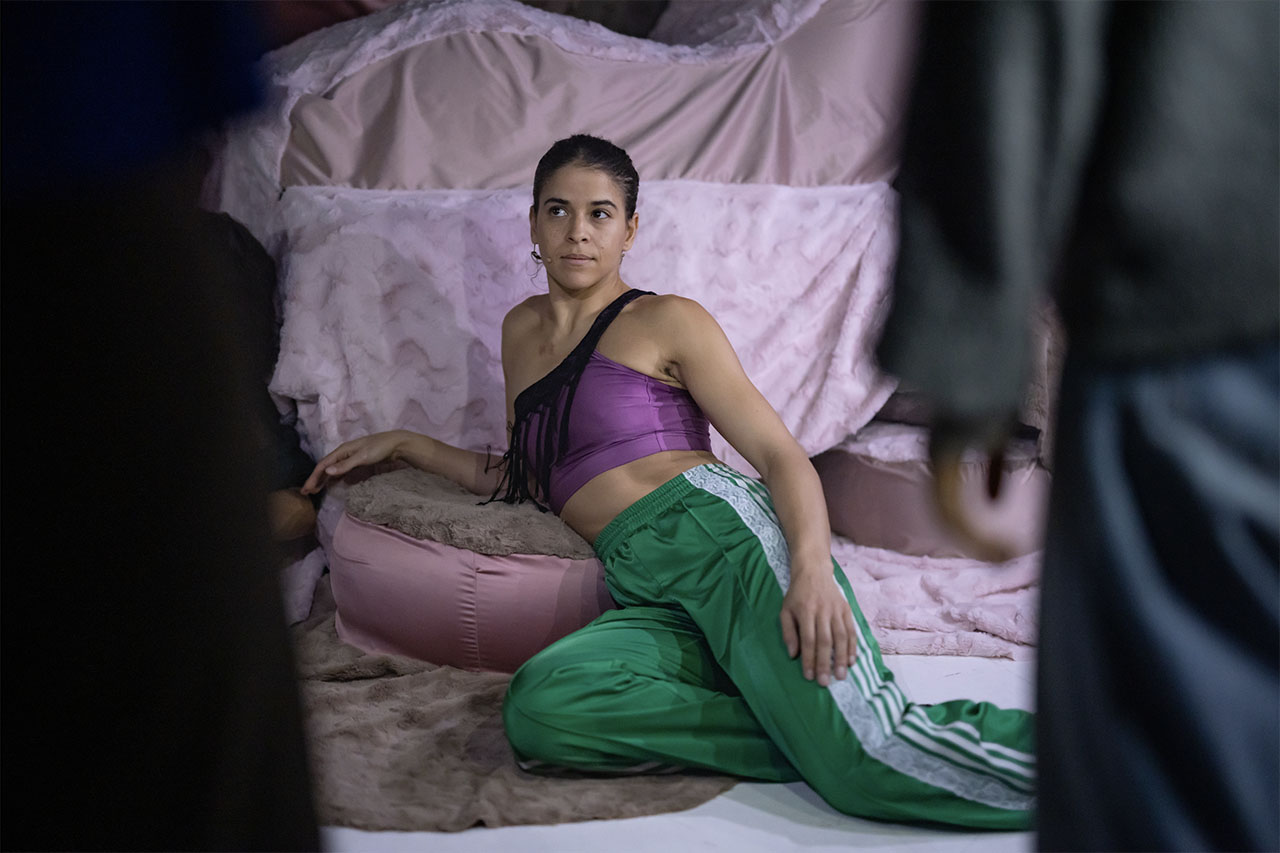
‘What is pleasure?’, one dancer muses in TURN ON, before adding: ‘There is resistance in this quest.’ At Spring Forward, there was resistance to be found among the audience, too – and bad writing wasn’t the only culprit.
The Swiss-Moroccan choreographer and performer Soraya Leila Emery set out to explore female pleasure, but the result is too unfocused to ever build to a climax. Upon entering the auditorium, audience members are asked to tour the stage as three eager performers ask for their names, and lead them into a few dance steps. Much of the 40-minute running time is then devoted to hugging willing onlookers and seating them on squishy-looking pink cushions. (Many of us opted for the safety of rows of chairs.)
From time to time, choreography materialises. Vague solos and trios land like an afterthought after a section devoted to teaching us how to chew candy. Did you know sweets like it harder and stronger? Neither did I, but some were handily left under the seats for practice. At least the sugar rush briefly delivered on pleasure.
Can I put my leg around you? Can I squeeze you very hard? May I caress your cheek? Those are some of the con-sensual questions the three dancers in Soraya Leila Emery’s TURN ON asked audience members as they lounged together on stage. The result is a flirty and provocative performance that invites the audience to consider what exactly it means to seek pleasure, often a taboo subject.
The performers direct us to walk around the stage, to set up soft velvet furniture, to smell candy found under our seats, to witness forgettable solos that appear unrelated to pleasure. The piece suffers from being so instructional, as if attempting to over-control an environment that is typically playful. The trio’s interactions often come off as clunky and predictable, lacking the seduction and spontaneity of pleasure.
Overflowing with potential but too ambitious, TURN ON ends with the dancers spinning in circles while holding flashlights. My head too was left spinning: how much pleasure did we really get out of watching this?
In Soraya Leila Emery’s TURN ON, the audience first walks into a space of comfort: pink velvety cushions are piled up in the middle of the stage, and three female dancers offer a warm welcome. They tease an upcoming game. However, considerable time is spent on seating arrangements, draining the sensual mood before it can take hold. The rules remain unclear: are we allowed to touch the cushions? Can we lie on them?
The piece alternates between audience participation and choreographed sequences, designed to be seen as sexually charged. Dance-wise, the action ranges from dynamic trios to meltingly sensual solos, weaving together swift floorwork, jiu-jitsu, partnering and sudden stops. The vocabulary is at times combative, yet everything stays playful. The dancers manipulate our other senses, too, even offering some audience members caresses and kisses. There is critical commentary on pleasure-driven consumerism, as well as a quest to identify the origins of pleasure, but neither resolve into clear statements. TURN ON toys with arousal and manipulation, but ultimately stays safe, leaving an ambivalent impression.
According to Soraya Leila Emery’s TURN ON, desire can be activated, redirected or even become discipline. But who is in control?
As the performance begins, we are gently asked to join an intimate ‘queendom’ centered on a tower of pink cushions. Three female dancers walk around the stage, asking people’s names, then choose random partners and embrace them, requesting consent before each action. Audience members are asked to turn on their smartphone flashlights and follow the performers. The tower is then dismantled and the cushions used as seats.
It made for a long preparation, a kind of prelude to the main action – dance itself. And then many more elements followed: they give us sweets, climax while chewing on them, dance a powerful trio, tender solos, come close to the audience, sing, breathe, ask existential questions, dance with shadows. In other words, everything but the kitchen sink. Is getting pleasure such hard work?