

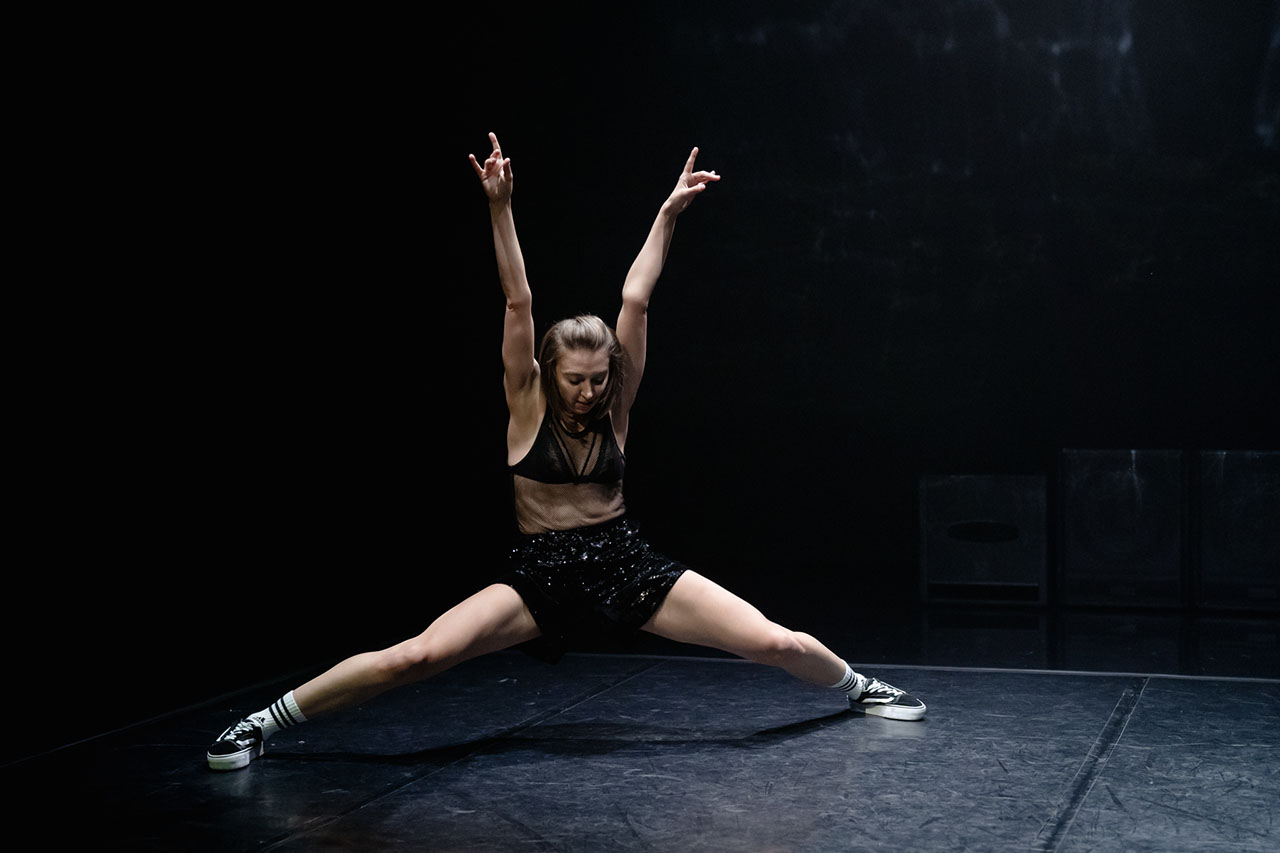
A dim spotlight reveals Simona Dabija seated upstage. Through the haze, only the shimmer of her sequined shorts catches the eye, her gestures unfolding with a slowness disproportionate to the frantic rhythm surrounding her. Dabija’s body occupies the space as if she is sharing the stage with invisible remnants of an imaginary nightclub.
Caught by the beat, her sneakered feet rebound endlessly against the floor, seemingly unable to stay grounded. In disjointed spasms or vibrating convulsions, her movements are carried by the music’s infinite repetition. Yet the beat occasionally falls silent, abandoning Dabija in a deafening stillness suspended within the smoke. To escape it, her gestures expand. Her hair slices through the air, and she appears almost airborne; a hypnotic humanoid creature hovering above the stage.
One wonders if relief will come when the beat finally stops. Or if we will find ourselves haunted by its echo long after the silence returns.
Dance performances about clubbing should by now be considered a genre of their own. So many great works exist (Giselle Vienne’s Crowd, Michele Rizzo’s HIGHER, the pieces of Lisa Vereertbruggen) that adding something new to this already saturated field has become genuinely difficult.
Simona Dabija’s BPM – Beats per Millennium, shaped by stories from people who experienced Romania’s club scene over the decades, unfortunately falls short. Aside from the poetic opening image – a shaft of light illuminating Dabija’s smoke-shrouded body, like the first spokes of dawn entering a club in the early hours – little else situates us in a rave.
Dabija moves with relentless energy to Vlaicu Golcea’s techno-infused soundscape, but her dancing feels mainly meandering and careless, a free improvisation tenously anchored to the grimy depths of club culture. The clean white bands on her brand new sneakers speak for themselves, one wonders if Dabija has ever been to a rave past a sensible hour in her life.
A blurred, club-like state of consciousness establishes BPM – Beats per Millennium as a work rooted in the memory of Romania’s club scene. Its movement suggests a body caught in invisible strobe lights – tense, yet visually echoing their pulsating effect. With haze shaping the space, we seem to enter Simona Dabija’s inner world, an effect further reinforced by the costume’s escapist, youthful, party-like quality.
Despite the performer’s evident technical skill and uninterrupted motion, the piece remains dramaturgically static. Her movement shifts with clear precision, yet little develops beyond this level. Without a stronger sense of transformation or progression, the staging remains largely unchanged, staying within the same atmospheric register throughout.
Only the programme notes reveal the broader conceptual and research context behind it – elements that remain difficult to grasp within the piece itself. Although it maintains a strong sensory impact, BPM lacks clearer development and a more distinct articulation of its ideas.
Tunes may change, fashions come and go, but the feeling of losing yourself inside a beat on a sweat-drenched dancefloor remains the same. Romanian choreographer and performer Simona Dabija attempts to capture this in BPM, a love letter to clubbing through the ages.
How much of herself Dabija injects into the piece is hard to tell (from the programme notes we know she spoke with Romanians who partied across various decades), but she alone is on stage to tell their tale. And the stories are surprisingly sanitised and pristine. As we would expect, Dabija’s movement is driven by the soundtrack’s throb; a pulsating torso, rhythmic head, and feet tapping incessantly as if stopping is not an option.
But despite pockets of attention-grabbing action (a slow descent into the splits; quietly hypnotic floating arms; some fun hair choreography), BPM struggles to convey the wild abandonment, whole-body experience, or heady exhaustion of a long night moving with a community of strangers.