

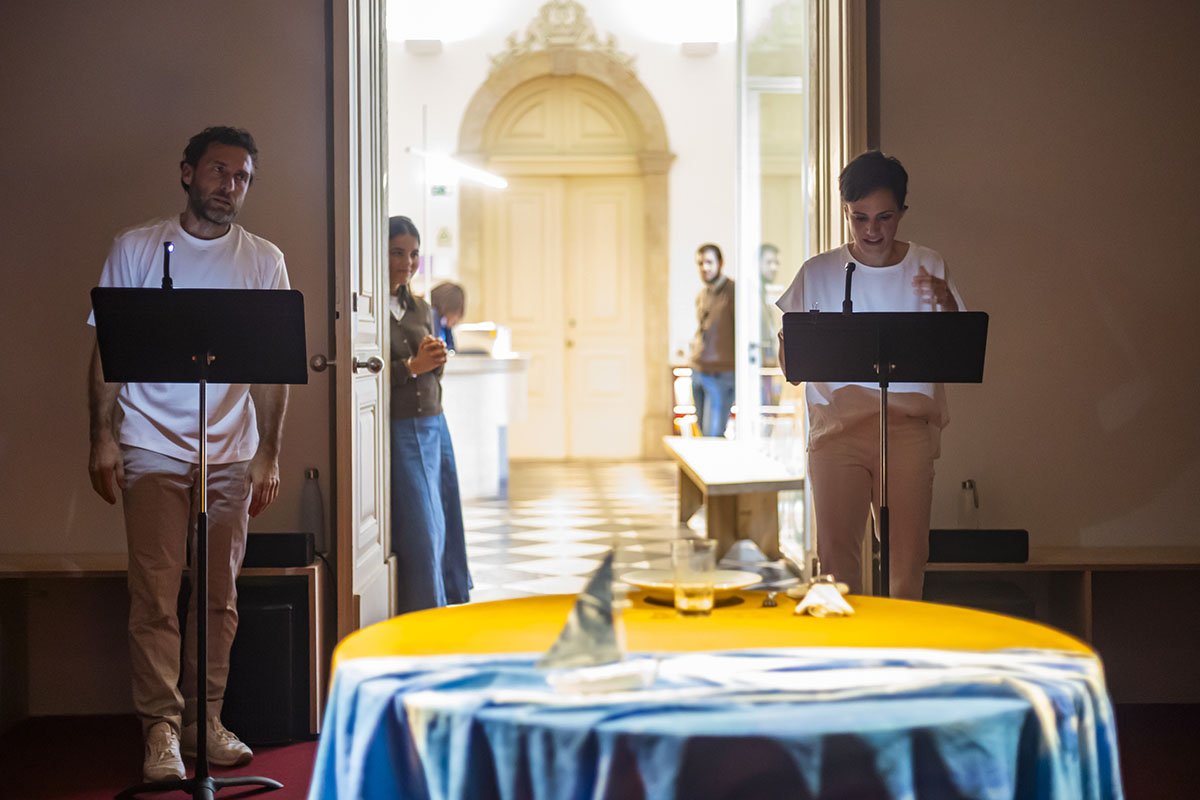
Of all the modern languages descended from Latin, Portuguese uses the subjunctive the most. Sometimes I think: this is not just grammatical, it’s systemic – it’s in the culture. I mention this because while attending Mesa-Paisagem – Corpo, a gallery performance by long-established Portuguese duo Sofia Dias & Vítor Roriz in response to a 1973 art installation by Ana Vieira, a thought came to my mind: this is a work in the subjunctive mood.
What is the subjunctive? In contrast to the indicative – what you can point to – it designates a realm towards which you can only gesture, a field of dreams and feelings that is not real, but nevertheless has force and consequence. Examples: As if it were…, I wish it were…
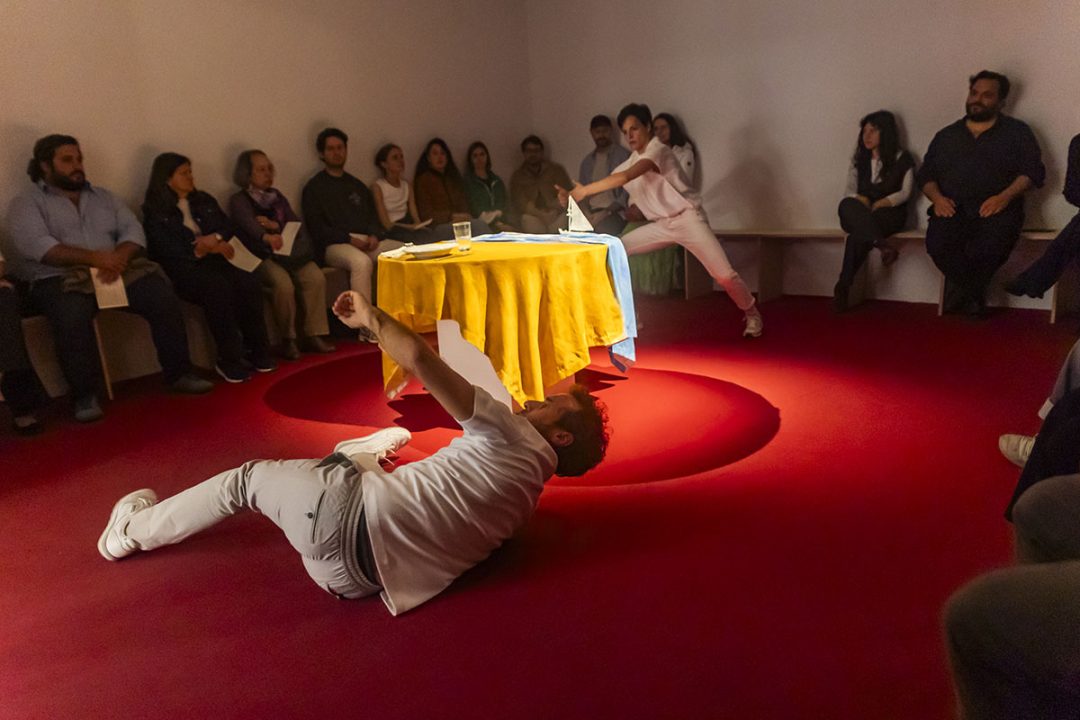
Vieira’s Mesa-Paisagem already leads us here. In a gallery room a cloth covers a table, one side yellow, the other blue – suggesting, but not representing, sand and sea. On the yellow side sits a plate, cutlery, napkin and glass, as if in readiness for an absent figure to arrive. On the blue side, a model boat stands between wrinkles in the cloth, as if navigating the waves of an imaginary ocean.
Corpo commences with Dias and Roriz gently herding our sheepish bodies into this hallowed space with semaphore arms and puppyish steps and stares – a stop-motion sequence that continues even after we’re settled on the benches lining the gallery walls. Now they tumble floorwards, then turn towards lecterns flanking the gallery door and read from sheets of paper, batting words between them – about the chair that is not there, about whether the glass, or the room itself, is empty or full – until the air seems to brim with speculations and conjectures, theirs and ours, some concordant, others contradictory.
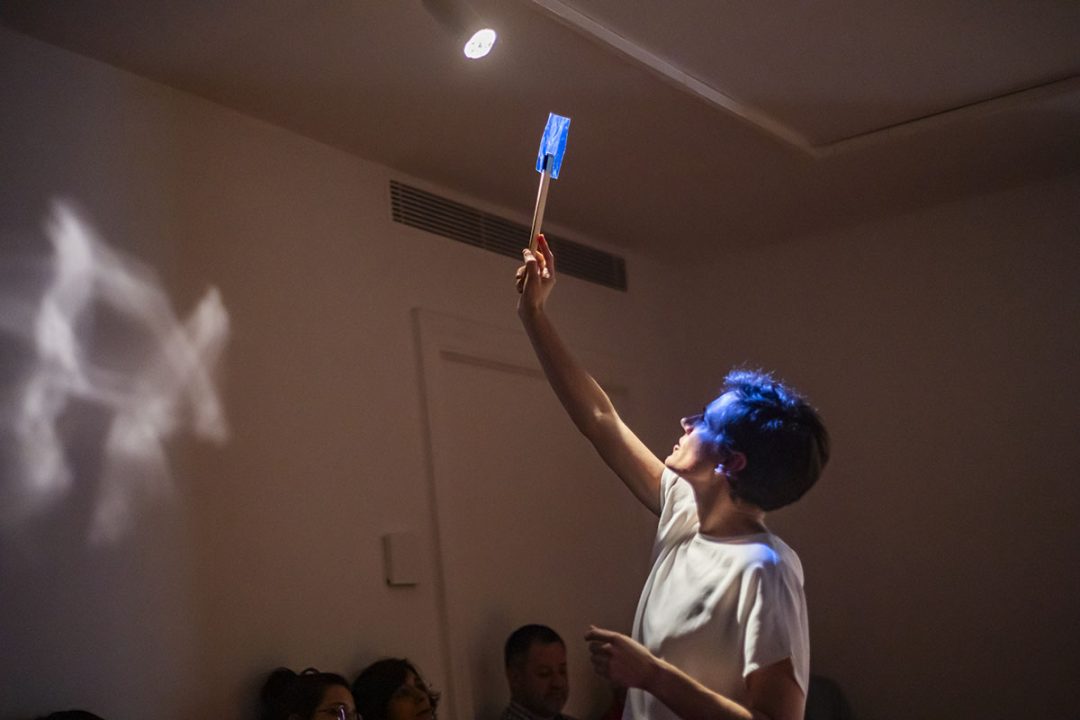
The duo break words into rhythms, switch places, trade antonyms. They raise wafers of blue cellophane towards overhead lights; sunlight filtered through slivers of sky. Our spectatorship has become a séance with the invisible. Or perhaps we ourselves are the absence the table had been awaiting.
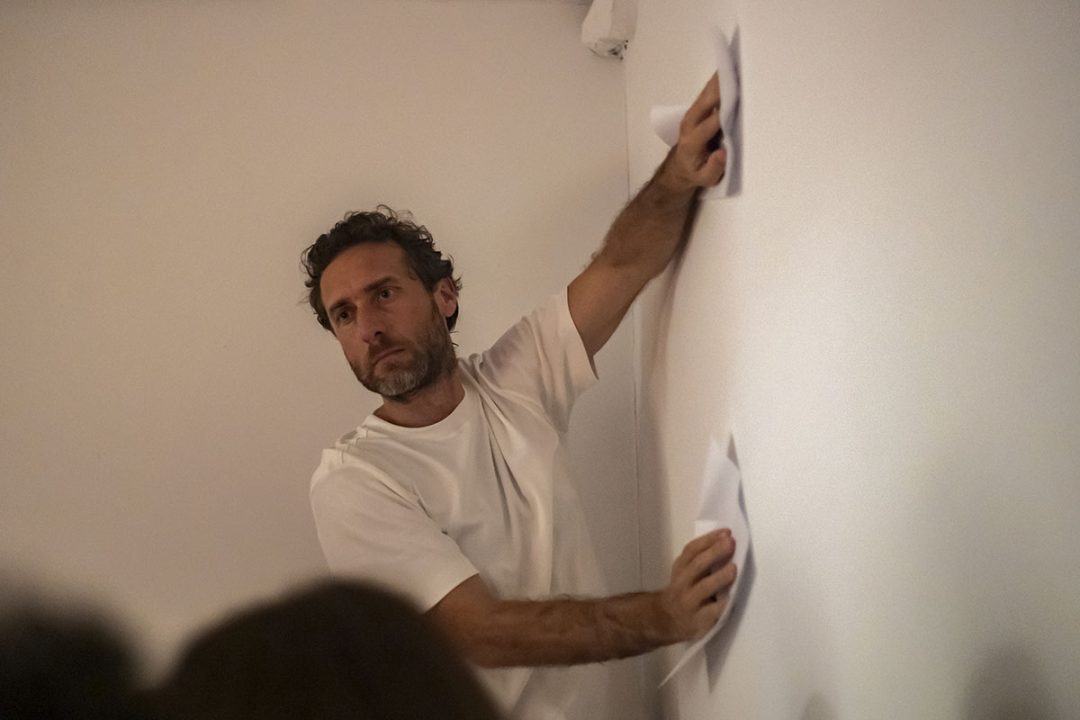
With a repeated phrase, no mar (in the sea), the wordplay fades to silence. Dias and Roriz scrunch up their pages and softly scrub them against the gallery walls and – oh, wonder! – we hear the sound of waves crunching sand upon a shore. They offer paper for us to crumple too, and we too take to the walls to make them sing with sand and sea. It’s an undramatised, communally made moment of revelation, as if our very presence – paper, walls, bodies – had become numinous with possibility.
© Pedro Jafuno
Reversing out of the room, limbs echoing the angles of the walls and door, Dias and Roriz lead each other, and so us too, back into the world outside – a world that feels strangely flipped, as if the foyer and stairs, the gallery staff, the conversations, even the people passing heedlessly on the street outside, were now all a dream, oddly insubstantial compared with the vivid mirage we had just conjured up, and inhabited.
Mesa-Paisagem – Corpo was a one-off, one-time only performance, never to be repeated, a moment that reached from the indicative to the subjunctive and back again, and is now past. That’s life, and I was glad to be there. ●
15.05.26 Brotéria, Lisbon, Portugal
sofiadiasvitorroriz.com/2026-performance-para-mesa-paisagem
Performance and text: Sofia Dias & Vítor Roriz
Sound: Sofia Dias
Production: S&V, Brotéria
Administration: Cátia Mateus
Thanks: Paulo Pires do Vale, Maria Manuel Albergaria
Mesa-Paisagem – Corpo was one of four multidisciplinary Brotéria commissions responding to Ana Vieira’s installation. More information here.