

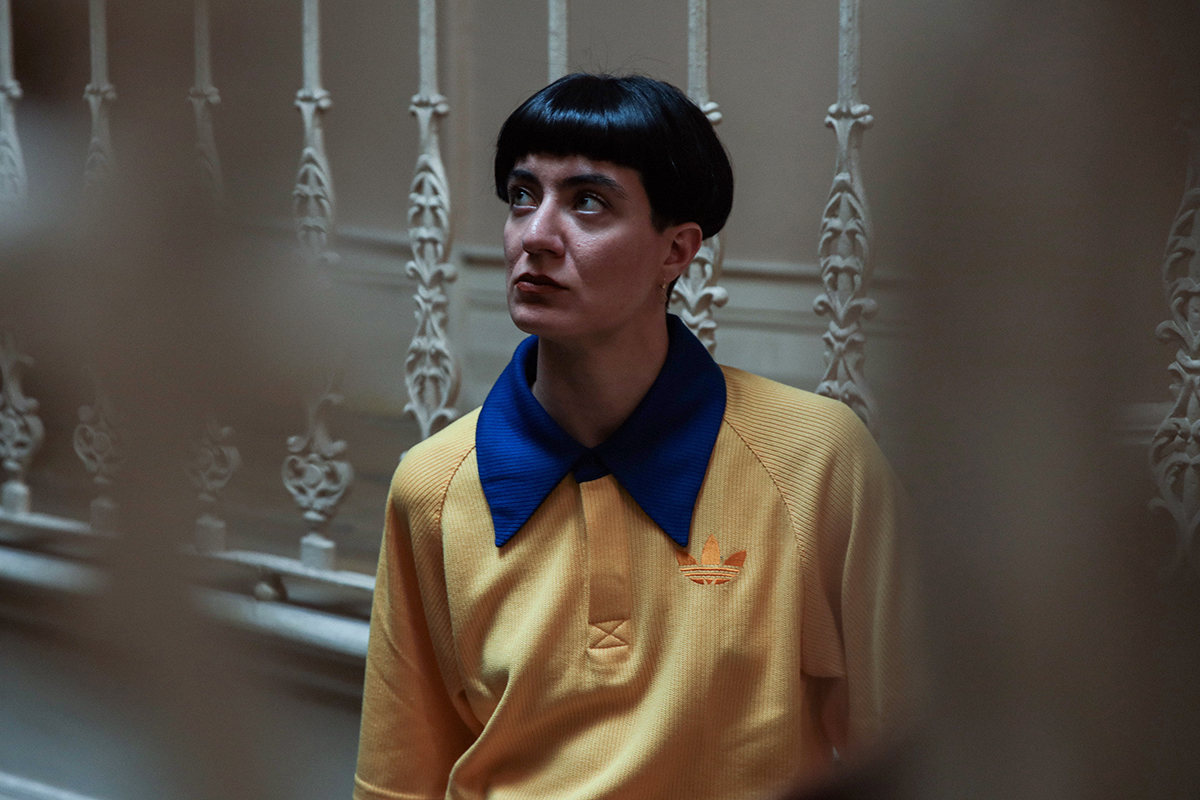
Mélanie Ferreira is, first and foremost, a performer. She has been nominated twice for Best Dancer at the annual Portuguese Society of Authors awards: once in 2023 for her role in Carcaça by Marco da Silva Ferreira, and again in 2024 for Coreografia para uma Santificação, a solo made for her by Tiago Vieira.
The latter performance is part of the ongoing Dependência Aberta (Open Dependency) project, initiated by Ferreira in 2021, in which she invites different choreographers to create a solo for her. She remains the performer; the choreography is up to them.
We meet up during the Spring Forward festival 2026 in Guimaraes, to discuss the origins of Dependência Aberta, how Ferreira selects choreographers, and what these role reversals could mean for changing power dynamics in the dance world.
You’ve made two solos in the Dependência Aberta series – one with Tiago Vieira, one with Daniel Matos, and you’re now working on a third. Where did the idea for Dependência Aberta come from?
In 2020, I tried to make a solo for the first time and it was awful! It was very lonely and I thought “OK, I can deal with loneliness in my daily life but I can’t deal with it in the studio!” And even if I had friends and artists around me it was not enough – I needed something extra to help me. And so I thought that maybe I can just ask someone to choreograph for me, to be with me in the studio, to put everything together. And that’s where the project began. On top of this, I just wanted to embrace that I like to be a performer. I am a performer, that’s what I do, and you are a choreographer, that’s what you do.
So you’d define yourself as a performer rather than a choreographer?
These definitions are always a bit difficult for me. I feel myself firstly as a performer, not a choreographer. Even so, I think creating is a big part of being a performer. For example, even if I’m just learning counts, I’m still contributing something creative and interpretative to the performance. I don’t believe in choreographers sidelining the ideas of performers. I always feel that we are co-creators in a dance piece.
When you’re selecting a choreographer for a dance piece, do they have to audition?
For the latest solo, An Ode to the Mouth, I had encounters with nine different choreographers. I prefer to say ‘encounter’, rather than audition, because I really don’t want to put people in the terrifying place of auditioning! Anyway, I gave each choreographer four hours in the studio with me, to do what they wanted. Of course I had to choose one person, but I just wanted to enjoy being in the studio with people. In the end, this time, I chose André Uerba. It felt like we had something together. I didn’t know what, but I felt that we needed to work together. Also, it’s important to say that every choreographer was paid a fee for their encounter.
When you start working with a new choreographer, do you already have a topic that you want to work on, or do you leave everything up to them?
There is one thing that needs to happen in every project, which is that we always interact with the audience. The audience needs to be active! Aside from this, it’s always an exchange. Though in Coreografia para uma Santificação, the solo which Tiago Vieira made for me, I told him in our first meeting that I wanted to dance in high heels. I told him that if it doesn’t work, we could just throw it away. But we tried it, and it made sense – so we did it!
Do you think this way of working allows you to move beyond the traditional hierarchies that exist in the dance world? That it creates a space where both performer and choreographer hold the same power?
There is always a certain hierarchy established when we work with other people in whatever context, but in my work I like to soften that idea. I’m not putting things completely horizontal – things are always shifting between diagonal and horizontal, but they are never vertical. I don’t just submit and say yes, yes, yes, yes, yes. I’m saying yes, but also why? I’m saying yes,and now, how can we do it together?