

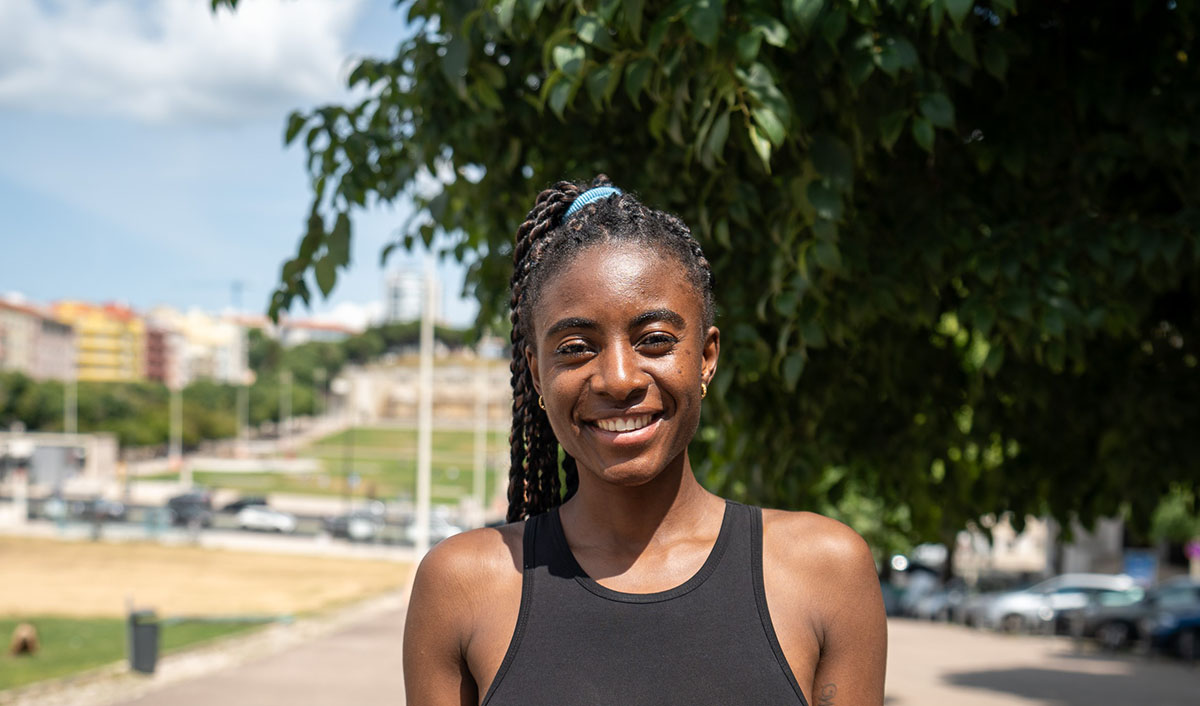
In Esther Kasenda’s work, two things take precedence: collective bodies and the space around them. Whether in workshops, socially engaged projects or solo performances, Esther channels the body’s capacity to transduce ancestral histories. These memories imbue the environment with new emotions that open possibilities for interconnected embodiment.
Born in Democratic Republic of the Congo, Esther grew up in the Netherlands and is now based in Portugal. She trained in Arts Therapy from the Zuyd University of Applied Science, with a specialisation in Dance and Movement. She has performed and taught across Europe and Africa, and is currently part of the UNFOLD 25/26 Fellowship Programme for socially engaged artistic practices in Serbia.
The space where you perform – whether a natural environment or an urban square – seems to be integral to your work. How do your surroundings inform your practice?
I love spaces. I talk to buildings, you know? [laughs] I always touch and feel their structure. After examining how the space is built, I always find energy that I connect with and which I channel in my performance or dance. Spaces hold a lot of ancient power; you can tap into that energy and use it to move. Sometimes it happens very intuitively – I just follow the urge to sit somewhere or lie down and let the energy go through my body.
My work is often connected to stories of what happened in a given space. One of my performances took place in a former factory, where only women worked. Together with another performer, we were sweeping there for four hours. By getting into this repetitive movement, we felt their spirits. We could understand what happened in the past and how it informs the future.
When you plan a performance, how much is already preconceived and how much emerges once you’re in the space?
Recently, things are more often just emerging in the space. Before a performance, I visit the place a couple of times to rehearse. This allows me to understand what I’m doing there and what’s happening in the body. But sometimes, when I already perform, something else happens. Spaces hold power, and dance is almost like a spiritual practice, a prayer, or a ritual. It bestows the space with a certain sacrality. Sometimes I feel like it’s not me who’s performing; it’s something outside of myself that moves through me. Because of that, I always end up connecting everything back to nature. I work a lot with the elements – earth, water, fire and air – and I bring that back into the movement.
I’m interested in this divide between nature and culture that seems to resound throughout your works. Your practice is connected to the natural environment, but you also investigate the many cross-cultural mobilities in your life. How do you connect this tension back to dance?
My practice became more meaningful when I started travelling. Five years ago, I decided to become a nomad, choosing to be rootless. My body became my home. I lived in different places in the world, where I was living with various communities. Understanding their cultures enriched how I understand my own culture and how it influences me while I’m dancing, teaching classes, or participating in workshops or festivals. We are all interconnected, you know? It doesn’t matter where you’re from. Maybe we all show emotions in different ways, but somehow we always understand each other, especially if we communicate through dance. After all, we always mirror each other through body language. And when you use dance as a medium, you can go even deeper.
You are formally trained in Arts Therapy and in Authentic Movement. Could you expand on how you perceive dance and the body from a psychological and therapeutic perspective?
I’m working with emotions; I connect them to the space and the body. For example, what happens if you bring fear to your movement – how is your body responding? I see emotions in shapes: trauma is like a wave in the body that goes really fast. If you want to heal trauma through the body, the only way to do so is to move through it, to experience it on your own terms. Then, you can connect this trauma to a different emotion and transform it into something empowering.
Lastly, could you say more about how your socially engaged art connects people to space?
Right now, I am part of UNFOLD 25/26 Fellowship Program for socially engaged artistic practices in Serbia. The goal is to connect the local community with the urban spaces they inhabit and to re-activate these spaces, giving them a new life. My project is called ‘Soft Cities.’ I want to envision a place where people can come together and where we work with hands and fabric.
I believe that if you put kindness in a space, it becomes a memory that stays there, and you can access this positive energy again later; it will always stay there. After all, the core of my practice is to create meaningful spaces for people and to move them in some way, both physically and emotionally.