

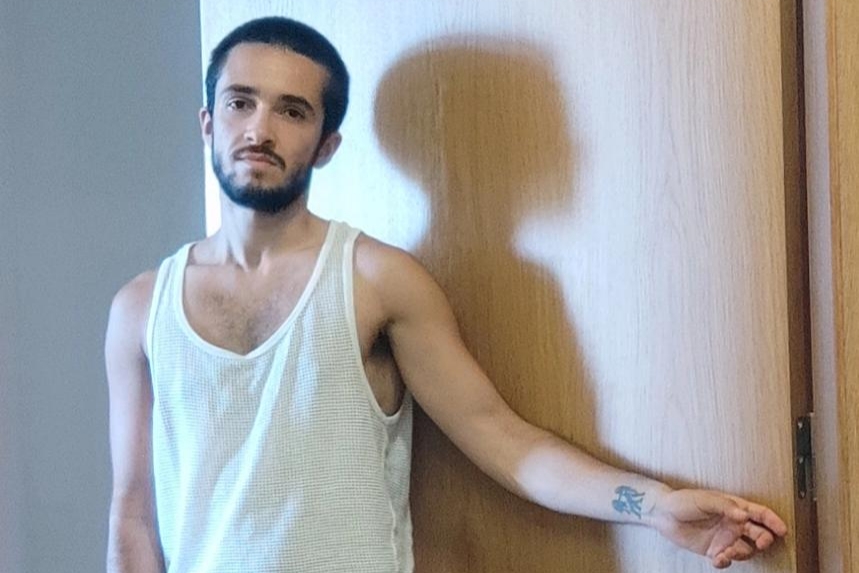
Eríc Amorim dos Santos is a dancer, performer, and creator working across contemporary dance, street dance, and clubbing culture. His work is strongly shaped by rhythm and musicality, drawing on his background as both a hip hop dancer and former drummer, and percussion continues to inform his approach to choreography and performance.
Alongside his training in contemporary dance at Escola Superior de Dança in Portugal and Fontys Hogeschool voor de Kunsten in the Netherlands, he remained deeply connected to hip hop, locking, and battle culture. He is also active in ballroom communities in Portugal, competing in Vogue Old Way as part of House of Telfar and House of Revlon.
We meet in Guimarães during the Spring Forward festival 2026, and discuss his artistic trajectory across these intersecting practices, from club and street dance cultures to contemporary performance contexts.
Between cities and communities
You mentioned Aerowaves in relation to your work and touring. How did your connection to the organisation start?
My first contact with Aerowaves was in 2018, when I substituted for a dancer in Brother by Marco da Silva Ferreira. Later, I applied for the Spring Forward festival with my own work but wasn’t selected. This year there was an open call in Portugal at the right time, so I applied again and got in.
Guimarães is also geographically close to you.
Yes, I’m based in Porto, so can go to Guimarães and return the same day. Everything is very close.
In Slovenia it’s similar – everything is centred in the capital.
It’s the same in Portugal. Everything is between Lisbon and Porto, and outside of that it’s much harder. Sometimes you perform in big venues and there are very few people. But it’s normal that scenes first grow in capitals where there are more structures.
Even within stronger cultural centres like Porto, independent artists still have to navigate unstable production systems and long funding timelines. How does that affect your work?
It’s difficult because you often apply one or two years in advance. By the time you finally start creating, the idea may already have changed, but you still have to continue with the project you proposed. When you don’t have a production structure around you, you also do all the applications and administration yourself.
From hip-hop to ballroom
You’ve been working across street dance, voguing, clubbing, and contemporary. How did these styles come into your practice and start to connect?
I started hip hop when I was 12 – that’s my base. At 14, I began battling and continued until around 18. Then I entered Escola Superior de Dança, where I first seriously encountered contemporary dance. That’s where my hip hop movement started mixing with contemporary. Voguing came much later, during the pandemic, through people like Nala Revlon and Pini, who are part of the ballroom and contemporary scenes in Portugal.
Were you already aware of voguing before that?
Yes, I knew about it, but it wasn’t really present in Portugal at the time. Before around 2018, there was no real ballroom scene here. It only started developing more during the pandemic and with migration, especially from Brazil. Now it’s still a young, but growing community.
Fighting to be seen
What initially attracted you to battles?
It was about having a space where I could be seen. I grew up in a small city and felt different. Battles were not about winning for me, they were about recognition and expression. I was successful in competitions, winning some and reaching the top eight in Eurobattle, which is now Worldbattle. It was an important scene in Portugal, and many of us later moved into contemporary dance through connections with choreographers like Marco da Silva Ferreira.
When you moved from battling into contemporary training, did you feel as if it was an expansion of hip hop or more like a shift?
I wanted to keep dancing, so I chose formal training. I applied for dance school even though I didn’t have any classical training before, and had to learn ballet and contemporary quickly to pass the audition. The transition into ballet was fine in terms of learning speed, but physically it was challenging. My body came from hip hop, so it wasn’t aligned with ballet technique.
Did certain techniques feel more useful than others?
Yes, I preferred Graham technique. It really strengthened my back and my overall body. Ballet also helped, especially with inner muscles, which later supported hip hop styles like locking. Everything started to connect physically.
Borrowed bodies, personal stakes
How do you usually start a new piece?
Through improvisation and physical research, often from a body part or sensation – like in Prima Rosa, which started from the hip.
Why the hip?
It connects to my identity and dysphoria. I used movement to transform that. Ballroom and voguing also helped me accept it physically. My work is very physical – I rely on my body, and I want to use it fully while I can.
You work with other choreographers but also create your own pieces. How do these practices coexist?
It’s a mix. I collaborate with people like Marco, and started my own work in 2021. My first piece was GA (2023). At first I was hesitant about creating my own work, but people around me encouraged me to try.
Do you prefer working alone or collaboratively?
Both, but not completely alone. I always need external eyes – otherwise I get lost.
And what about drumming?
I stopped for years and returned through Marco. We treated it choreographically, with structured patterns, so it became part of the performance – like a partner.