

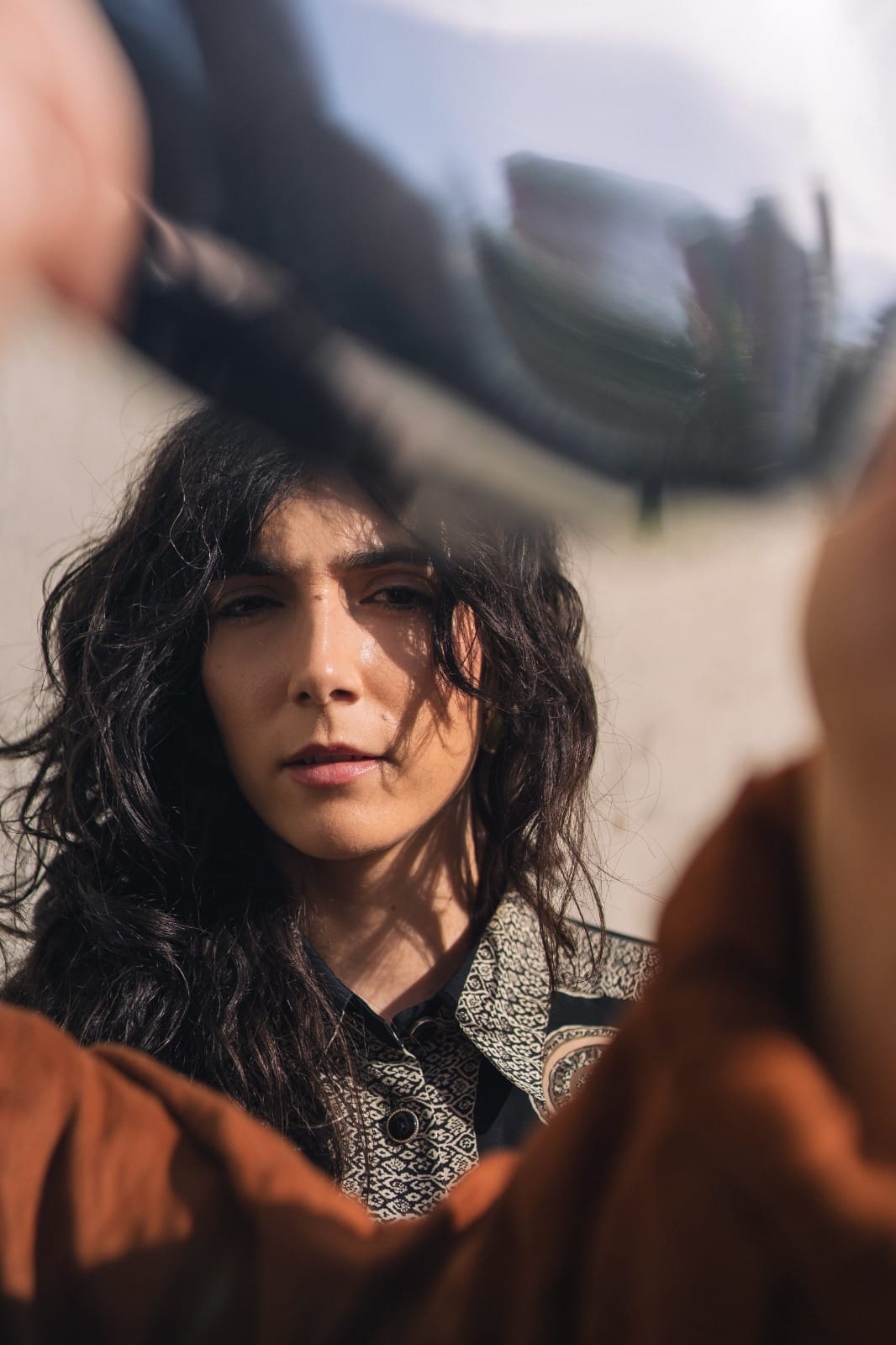
Since 2021, the choreographer Maria R. Soares has built a small, deliberate body of work that treats the stage as a space for testing how people relate: how power is distributed, how intimacy is extended or withheld, how conflict and affection can coexist in the same room. Her 2023 piece Void Void Void explored this by breaking down the boundaries in the making process between herself as a dancer, and a musician. Her latest work, Bright Horses (2025), continues that research with an expanded cast of six dancers. Interested in interdisciplinarity, she has a background in both dance and literature studies. I met her in Guimarães, where she was selected for the Aerowaves Spring Forward 2026 Artists Encounter mentoring programme, she discussed her creative work, what it means to build relationships on stage, and the inspiration she has drawn from having a twin sibling.
You work with different mediums: sound, space, the body. Do you see yourself as a choreographer first, or as an artist in a broader sense?
Maybe first and foremost as an artist, but choreography is for sure the basis of my work. I create interdisciplinary performances, but the starting point is always the body and choreography. My work as a creator is influenced a lot by my work as a dancer. But I also don’t need to put myself in the category-box of ‘choreography’.
How did sound and sonority find their way into your work?
It evolved with my piece Void Void Void (2023), which I created in collaboration with the musician Antonio Marotta. I already had an ongoing interest in sound, but it became more specific in that research, where the goal was to dissolve the distance between a sound-based approach and one led by choreography, and also the distance between our roles inside the performance – decategorising everything to create a really democratic process.
What made you choose moving bodies in space as your primary form of expression? What interests you in the body?
I think I have an interest in relational dynamics: how different elements relate to each other. Sometimes it’s through conflict, sometimes through intimacy or affection. These elements can be visible or invisible, external or internal. What moves me is this curiosity. I also don’t see movement only in the body: it can be found in objects, in sound, in the gaze. I want to explore how the audience can perceive the relations between different elements on stage.
Some of your recent works address competitiveness as a defining characteristic of capitalist societies. Bright Horses (2025), for example, uses siblings as a metaphor for it.
I also used siblings in It’s a Long Yesterday (2021), which was a collaboration with my twin sister, the artist Carminda Soares. So it’s impossible not to relate that work to our relationship. Bright Horses came at a much more mature time for me: the idea was to talk about power structures and competition through family dynamics, by bringing real-life relationships to the stage. The dancers are three pairs of twin siblings. The piece is not about my relationship with Carmina, but of course it’s the starting point. We also analyse the coexistence of competition and rivalry with affection and intimacy within the same relationship. Growing together and being side by side for a long time, you really understand it.
On your artist homepage, you mention using intimacy as a method of resistance – how do you think about this?
It’s related to what I was saying about relational dynamics. I think it’s impossible to create and also to be on stage without being aware of the ways in which your ideas are related to the political and social contexts that you live within. Intimacy is therefore about tension and conflict, but also about care and affection. I think that in our world today there is a lack of awareness of this. Intimacy is not just being close to someone or being touched by something. I think it lies in the moment of building a relationship, and understanding what kind of dynamics you can construct with it. I don’t have a final answer, it’s something I’m still exploring every time I go to the studio.
What would you like the audience to experience when they see your work?
I don’t want to make the audience think about something specific. A performance is an immersive experience, a new reality created in real time. It can be ambiguous, and you can decide your own way of reading it. Mostly, I would like to create a sensation.
Do you think of artists as having a specific mission in our world today?
It might sound like a cliche, but I think it’s about creating resistance in a society where we’re always consuming. Creating means putting yourself in a vulnerable and fragile position. I think that just continuing to create is a big mission in and of itself.