

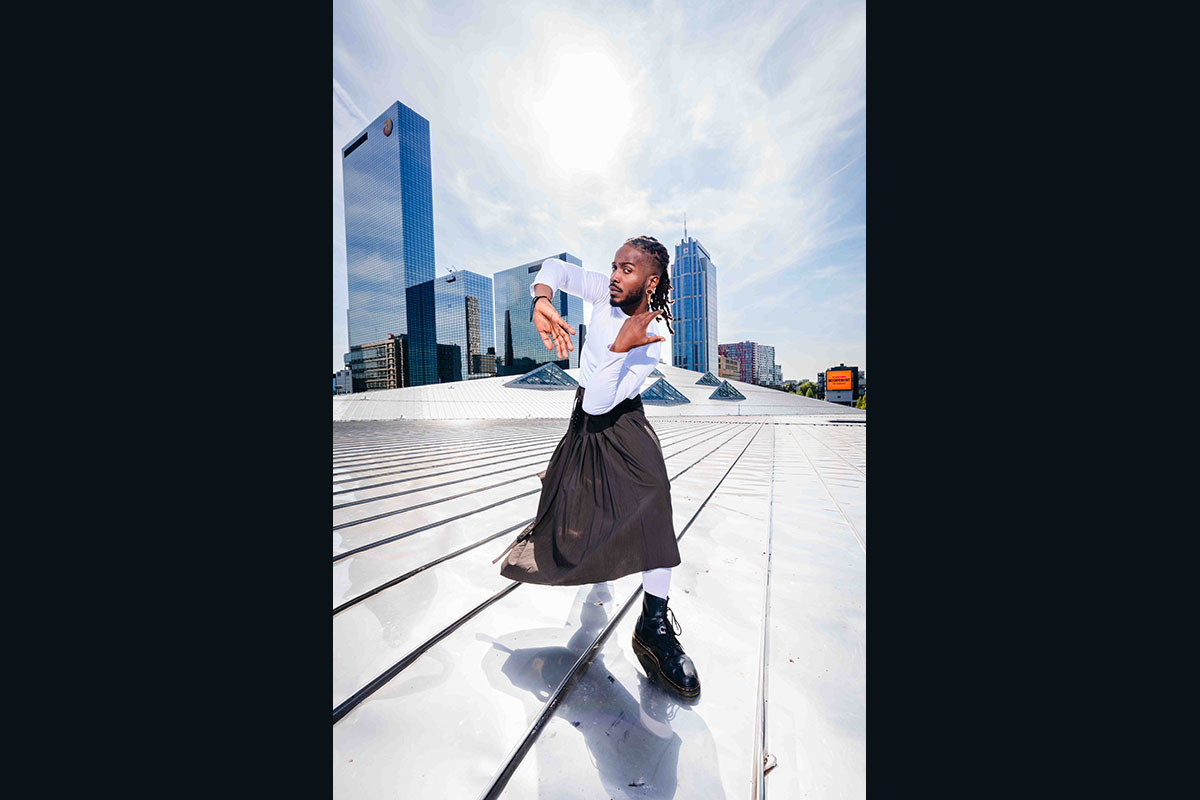
Shaquille George charts their own path. Born and raised in Curaçao, living in the Netherlands and working across Europe, they work as a performer, dancemaker and dramaturg. Recently, they have begun curating dance and is part of Aerowaves’ 2026 Startup Forum cohort. I caught up with them at Spring Forward Festival in Guimarães, Portugal, to learn how their background in contemporary dance, hip hop styles and the Ballroom scene shapes how they create and curate. What began as a conversation about labels soon opened into themes of belonging, responsibility and risk.
As someone who works across multiple dance forms and roles, what do you think of labels?
This is a debate I have with myself as an artist. I do understand the notion of having to label something and give it a name. But when it comes to something artistic and subjective, it’s an opinion – what you see and what you perceive. For me, it becomes very complicated to then give it a label. As a professional dancer and a choreographer, I don’t believe in labels. As a dramaturg, I have to. As a curator, I have to as well. It’s a weird balance.
If you have to use labels as a dramaturg or curator, what are the opportunities to use them for positive change?
As a dramaturg, I’ve noticed that there is a lack of understanding. It’s all about words and the terminology that you use to describe the work. When it comes to curation, I think it’s important to find people of certain communities and certain labels. For example: If I want to work with a black and queer community, how do I curate a programme or a performance that educates a new audience or educates that same community with a new type of programme, movement quality or artistic point of view?
Do you think audiences can be pushed beyond what they think that they like or expect to see?
It’s about taking the risk and a leap of faith. That’s who I am as a person. That’s why I – [someone] coming from a small island – am sitting here talking to you about this. It’s because I took a leap of faith… like, okay, you know what? I’m going to make it happen. Everything that I’ve had in my career has been based on that risk. As a curator, I probably won’t stop doing that. It’s about always looking for the discomfort within the comfort and trying to push those boundaries. Will I fail sometimes? Absolutely. [But] I will also succeed.
Your life and work has taken you across continents and cultures. What motivates you to keep moving forward?
The core reason why I push forward is because I don’t want those that follow after me to have to struggle with [belonging]. I take as much as I can and learn as much as I can from every single gender, sexuality, religion, culture, so that I can shape and mould myself into a human that can understand other humans. [I] acknowledge everybody’s journey and the paths that they have to traverse so that the ones that come after me don’t have to struggle as much, that it becomes a bit easier.
You’ve brought up risk a few times, in the context of your role as a dancer and choreographer. What does risk look like as a curator?
You need to protect the artist, the audience, yourself, the organisation, the event – but also allow space for something new to come out of it. I think risk is important. But I’m also very practical. And again, it’s about the balance. You can’t take risks without balance.