

After an intense and richly layered experience at the Spring Forward Festival, what stayed with me most was the space between the shows. Not the performances themselves, but what lingered after: the conversations about what we liked and disliked, the discussions offering different opinions and interpretations, and trying to jam those impressions into 150 words. My perspectives expanded as I tried to dissect the performances. Perhaps that’s the main function of contemporary dance – not to deliver meaning, but to generate open questions and interpretations.
Despite this, so much of the work I encountered at this year’s festival seemed to resist that openness. It arrived already framed, contextualized, explained. Programme notes told us exactly what we were about to see. Texts projected on screens and monologues performed live or prerecorded communicated, with a sense of urgency, the methods and the messages behind the pieces. The meanings were fixed before the shows were over, and sometimes even before they began.
Does dance need to justify itself so explicitly?
In some work I found this justification useful. CLAP & SLAP by Agnietė Lisičkinaitė and Igor Shugaleev, Lithuanian and Belarusian choreographers respectively, explored the tense relationship between their countries after Russia’s full-scale invasion of Ukraine. The projected facts and explanations during the work were essential to fully grasp the crucial message of the piece. Similarly, in Fábio (Krayze) Januário’s Musseque, where the dancers reflected on Angola’s colonial history and previous wars, the text was important to understand the context and history of the dance. Even though it was in Portuguese, it gave a sense of atmosphere and generated a curiosity to learn more.
Elsewhere, I questioned whether direct explanations enriched or limited works. At festivals and platforms, a pattern repeats: shows present themselves with a clear theme or message in order to be marketable. Contextualisation is useful – it helps us to navigate, remember and communicate. But it can also confine, reducing complex artistic expressions into simplified ideas.
For BIPOC or other marginalised artists, I believe this framing becomes even more pronounced. Often, it seems as if our work is most visible when it speaks of trauma, oppression and resistance. While these are undeniably important themes, and carry histories that demand attention, I wonder: when these narratives become the primary perspective that is communicated, are we expanding representation or reinforcing stereotypes?
I ask this not from a distance, but from within. I recently premiered a work exploring my Filipino heritage, from a queer and multicultural perspective, which was also clearly communicated in the programme note. It felt necessary. It felt urgent. But still, while watching other works that navigate similar themes, I felt a subtle discomfort.
Am I performing a version of myself that fits the market?
What narratives are required to validate movement on stage?
French writer and poet Édouard Glissant’s concept of ‘opacity’ describes the right not to be fully understood and the refusal to be categorised for the sake of another’s understanding. It is about resisting the demand for transparency, often rooted in colonial ways of knowing and categorising the world. In French Guianese choreographer Johana Maledon’s (titre provisoire), a repetitive sequence builds up to charged movements, evoking a legacy of rallying against suppression.Though a LED screen cycling between words such as OPEN, EXOTIC, and CAN’T BREATHE, gives hints to contexts and references, it remains vague in its message. Is this an attempt to resist clarity, and to allow space for opacity?
What would it mean to make dance from a place of opacity? To create works that do not need to explain themselves, but that remain partially hidden, ambiguous, undefined? Is there a way to leave room for imagination? A way to disrupt the expectation that marginalised bodies must always translate themselves? A way to give space for the abstract and complex power of dance?
Though clear messages and themes are important to make dance accessible for a wider audience, I wonder to what extent this clarity serves our art, and to what extent it limits us. Do we as artists over-explain and over-contextualise our work to fit certain criteria?
What is lost in the need to clarify our work into words?
What is lost in the process of trying to pack ideas into a maximum 40-minute easy-rig piece?
What if dance did not need to prove anything?
What if its value lay not in how well it communicates a predefined message, but in how deeply it invites us into shared bodily experiences?
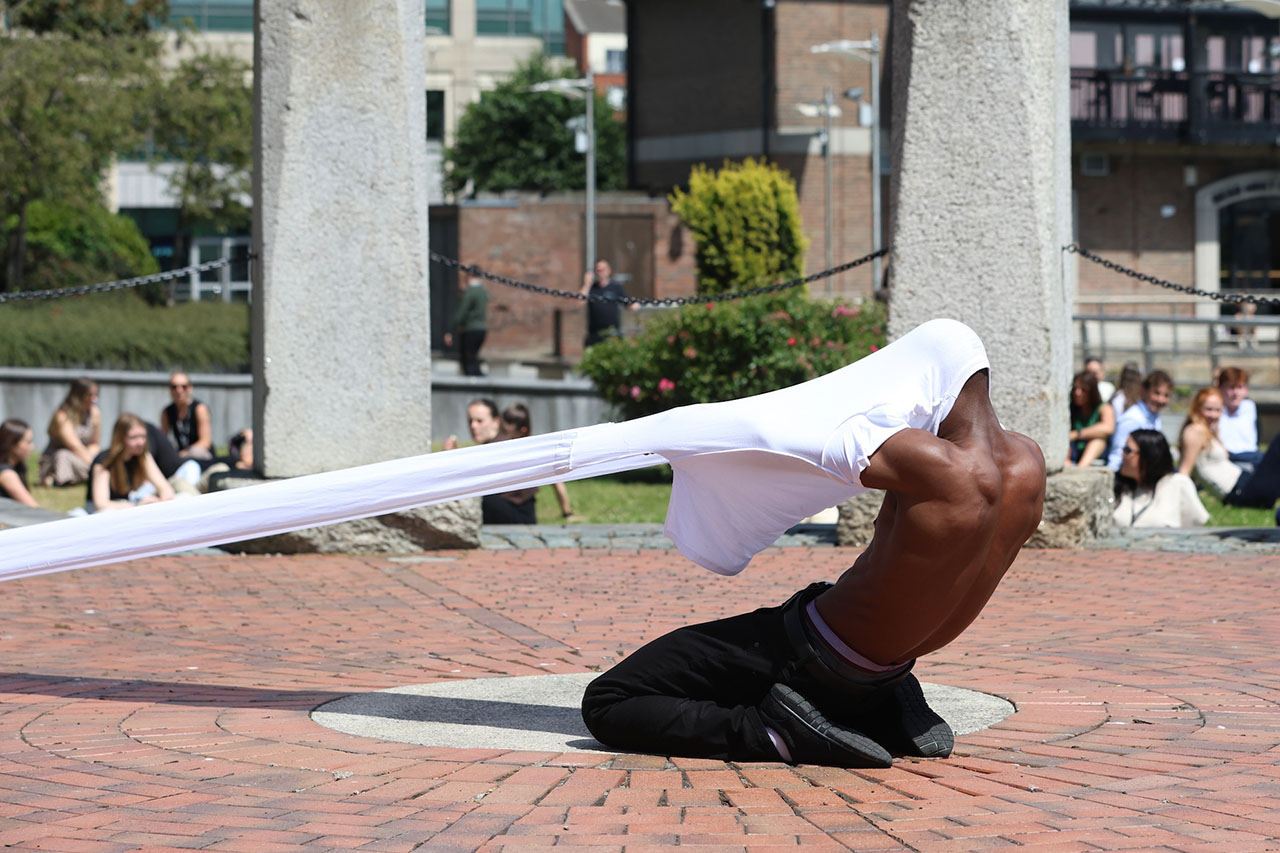
At Spring Forward, Nigeria-born, Irish choreographer Mufutau Yusuf presented Proses On Neither Here Nor There. After an intense and liberating dance in the big grass field of Centro Cultural Vila Flor, he walked away from the audience. Stepping into a long pool, water rose up to his thighs, before he headed to the end of the stone basin and observed the beautiful landscape ahead. For me, it was as if he was stepping out of the frame of his performance. Why does it have to stop there?
Maybe the most radical gesture is not to define, but to remain, at least partially, undefined. And to let the dance speak for itself.