

On 5 May 2026, I was on board a plane about to land in Porto. A week of reviewing and writing lay ahead of me at Springback Academy. As I looked down over the city from my window seat, it suddenly hit me: two years earlier, to the day, I had also been on a plane landing in Porto – not for Springback, not for dance; for love.
Or maybe it was just lust. But that flirty adventure two years ago was short-lived: the boy who had asked me to visit him was quick to tell me he was too busy to spend time with me. Now, flying over the old town, I saw my past self having lunch alone in an empty Chinese restaurant, watching the Portuguese news on an ancient television. In the following days, I wandered aimlessly, took the bus to the beach and watched the waves crash for hours – heartbreak filling the void where curiosity for new experiences usually lies.
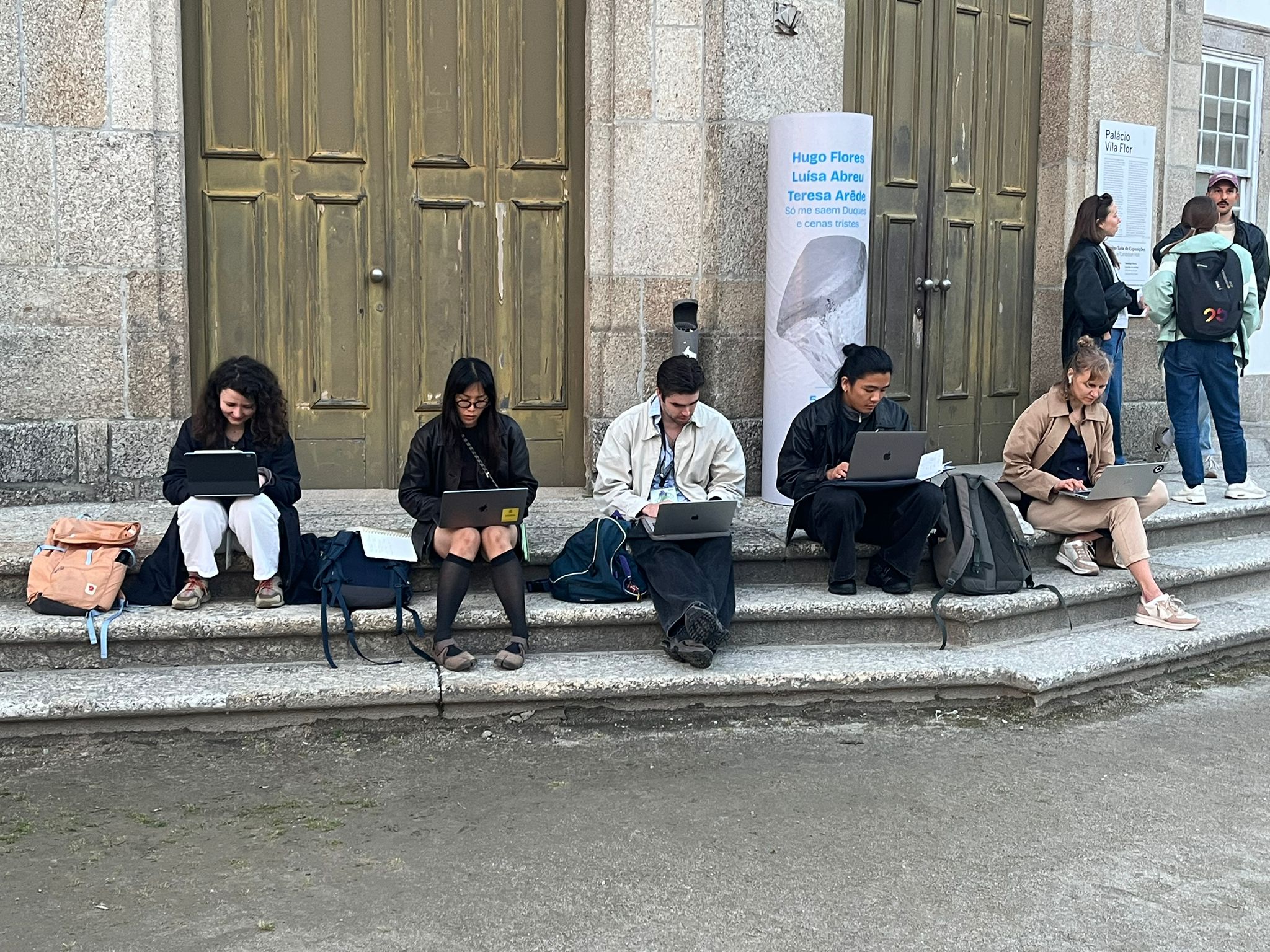
Somehow without noticing, two years later, I followed my own footsteps back to Porto. Only this time I headed inland towards Guimarães – a town whose name, we were later told, can only be pronounced with a smile. Indeed, the five days of Springback Academy and Spring Forward filled me with much joy. I had the incredible opportunity to watch 21 performances, write reviews every day, and connect with other wonderful writers, dancers and producers. It was both a dream and a stark contrast to my previous trip to Portugal.
On my flight back home, I couldn’t fathom that both this trip and the one two years earlier existed in the same timeline. The two realities couldn’t have been more different. You’re telling me life does in fact move forward, that time is real? That everything we once experience eventually becomes a glimmer in our ever-fading memory?
One Spring Forward performance felt especially salient as I wrestled with the notion of time: IT’S THE END OF THE AMUSEMENT PHASE. Chara Kotsali’s piece is a dance marathon that drowns you with information, whether it be props, historical dates or dance references. It skilfully highlights humans’ tendency to generate excess, and asks what is salvaged from the landfill of our collective history. What do we, both as individuals and as a group, choose to assign significance to in a rapidly evolving world?
When I think about it, my own heartbreak story feels nearly insignificant. I seemed to have forgotten it myself. Is it simply a coincidence that two years later I returned to the same place, nothing less and nothing more? And yet here I am choosing to write about it – because?
I struggle to grapple with the unfolding of events, determining what importance they might hold in the grand scheme of things. Heartbreak and insignificance. Laughter and forgetting. Alone, I seem to collapse under the burden of everything and nothing. What does this all mean, and does it even mean something? How do we move forward if our private life appears so banal and irrelevant, compared to the world around us?
CLAP & SLAP, another Spring Forward performance by Agnietė Lisičkinaitė and Igor Shugaleev, provided an answer – precisely because it connects the individual’s experience with the world around us. Dissecting the complexities of Lithuanian and Belarusian politics, the duo mix powerful gestures with a greater conversation around complicity, responsibility and morality in personal relationships. CLAP & SLAP is evidence that a personal experience can speak to something bigger, and the performance uncovers how connection and communication can triumph under the crushing weight of insignificance.
What I took away from Spring Forward and Springback is the importance of connection: how much joy and love hides behind experiencing something together. Whether it be through dance performances, conversations or simply existing besides one another. So perhaps there is no point in grappling with questions about the past and the present all by myself: maybe we can simply link arms as we float on the insignificance of our individual realities, and if we’re lucky, drift towards a better future.