

Is it the time for making dance? I keep hearing this question from dance artists across Europe. Aren’t there more important things to do? Okay, sure, let’s keep dancing — but it’s got to reflect the mess we’re in right now. So, artists are trying to be everyone’s therapist, while also dealing with the way these crazy times are shaping their own creativity.
Spring Forward definitely captured that mood. The program felt to me like a collection of the varied ways in which dance navigates uncertainty and adversity. The artists are putting tough questions on stage, and figuring out at the same time what the role of dance might actually be these days.
Uplifting
When instability, migration, wars, and moral exhaustion loom in the background, dance appears as an avenue to produce energy, still – and the desire to live.
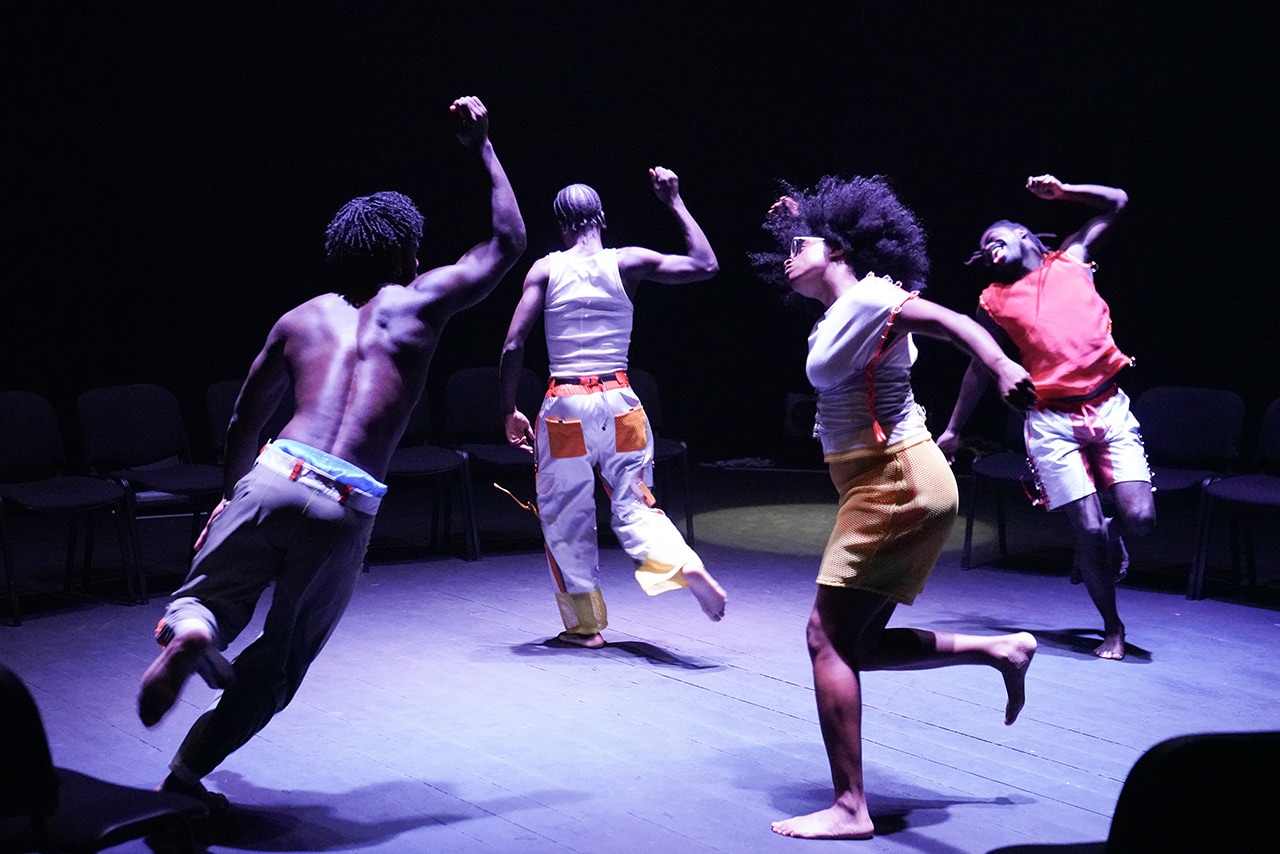
For me, the strongest work in that regard was made by Fábio (Krayze) Januário in Musseque. Kuduro – an Angolan music and dance style born in the late 1980s – transforms the desperation of life on the periphery into powerful footwork and the thrill of collective movement. The work insists on dancing – and through dancing, on producing life itself. The image of the pregnant performer Selma Mylene dancing furiously was a revelation, and became my ultimate festival crush. This piece felt like a hymn to vitality and resistance in the face of unfairness. A dance capable of reigniting energy inside your body at 10 p.m. is absolutely necessary in dark times.
Alongside it stood the intimate site-specific work Proses On Neither Here Nor There, by Mufutau Yusuf. Here, in contrast to the previous quartet, the dancer resists alone. This minimalist physical poem reminds us that even in solitude we must search for inner strength, confront our internal limitations, and seek freedom first within ourselves. Nothing particularly new, yet a fundamental part of dance.
Another work that, for me, affirmed life and movement was the interdisciplinary dance & music performance Wired, the final work of Spring Forward 2026, by Marie Kaae. The piece brought smoother energy than Musseque, yet still placed dance’s ability to unite, captivate, and celebrate at the forefront.
Speaking
Some works speak, desperately – or scream. Many performances this year included singing. The voice burst through as an extension of inner strength, spilling outward alongside dance.
In Logbook, the voices of Solène Wachter and Bryana Fritz converged into a polyphony that reflected the complexity of a world drowned in endless informational noise. Inka Romani, the choreographer and sole performer of Volvamos al baile, told an essential story about a dance lost under a dictatorship of Franco, and control over women’s bodies – as though dance itself were dangerously subversive. The very fact that dance was repressed under this regime reveals its rebellious nature and explains Inka’s desire to recover something that was taken from her people.
One of the most important experiences I had during the festival was the slap delivered by the choreographers of CLAP & SLAP. This painful work brings to the stage the awkwardness, tension, and emotional fragility that exists in conversations between Agnieszka Lisičkinaitė, who is from Lithuania, and Igor Shugaleev, a Belarusian dancer. Though deeply personal, their dialog resonates far beyond them, echoing the experience of many people in Eastern Europe who have found themselves entangled in the ongoing violence of Russia’s war against Ukraine. CLAP & SLAP touches on the sensitive issue of collective guilt – a question that has spread far beyond the performers’ countries of origin and resists simple answers. Through the audience’s applause – clap – and the performers spanking themselves on the back – slap – the performance manages to create at least a brief sense of release.
Meanwhile, in IT’S THE END OF THE AMUSEMENT PHASE, a meticulously assembled collage, Chara Kotsali combined an archive of dances performed to popular music, spoken text, a selection of historical dates and one unapologetic statement projected onto a screen: years elapse, but dance will remain. The work did not offer any clear answers, but instead absorbed every possible doubt, becoming a collective reflection on this shared question: does dance still have the right to exist in wartime?
Loving
While radically different in form and physical vocabulary, three duets cultivated a quality capable of saving people in any era: tenderness.
The pieces presented very different approaches to contact. In Scáling, Markéta Stránská, a dancer with one leg, and Charlie Morrissey carefully explored partnering through the differences between their bodies. The spinning metal structure Inan Sven Du Swami and Mojca Špik climbed on and dangled in Do Birds Dream of Flying? sharply contrasted with the extreme delicacy and attention the performers showed toward one another. Meanwhile, Marcos Arriola and Bast Hippocrat allowed both themselves and the audience time to observe an intense, tight physical connection during Joyaux Lourdement Sous-estimés.
All of these duets grew dance out of the risk of moving toward intimacy, taking shape as an alternative way of connecting – and in doing so, producing a kind of fearlessness.
The end
If contemporary dance, as its name indicates, reflects the state of its time – while the state of that time leaves much to be desired – then there is something vital about offering audience members and colleagues not only material for sorrowful and profound thinking (there is already enough of that), but also hope. The medium of dance is the body: perhaps now, more than ever, artists need to embrace it, give it a voice, and keep moving.
This feature was initially called The Rebellious Potential of Dance. Perhaps, for now, this title was more what I long for than what truly exists in reality; Still, I continue to believe that it is the next step, after everything dance showed at Spring Forward: crafting rebellion.