

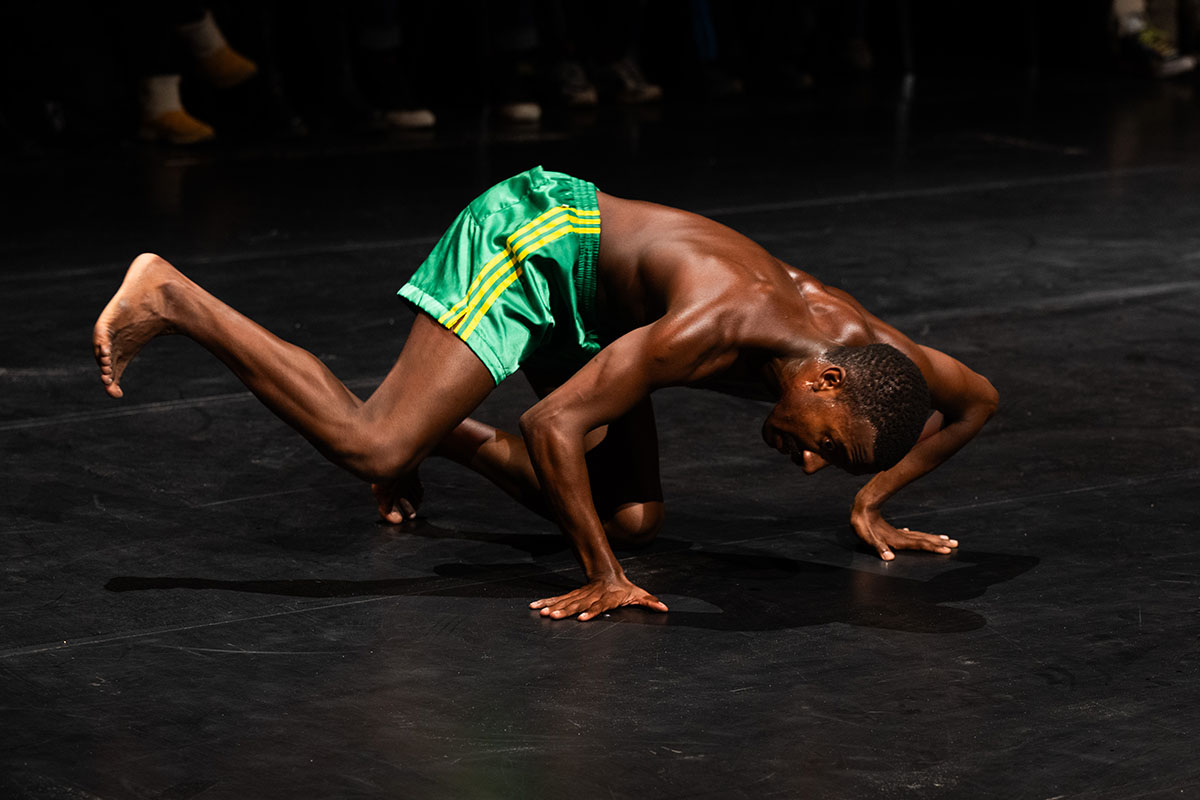
There is no fluff to the opening of PUFF. Audience hubbub is cut cleanly by Brazilian dancer Hiltinho Fantástico’s undramatic entrance. He bounces onto the stage as if from nowhere, surrounded on all sides by our gaze.
PUFF continues a seven-year collaboration between Fantástico and choreographer Alice Ripoll that hybridises contemporary dance and Brazilian urban forms. The word puff, a synonym for a ‘light breath’, inspires the way Fantástico moves, or is moved. At first, he bounces from one foot to another like a tumbleweed in the breeze, head lolling, eyes rolled back and arms held up and out as if in tired prayer.
The flirt and sway of samba soon finds its way into his hips after prolonged silence, jarringly broken by an audience member’s phone. Fantástico (literally) shakes off the interruption and the music begins, an infectious original soundtrack by Ripoll and musician Mimosa. A torso tickled by rhythm is delightful to watch. Bursts of capoeira are effortless despite the incredible physical feat of the technique. Fantástico springs high from low squats and sends himself legs first through a skipping rope of his own arms.
The second half introduces grip and unease. The circular patterns of samba’s roots, and indeed many urban social dances, are echoed by Fantástico’s strained progression around the perimeter of the stage. Hunched over, shoulders gurning, he surveys us one by one as PUFF becomes inexplicably abstract. Drops of sweat trace his path. Gold, glittering paint released down his back is quietly shocking, but the silver paint that later runs from his mouth more so, for it coats his teeth like a vampire with a penchant for unicorns.
The research behind PUFF explores silenced cultures and the breadth of knowledge they possess. Capoeira is inherently disguised in its concealment of self defence within dance. Passinho dance, born out of Rio de Janeiro’s favelas from which Fantástico himself originates, was once criminalised. The styles have necessary disguisement and forced disappearance in common. The exposed staging, semi-nudity and Fantástico’s solitude leave little unseen. And yet there is trickery in his fast footwork that charms and disarms, in the use of paint that relies on deception.
The more compelling illusion, however, is Fantástico’s metamorphosis, the result of not only physical exertion. PUFF is a slippery traversing of unique yet complementary movement languages. In transmitting these to us, Fantástico is changed. It is not unlike the retrieval of a memory, each recall slightly distorted and influenced by context, in this case, a scrutinising audience in the round. Fantástico’s magic is his ability to bring to the surface, as a soloist, essences of dance cultures rooted in the collective, and the coexistence of joy and oppression that make up their ancestry.
Reminiscent of his opening bounce, he fires up his legs to leap through the finale, this time with great liberation. While airbound, the height of an inhale, the light is snatched from us. PUFF is left unfinished, a landing hidden from view, in flight on the breath that carried him to us. ●
13.05.2026, Lilian Baylis Theatre, London, UK
Direction: Alice Ripoll
Creation and performance: Hiltinho Fantástico
Assistant direction: Alan Ferreira, Thais Peixoto
Light design: Tomás Ribas
Costume, scenography: Alice Ripoll, Thais Peixoto
Tour manager: Joana D’Aguiar
Production assistants: Isabela Peixoto, Thais Peixoto
Original soundtrack: Alice Ripoll, Mimosa
Coproduction: Rotterdam Theater
Support: Festival Actoral, Câmbio
Distribution: ART HAPPENS