

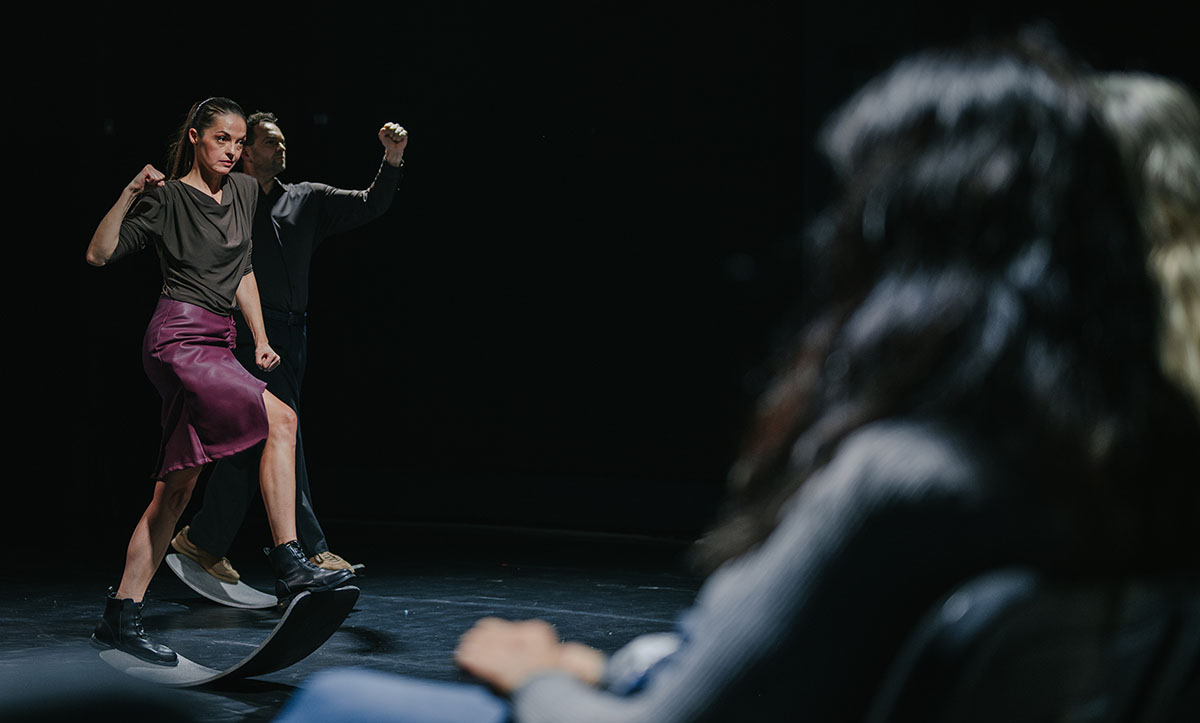
‘We are the D(ance) Generation’ was the motto of the 19th edition of Antistatic Festival, an international festival of contemporary dance and performance held annually in Sofia in the spring. Initiated in 2008 by three friends, performers Iva Sveshtarova, Willy Prager and Stephan Shtereff, with the aim of promoting and developing contemporary dance in the Balkan region, it has over the years become a reference point for contemporary dance-attendees in the capital and in the Balkans. Since 2018 it has included a biennial showcase of works by local artists, named the Bulgarian Dance Platform. When I moved to Sofia that year, I took part in the festival as a volunteer, and have continued to follow it ever since. Here is a selection of works from this year’s edition.
Past in the present
Despite being a Gen D(ance) festival, present on TikTok videos and Instagram pictures like Gen Z, Antistatic didn’t neglect its foundational roots, and dedicated its opening to re-enacting a 1997 work, A Never Ending Story. Created by Galina Borissova, one of the most important choreographers in Bulgarian contemporary dance history, the piece was reconstructed as part of the research and archive project DanceMap, and was interpreted by Nelly Georgieva, Silvia Cherneva, and Daniel Kearns.
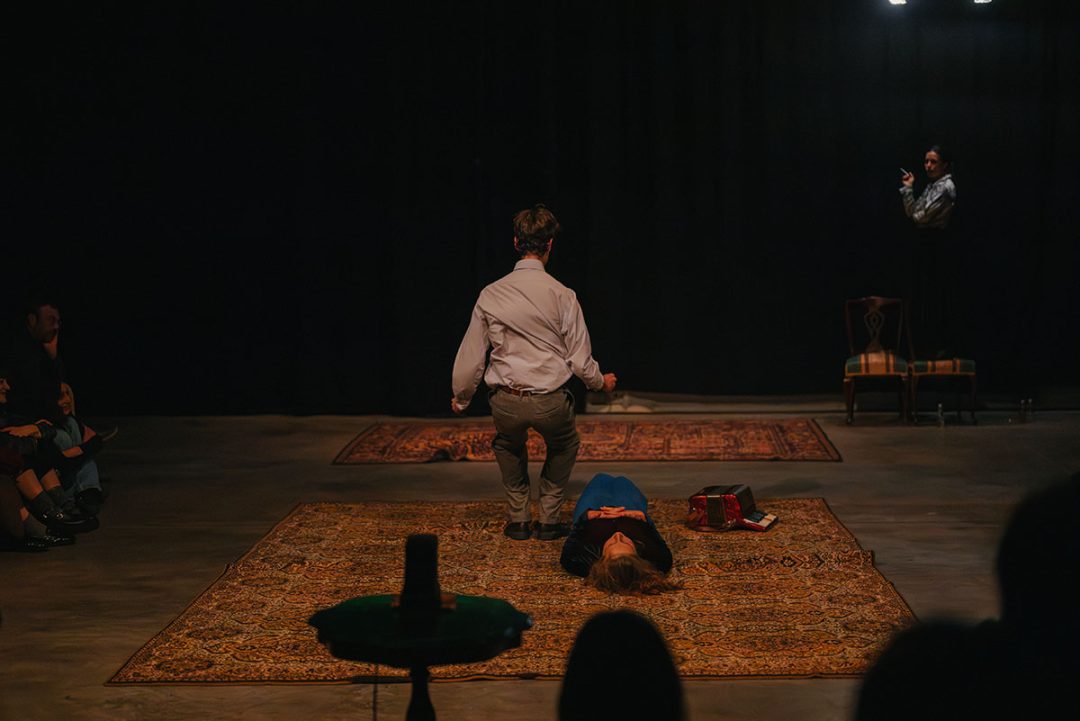
Dressed in elegant old fashioned clothes, the dancers trot, play tag, smoke a cigarette, or offer us candies in a cosy retro-looking living room, transporting us to a past we did not experience but are nostalgic for. Female friendship seems to emerge from the playful women duets, while those between man and woman suggest a more troubled relationship. In the tango duet, for instance, the accordion between them and their intricate steps seem to objectify the inescapable obstacles a couple faces, while the beautiful sensual poses they indulge in suggest a path towards compromise and trust. A bunch of keys, glass bottles, a loaf of bread are briefly used by the performers, with no evident link to their actions.
Did the audience of the 90s perceive their recurrent exhalations or pointing hands at the pelvis as avant-garde? Or did they find the vagueness of the subject more unsettling? Perhaps, like me, they were primarily captivated by the dancers’ desire to let go, have fun and share an evening with us.
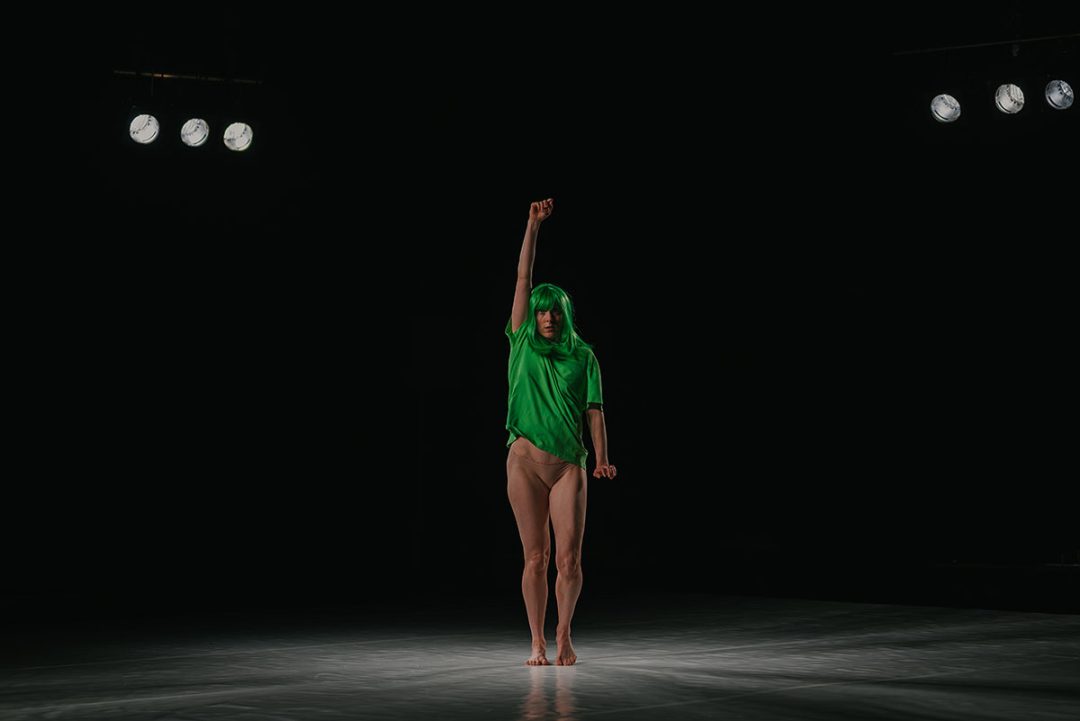
Still in the wake of nostalgia, Ruth Childs’ solo fantasia brings us into her childhood world by using classical music – which she grew up listening to extensively with her family – like ‘pop hits’, as she declared at the post-show talk. On a minimalist white floor, dressed in solid-coloured t-shirts and wigs, Childs plays with famous classical scores, sometimes simply dancing to them, other times actively dismantling and reassembling the musical phrases as if she were putting together a puzzle. For instance, she abdicates movement to simply tap the rhythm with her fingers on the floor to grandiose symphonies, or triggers distorted notes of the Nutcracker by pulling her shirt, exhaling or sneezing, thus becoming an instrument herself. Visions of crabs, horses or Egyptian bas-reliefs are triggered by her poses, while the repetition of certain gestures, like the rhythmic turning of her head, partially recalls the postmodern choreographies of her aunt, Lucinda Childs. However, this repetitiveness leaves room for warmth and irony, making Ruth’s work evocative, accessible, funny and beautiful.
Bodies of work
Another block of works focused on the body, power dynamics and the critique of capitalism. Work Body, by Vienna-based physically disabled artist Michael Turinsky, draws inspiration from Marxist politician and journalist Antonio Gramsci, and from the poem Pier Paolo Pasolini dedicated to him, The Ashes of Gramsci.
Turinsky, dressed in a worker’s uniform, builds a stage by transporting square tables to the centre of the room on a heavy duty cart, before starting his concert with the energy of a rockstar. His songs are full of wordplay (‘I am making – I am aching’, ‘You are on your own, you are home’) and deal with disability, the productivity-driven logic of capitalism, and the need for social rights and solidarity. People with disabilities, he says, usually have a slower rhythm. We can notice this in the performance: it takes time (and physical effort) for him to set the stage, to thank and applaud all his collaborators, or to drill a block of marble. We learn to slow down, embrace vulnerability, and also acknowledge that this doesn’t collide with getting the job done. Through Turinsky’s manual labour, done with care and a smile, we can find echoes of Gramsci’s philosophy: the factory is not necessarily a place of alienation, but primarily a school in which to cultivate a collective consciousness against capitalism.
When my back starts to hurt after half an hour of sitting on the floor, I think of the difficulties people with disabilities might encounter when attending events. But by staying there I also have a multisensorial experience: besides seeing the smoke, I can feel its chill on my skin and its smell; I perceive the vibrations of the bass not just with my ears, but in my whole body. I reflect on the level of accessibility of the performances, and how little space is dedicated to this topic in Bulgaria.
As an Italian who studied in Bologna, where Pasolini was born and also studied, I was deeply moved by the recording of him reading Le ceneri di Gramsci. He is in front of Gramsci’s grave in Rome, and directly addresses him and his thinking. It felt like a breath of hope – the certainty that their ideas of social justice, education and art keep moving, living on through Turinsky’s outstanding performance, and our own legs.
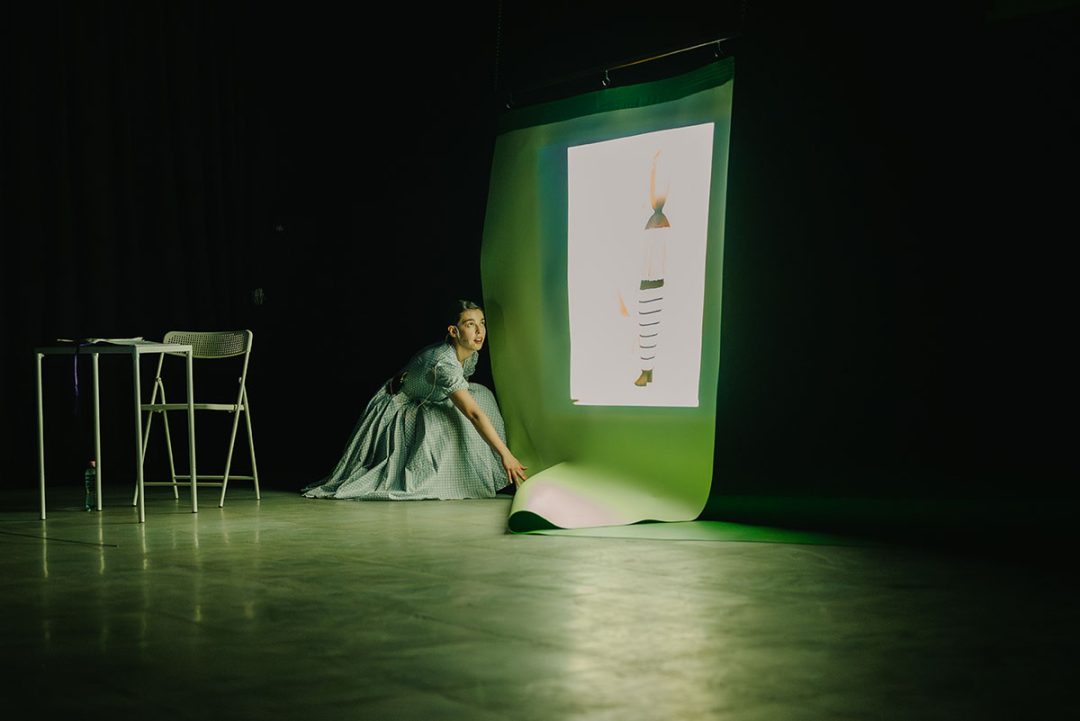
In contrast, in Unauthorized movements by Romanian choreographer Mihai Mihalcea, factory work is described as a scientific mechanism whose sole goal is efficiency. Actress and co-creator Mara Bugarin takes the microphone and enthusiastically recounts the story of American management consultant Frederick Taylor and his innovations, but some glitches in her movements reveal an internal contradiction. She points at her heart while speaking of her arm, or asks inappropriate questions that she then withdraws, suggesting that the obedient body we constantly keep under control yearns for freedom of expression, wants to perform unauthorised movements. With the help of a video projector, she continues her journey into body control through the history of biometrics, AI facial recognition and, ultimately, Romanian bears. Meanwhile, she changes costumes, accents and body language – adapting, like capitalism, to different contexts, or conforming to the unwritten rules society demands of us. Despite Bugarin’s extraordinary acting skills, the volume of text can be overwhelming. Nonetheless, the performance succeeds in stimulating reflection on how to remain free and resist a world that continues to push us towards standardisation and new, subtle forms of control.
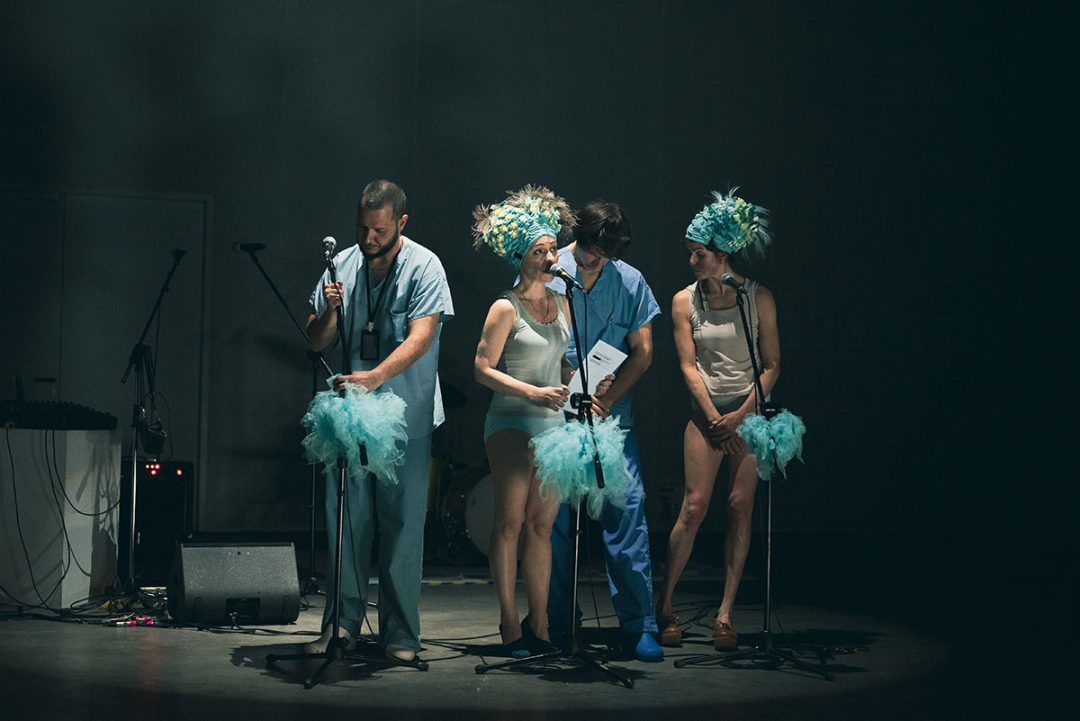
Two Bulgarian performances also deal with these themes. raw confessional poetry, by Galina Borissova, is a concert-performance interpreted by herself, rock musicians Martian Tabakov and Martin Penev from the band KAKE, and actresses Nevena Kaludova and Elena Dimitrova. Juxtaposition can be hard to handle for a reviewer: what should I pick among the many absurd sentences, energetic rock songs, and funny situations that I saw to give an idea of this work? I decided to prudently start from the beginning. While we wait in the foyer, the performers, dressed as doctors, approach some of us to enquire about our health issues, whether we have national health insurance, and write our names in their registers. Once we enter the room, our unconventional diagnoses are read out loud: social prejudice, pessimistic thinking, rejection of reality, lack of moral integrity… The Bulgarian is translated into English, but because the doctors talk over each other, we can’t catch everything and remain a bit lost – or rather, funnily confused in translation. This initial sketch, whose setting really recalls a small disorganised Bulgarian medical cabinet, seems to illustrate the mood of the performance: don’t worry if you don’t get everything, we have already given up understanding. Similarly to Bugarin’s glitches in Unauthorized movements, the physical actions often ironically subvert the spoken text, such as when the actresses push heavy blocks with their backs unnaturally held parallel to the floor and say ‘We don’t like uncomfortable positions’: the world we live in is definitely full of contradictions. I wonder whether I am missing something by being unable to remember and process all the concepts verbally delivered, or to logically connect all the actions on stage. Nevertheless, I find comfort in the statement: ‘Postmodernism is responsible for everything’. This flood of scattered, puzzling content sometimes grows boring, but most of the time, the performers’ absolute commitment to absurdity – in medical routines, music, dance, or translation – keeps the performance both engaging and coherent.
Bodies of Power, by Iva Sveshtarova and Willy Prager, who are on stage with Daniel Denev, Violeta Vitanova and Vasilia Drebova, dissects the dynamics of power by directly applying them to the audience. As despotic rulers, Sveshtarova and Prager sit mostly on the right side of the stage and direct the others’ actions by typing on laptops real-time instructions that are projected onto the walls. In the opening section, Vitanova and Denev persuade two spectators to come on stage and participate in a quite static, yet ecstatic dance, whose main movement is the gentle shaking of golden leaves and fans. The simple, impactful choreography takes a comical turn as Vitanova’s extreme enjoyment resembles an orgasm. Being told what to do, how to behave and what to like can be more tempting than we usually think: it liberates us from the burdens of choice, responsibility and critical thinking. In this performance the text, sometimes difficult to follow, has the important role of presenting power as a gradually expanding cancer, as a mission to be accomplished by the chosen ones, as a game of control. But once again, it’s through the body that we feel the manipulative nature of power: the spectators are invited on stage with tempting offers, where humiliation is sold as a desirable game, striptease parties as a privilege, and exploitation as an award. While we can’t help but laugh at the final scene, the performance does not end with any positive advice or message: it’s up to us to be vigilant and not succumb to the insidious deceptions of power.
Triple time
Continuing with the Bulgarian Dance Platform selection, If Aphrodite Was a Monster and Happy Together – Unhappy Together both feature a female trio onstage. In the first, choreographer Iva Sveshtarova, together with Vasilia Drebova and Ana Petkova, dressed in short pink and golden outfits, embody Greek mythological figures and grotesque creatures, challenging stereotypes of femininity and the traditional symbolism of classical characters. The beauty of these modern Aphrodites, with asymmetrical smiles painted on their faces, is more reminiscent of a Picasso painting than a perfectly proportioned Greek statue. Their swaying butts, playful gaze and deep, almost violent moans make it clear that they are not gracious, passive objects of desire. They are love goddesses who like to have fun, yearn for pleasure, and obtain it without violating other humans. They fluidly metamorphose into non-human creatures by bending forward, holding their heads upside down between their legs and spitting out balls, or by drawing eyes on Sveshtarova’s buttocks, transforming her into a sensual Medusa. The scenography plays a special role: thick paint drips from the picture hanging from the ceiling throughout the performance, and our previous conceptions of Medusa and Aphrodite dissolve with it.
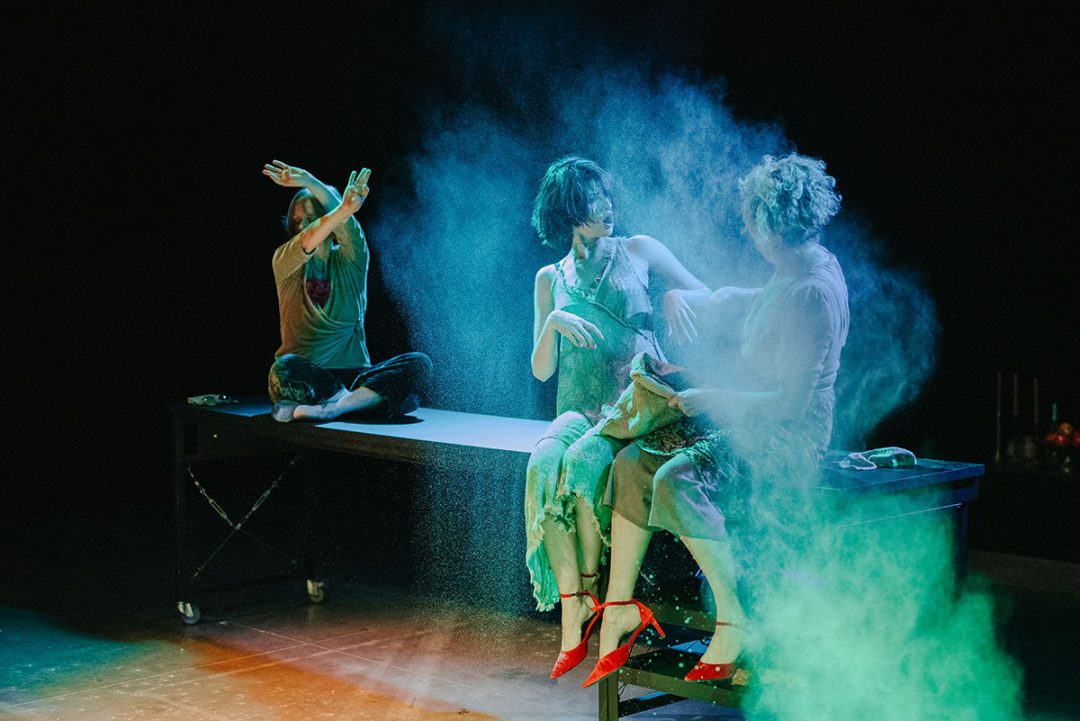
Happy Together – Unhappy Together is a rare example of a narrative contemporary dance performance, and has the merit of bringing dance professionals of different ages and backgrounds on stage: Teodora Popova, who authored this work, and Mila Iskrenova are established contemporary dance choreographers, while Yasmina Rade is a young ballet dancer. Narrated by the voice of Svezhen Mladenov, the modern fairytale tells the story of three friends who gather one afternoon to make chocolate brownies. Despite their character differences, the three women enjoy spending time with each other cooking, dancing, cross-dressing and, above all, trying to figure out whether they are happy together, or unhappy. The cosy atmosphere of the kitchen, enhanced by the chocolatey aroma wafting through the room, and the everyday actions and topics the three women deal with, make us reflect on the value of small things and the importance of friendship – with some cliché, but without fairytale embellishments. We end up asking ourselves: do we, too, feel a sort of melancholy when taking a cake out of the oven, because a successful process has come to an end? Does an artistic life have more meaning than a non-artistic one? What makes us happy or unhappy together? ●
8–20.05.2026, Sofia, Bulgaria