

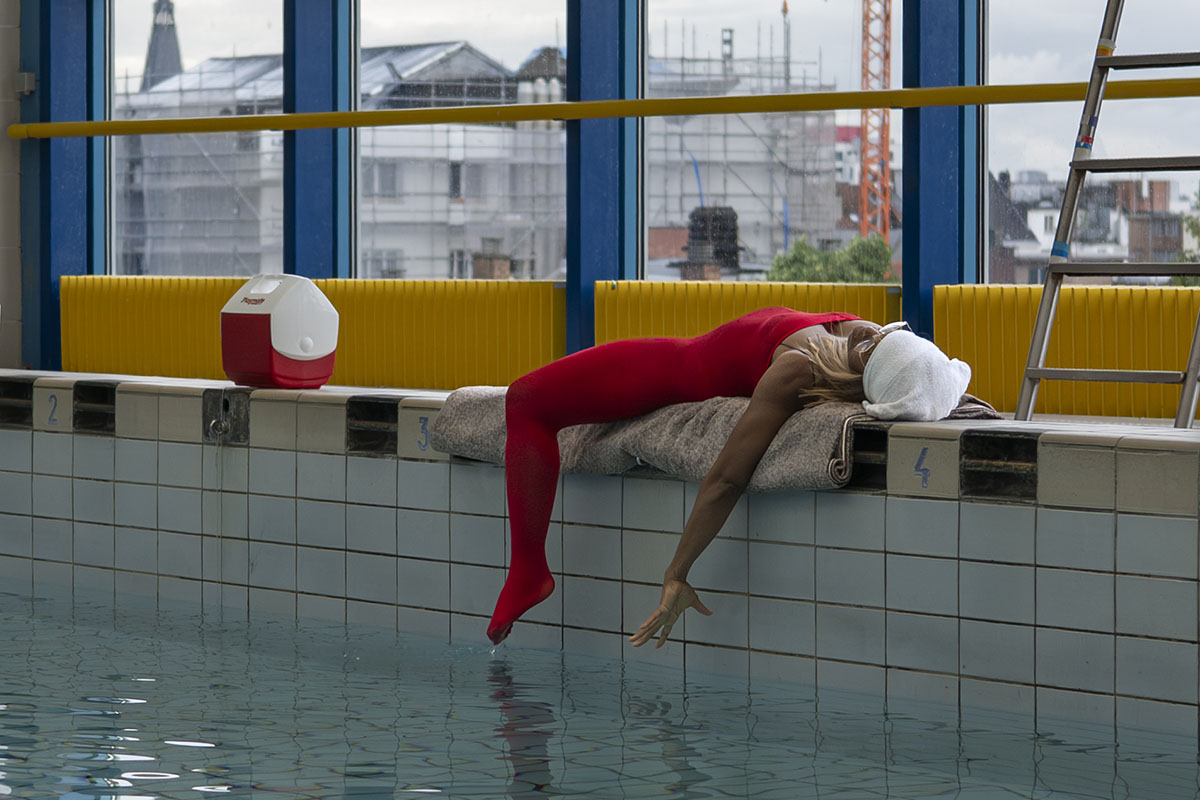
All across Brussels, this year’s Kunstenfestivaldesarts poster is a dive into shades of blue. Going from deep to lighter nuances, as if a clear sky were stretching over a vast ocean, the image invites towards potentialities. No shiny names or enticing titles written there, just a deep plunge into unknown waters.

As some images are becoming more and more opaque to decipher, true or fake melting into an indigestible slop, this immense blue expanse feels like an invitation to hop onboard the festival’s programme and sail towards a variety of landscapes. I enter the first week of the eclectic month-long programme ready to discover a mix of theatre, dance, performance and visual arts. As this 31st edition opens – the last programmed by Daniel Blanga Gubbay and Dries Douibi – movement is at the centre of it all: shifting gazes, moving places, going from an old chapel to the city’s central swimming pool. Let’s see what the journey has to offer.
Bouchra Ouizguen and Dançando com a Diferença: Este Mundo
The vessel first reaches the island of Madeira. Choreographer Bouchra Ouizguen with Dançando com a Diferença, a company bringing together on stage people with and without disabilities, inviting dancemakers to create custom-made works since 2001. Este Mundo opens in a calm, black, empty space, with dim lighting. A dancer with long hair kneels, rolls on the floor, gets up, repeats the same compact sequence in different points in the space, tracing an invisible circle. She’s joined by a second, then a third and fourth woman. Each inhabits a unique score, with a focused presence. Together, they weave a silent collective ritual, an organisation of simple gestures concentrated in the movements of their hands and hair. This dance feels like a prayer addressed to the inner self. The choreography builds a delicate architecture of counterweights and shifting balances. They are united, radiant, the contours of their personalities shine gradually, for the piece allows room for these four singular performers to exist fully, with their joyful humour and aplomb.
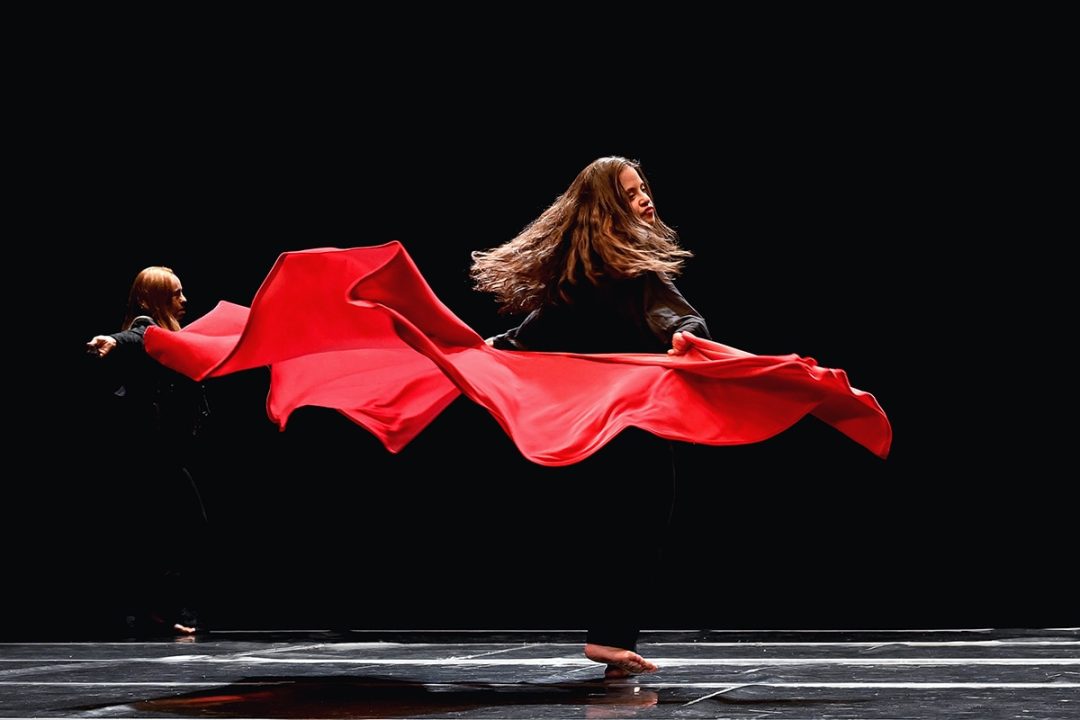
Rupturing the calm, thunder rumbles in the soundtrack and a male dancer bursts into this tightly woven constellation of women. His arrival unsettles the fragile order that had just formed, as he leaps around, interfering with the narrative I had begun to unfold for myself around this group bound by complicity and care. A storm of fabric sweeps across the stage. The dancers run around holding giant capes hovering behind them, disappear beneath the folds before emerging again. Then comes fado. Amália Rodrigues’ voice fills the space, everyone lip-syncs while draping themselves in velvet, becoming a diva for a fleeting moment. Pina Bausch’s aesthetic briefly comes to mind, in the way studied poses collide with ordinary gestures, in a persistent undercurrent of humour. Without warning, the soundtrack veers to Bollywood bonanza. In a comic tableau, the male performer reappears as an over-eager fairytale prince, repeatedly and awkwardly lifting a blonde-princess into the air while bouncing around the stage. Humour softens his presence by displacing it, rendering it ridiculous rather than threatening.
The encounter is a surprising collage, ending in a shared laughter, and if the piece’s energy sometimes stretches too thin across the succession of sequences, what lingers is the quiet beauty of its opening images, the remarkable breadth of the performers’ registers and presences.
Alice Diop: Le voyage de la Vénus Noire
We then sail towards the desk of filmmaker Alice Diop, alone on stage at the Théâtre Le Rideau. She carries the words of American poet Robin Coste Lewis, whose Voyage of the Sable Venus received the 2015 National Book Award for Poetry.
Diop sits calmly behind the desk, placed centre stage. Stacks of books pile up, on Africa, history, blackness. One spine reads Negro. Diop faces us, composed, dignified, alone but not quite, accompanied by ancestral presences materialised in writings and pictures. As she starts speaking, following the thread of Coste Lewis’s text, she gradually summons fragments of black women scattered throughout the history of western representation. Figures relegated to the background of classical paintings, anonymous women turned into decorative objects in sculpture and furniture-making. Around the figure of the ‘Sable Venus’, Coste Lewis’s text puts together an immense poetic archive of deliberate dismemberment and erasure of black women from history. Systemic violence slowly assembles before us. The poet’s research process is profoundly moving: entering museum after museum for years, reading cartels obsessively, writing down every appearance of a black female figure, working with the holes in the narratives, to finally pour it all into a collection of poetry.
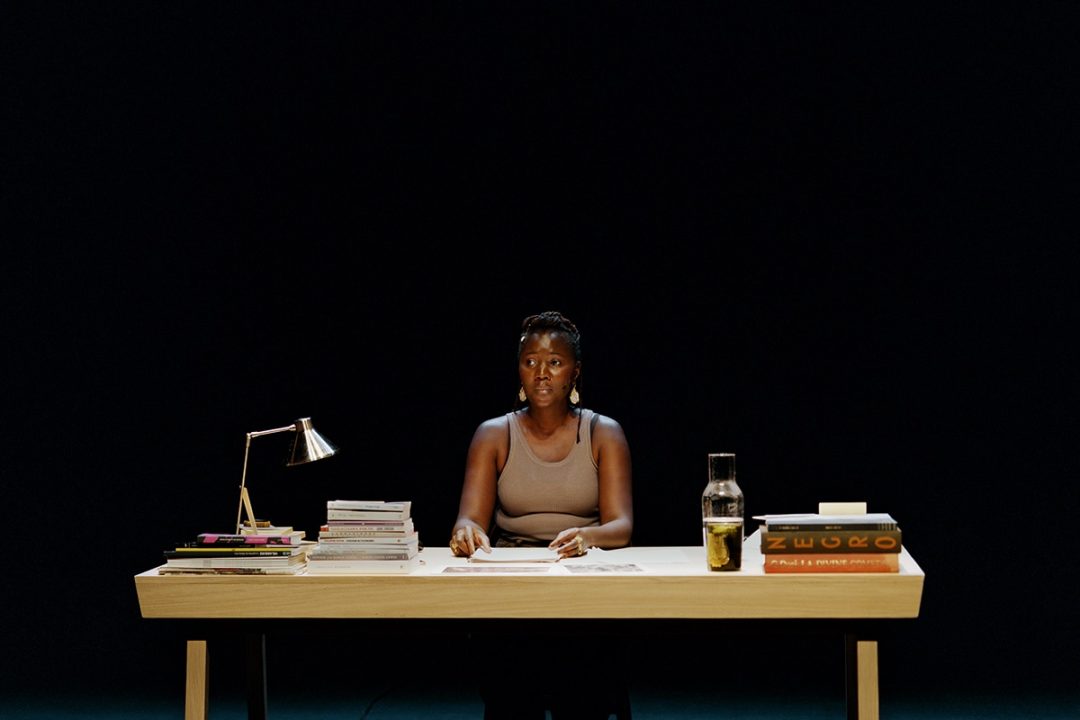
At one point, Coste Lewis describes an imaginary vessel docking outside her New York window, carrying the scattered presences of these women. Diop’s calm, magnetic presence rivets us all along the crossing. Every word seems carefully placed, lightly scored into silence. She evokes the shock of first encountering the poem, the sensation of hearing, finally articulated, something long buried but always present within her, and the inherent necessity to carry the text onstage directly from that moment on. What unfolds here is not an act of accusation so much as an act of sharing facts, data, pieces of ‘the history containing all of our history’. An opportunity to take cognizance, be an informed witness, learn how to look again, differently at paintings, museums, labels, classifications. Diop’s vessel is an arch, working with memory in the present instead of building statues to remember. Both the text and its incarnation unsettle our gaze with such cleverness that by the end, one leaves altered by the crossing.
Dana Michel: YOU CANNOT CAN
It is not often that we are politely instructed to bring our own flip-flops to a dance performance. The rendezvous is with Canadian choreographer and performer Dana Michel, setting sail for Brussels’ central swimming pool, a former public bathhouse. Shoes off, plastic sandals on, we enter the humid space, to discover a large open view on Brussels while sitting around the pool.
Michel is already here, preparing on the side, dressed in a brown latex one-piece swimsuit and white lace stockings, red luscious curls cascading under a cap. She kind of warms up, looking like the star of a poolside music video but awkwardly moving her body around, not at ease in the super tight swimsuit. She tiptoes, rolls a bit on the edge of the pool, stumbles. She steps on icecubes spread over the tiles while taking the mandatory shower.
Nothing ever settles into ease in this dance. Michel attempts to carry out a sequence of actions she cannot fully inhabit. She is never still, never entirely comfortable. She searches constantly at the edge of things. She gears up. Takes off her wig, putting it in a big metallic cooking pot. All objects are carefully organised on the poolside in chromatic clusters: red tights, red inflatable armbands, yellow accessories. Textures and materials matter. Michel composes fleeting images before dismantling them. At one point, she carries a sack of white linen across her back, her gait suddenly evoking manual labour. Time stretches. She delays, dilutes, suspends. Every gesture takes longer than expected to arrive somewhere, often on an erratic path.
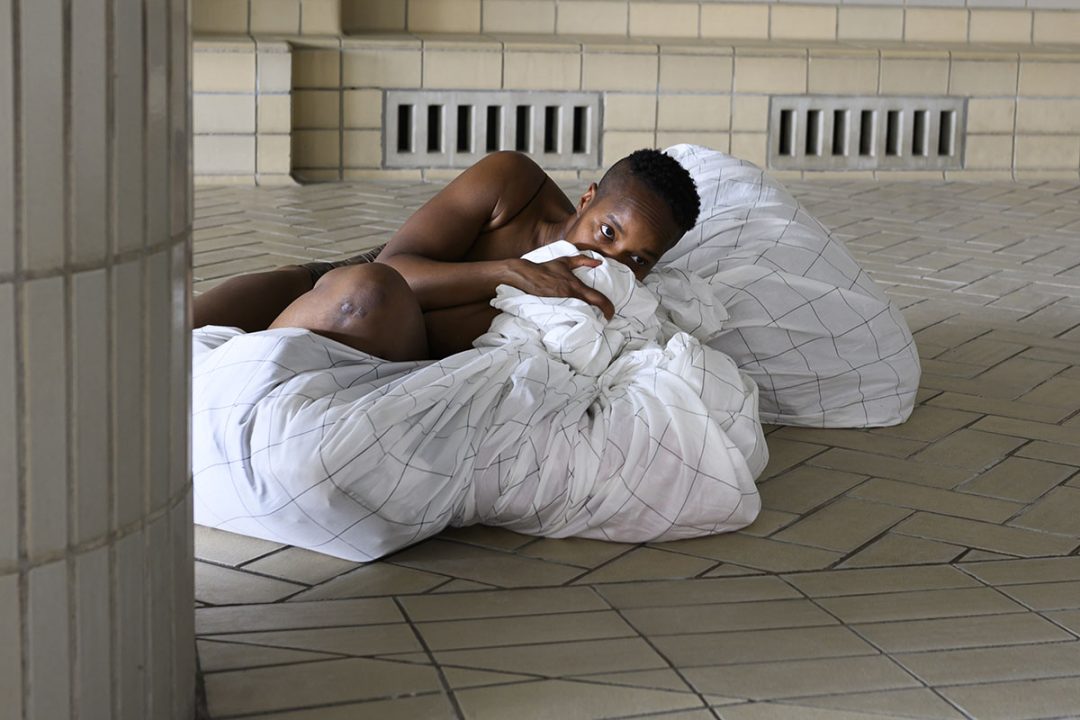
At times, the performance drifts so far from recognisable structure that it becomes difficult to follow. Michel repeatedly brushes against the edges of reality itself, as though checking both her own presence and the world’s solidity at the same time. Her choreography is restless, perpetually unsettled, navigating unstable waters. There are stretches during which the audience begins to drift. Eyes wander towards the ceiling, or down into the turquoise depths of the empty pool. Still, something moving emerges from this strange crossing. Michel evokes in the programme note her difficult relationship with swimming and water, regretting not feeling more at ease within the element that constitutes most of the human body, and which can be a vital skill. In her words also lies the traumatic colonial heritage, making water a battleground of racism. The feeling of her battling becomes a bit more transparent then.
Sounds of breathing, horns, vinyl crackle and vocal calls ripple through the space. At times, Michel wails, summoning distant presences through sound, calling out towards mammals, spirits, other stranded beings somewhere beyond visibility. I wonder if Alexis Pauline Gumbs’ Undrowned – constructing a parallel between black bodies and mammals as allies – was in her pocket at some point in the process. Her body remains fidgety, untranquil, fragmented into partial states of being. Nothing is ever fully resolved. Then comes the ending. Michel gathers herself around the fragile breath of a bandoneon, hidden and wrapped in a heavy checkered parka. Suddenly, all the wandering instability that preceded condenses into something deeply tender. The performance finds a landing place through this powerful possibility of breathing deep, at least thanks to the borrowed breath of the instrument. By the end, empathy for this vulnerable, erratic figure, endlessly trying to secure her place takes over.
Apichatpong Weerasethakul: A Flower of Forgetfulness
When leaving the swimming pool, the vessel mutates into a ghost ship, carrying us towards the seventeenth-century chapel of Les Brigittines, where filmmaker Apichatpong Weerasethakul and his collaborators present a film-installation suspended somewhere between cinema and dreamscape.
As we enter, darkness prevails. Two screens face each other at opposite ends of the chapel, while a large white sheet hangs partially suspended in the middle of the space. A handful of chairs are aligned against the wall, the only place to sit. An enormous scaffolding stands at one end, allowing spectators to climb up and observe from above at any point during the performance. The spatial proposition is clear from the start: choosing one’s point of view, changing it, being in movement for the duration of the piece, is part of the experience.
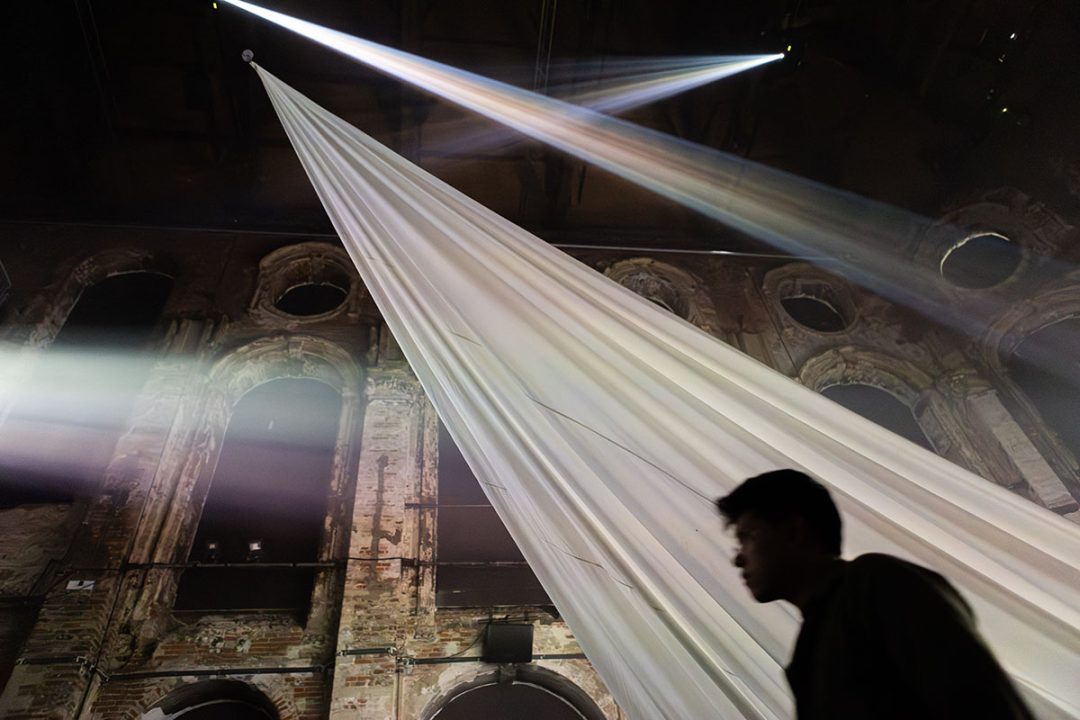
For ninety minutes, we drift through a bath of oneiric images, unfolding like pages from an intimate dream journal. Flames flicker in superimposition across forests and sunsets, setting entire landscapes on fire. Images of a procession filmed in Sri Lanka show people climbing up and down scaffolding set against a red mountain, mirroring our own moves. Smoke gradually fills the space, at first imperceptible. Meanwhile, the white veil moves slowly but surely, making spectators shift position continuously to avoid being swallowed by the drifting fabric and lose sight of the projections altogether. The sound of a distant ship siren can be heard. The veil seems endlessly transformable, resembling a manta ray gliding through darkness, now a giant ghost, now a mosquito net suspended above sleeping bodies.
It is impossible to behold the installation in its entirety at once. Just as we have to choose where to look, what not to watch, where to stand, it offers a unique perspective on the moment. At one point, standing at the very top of the scaffolding, a ray of light cuts through the darkness like a lighthouse beam at sea. Around it, the soundtrack pulses with living textures. What emerges is a sensory crossing, during which the installation choreographs the audience as much as the images themselves, constantly displacing us physically and perceptually.
Ewa Dziarnowska: This resting, patience
An electric blue carpet covers the whole floor of the Bodeek space, a former club. Black chairs aligned in a quadrifrontal disposition welcome us, though some of us remain standing against the brick walls at first, for there is not enough room for everyone to sit. Over the course of the evolutive, three-hour performance, some more chairs will be placed in the space, close to the dancers. Spectators will gently be repositioned by the two performers, space will shift to make room for the dance, to open new perspectives for us to watch from, to reshape our attention.
So how does is start? Leah Marojević stands alone in the centre, her sculptural silhouette wrapped in a breath of a sheer blue dress. She playfully dances, with her arms swaying and hands tracing vivid arcs in the air, to the sound of the famous What the world needs now is love. The song is on repeat. She is joined by Ewa Dziarnowska, dressed in a torn tie-dye t-shirt and ragged jeans. Together, they perform on repeat a lively choreography, full of vitality and sharp outlined movements. From the very beginning, we are drawn into the dance, by exchanged glances and discreet smiles. The invitation remains subtle, not yet seduction, but rather a gentle welcome into a shared space of attention.
And what then, over the next two hours and forty-five minutes? A constantly renewed game, so clever that somehow it never feels long. Variations proliferate endlessly around a 1990s imaginary, in the clothes, in the music. Humour continually surfaces. What does it take to keep a dance alive, to sustain it without exhausting it, to remain intensely present at each second, as a performer? How can pleasure be maintained without overperforming it? How to play, without overplaying? These questions slowly crawl and shine at the centre of my attention as the piece goes on. This is what feels at stake in the performance’s immense blue crossing, the constant and organic renewal of a dance, relying on a well-designed dramaturgical structure. The flow goes through several costume changes, manipulative lighting effects, resting pauses without dance. Throughout, vitality pulses from constant attentiveness, to rhythm, to repetition, to tiny shifts in energy between the two impressive performers.
It is of high mastery, this constant engagement into the dance. Marojević and Dziarnowska agitate the molecules in a choreography sometimes evoking clubbing and raving slowed to an elastic dream-state. As time stretches we drift between hypnosis, drowsiness, curiosity, frustration, excitement and renewed engagement. Bells shimmer faintly in the soundtrack, dogs bark in reverb. Again and again, they relaunch the dance. One final sequence. Then another. Then another still. Marojević’s body seems capable of infinite variation, windmill-like arms slice the air, seaweed-like limbs open into unexpectedly tender images. Around her and Dziarnowska, humour floats lightly through the performance. Perhaps what proves most moving is the piece’s extraordinary commitment to attention itself. Through subtle unisons, repeated gestures and endless recommencements, the performers continually activate our capacity to keep watching, keep feeling, keep remaining with the dance, while offering a resting zone.
Marlene Monteiro Freitas: Nôt
Finally, our vessel plunges into the night. High action is already under way when we enter the world of Cape Verdean choreographer Marlene Monteiro Freitas. We are catching the eight performers mid-motion, as though the performance had been unfolding long before we enter the room. They are busy, walking across the space, moving objects, getting dressed, addressing silent speeches. A colour code governs the landscape: cardinal violet, green, black, red and white. The stage could be a hospital ward, a fever dream, or the aftermath of some unnamed ritual. Small beds covered in white sheets line the space alongside basins, urinals and white metal grids. The bodies circulate through this strange infirmary without ever settling, neither into a narrative nor into a string of actions.
The piece proceeds through abrupt changes of scale and focus, as though operating a perpetual zoom lens, from tiny details to monumental tableaux, from intimate trios to sprawling frescoes. At times, the performers themselves seem to shrink into miniature figures manipulated like marionettes. Voices distort into cartoonish sound effects, bodies become noisy, excessive, grotesque. And yet, beneath the apparent delirium lies an extraordinary compositional precision. For years, Monteiro Freitas has worked with puppet-like bodies, exaggerated facial expressions and virtuoso accumulations of costume, make-up and gesture. Here, layering is present from the beginning, one material constantly overlaps another, several planes of action remain simultaneously active, images continue unfolding behind images. The remarkable achievement of the piece is that multiplicity never collapses into disorder. I remember interviewing Monteiro Freitas ten years ago; asked how she constructed her performances, she answered with an unexpected keyword, chorizo. Fill the space to the brim with materials, images, music, movement as one would do in charcuterie-making. A decade later, the principle of abundance remains, the chorizo has become intricately structured, micro-stories slot into one another like infinite nested tales.
Mirrors and spotlights repeatedly blind the audience, beams suddenly isolate spectators inside violent cuts of light. There is a lot going on, our focus is persistently drawn elsewhere on purpose, distraction and illusion are necessary decoys to hide some horrible actions. With this clear manipulation of attention we are at the heart of The Thousand and One Nights tales in which Scheherazade has to perpetually narrate and divert to save her own life. Rather than illustrating ideas directly, Monteiro Freitas seems to grind them through successive choreographic filters and prisms until they mutate into stranger forms, while still retaining traces of their original charge. Just as an image intensifies, something elsewhere whistles, a siren erupts, drums roll. The performance constantly shifts from gravity to pantomime, from horror to absurd comedy. Again and again, bloodstained sheets are rolled across the stage, as though attempting endlessly to conceal what still remains underneath. Eventually they resemble shrouds laid side by side on the floor, perhaps sheltering tiny absent bodies. War flickers there. So does the blood of violated virginity.
Much of the imagery is unsettling and polysemic. Certain masks evoke Asian theatrical traditions, fragments of music seem to drift from distant places. Everywhere, tensions accumulate through embraced contrasts, softness and brutality, ceremony and vulgarity, childish play and terror. What remains most striking is the way Monteiro Freitas sustains all these charges simultaneously without ever resolving them. The performance refuses simplification. It insists instead on the density of this night. Festive, bloody, pitch-black. Shining like a masterpiece at the end of a long journey. ●
08–30.05.2026, Brussels, Belgium