

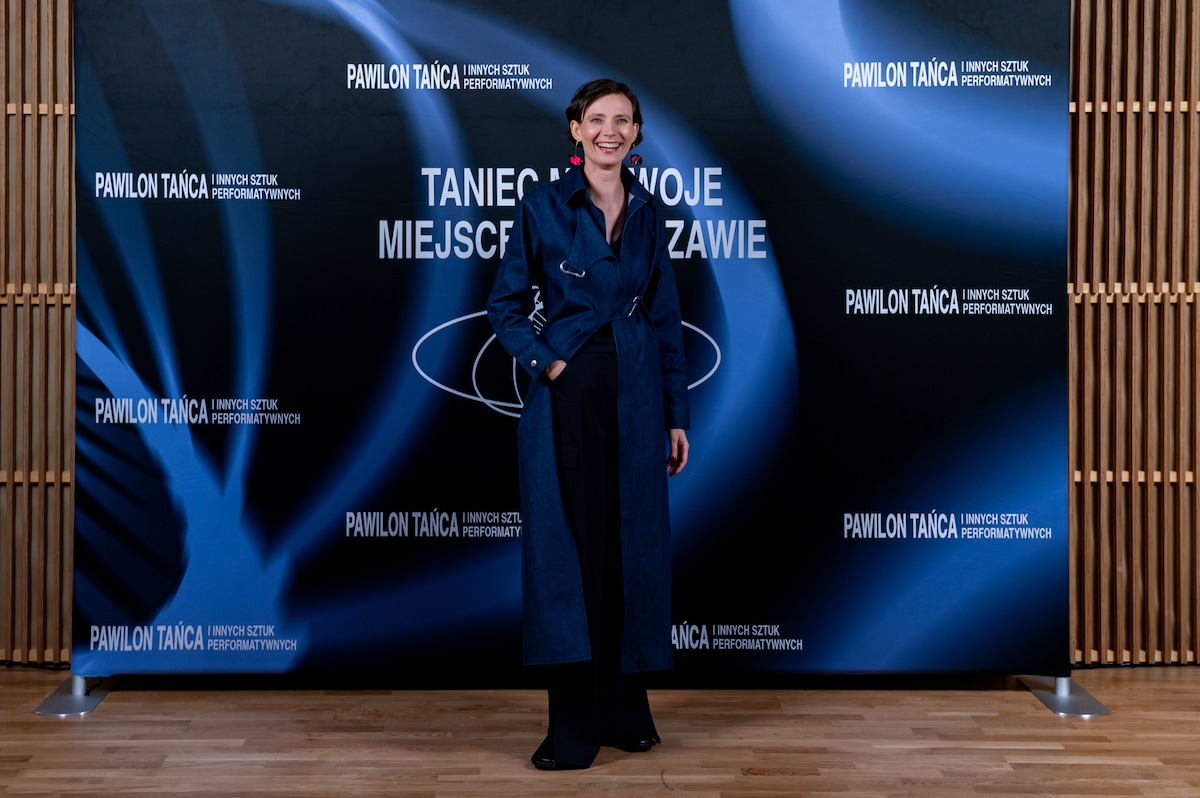
Pawilon Tańca, Dance Pavilion, Táncpavilon – three names in three different languages, but the same wondrous phenomenon: a newly opened dance theatre in Warsaw. When a group of international dance critics gathered in the Polish capital at the beginning of September 2026, there was no question about where our first visit would take us.
‘TANIEC’, announces the sign proudly atop the white box-like building standing on the banks of the Vistula. Indeed, since the beginning of the year, Warsaw has had its own theatre – or, more precisely, its pavilion – dedicated to ‘dance and other performing arts’. In 2023, following prolonged lobbying by members of the local dance scene, the cultural department of the Polish capital’s municipality called on representatives from the sector to engage in joint discussions. As a result of the consultations held between September 2023 and March 2024, the political leadership increasingly recognised that dance is an autonomous art form which serves the city and its residents in numerous ways, and as such deserves its own venue, alongside stable funding conditions.
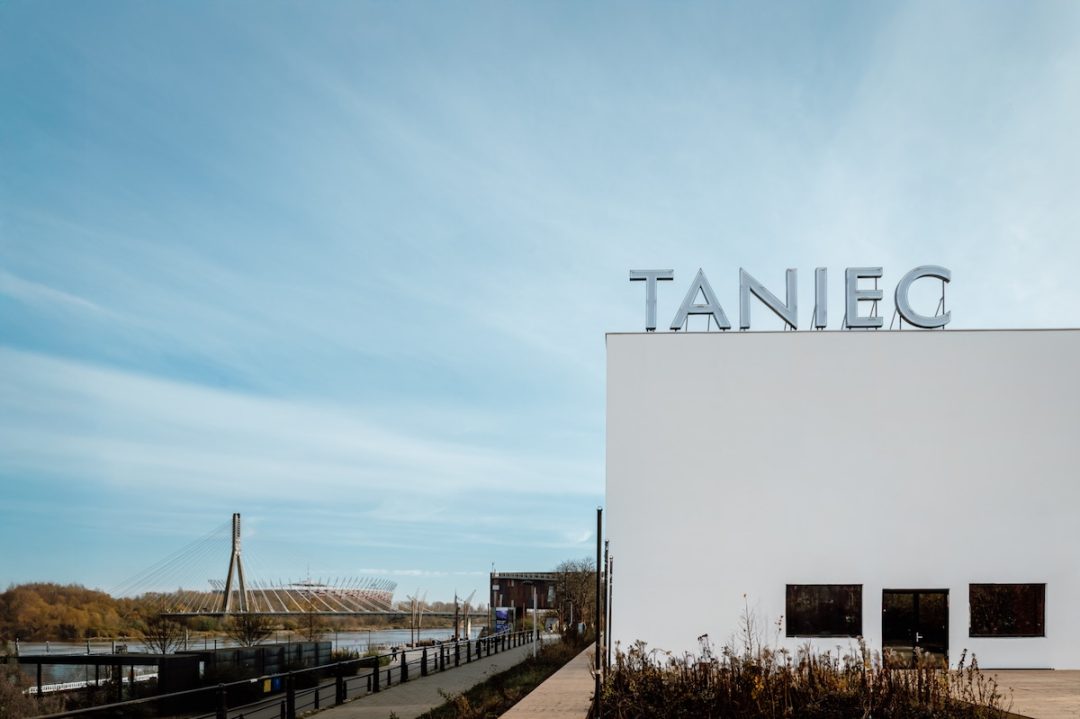
Given the state of politics in my home country of Hungary over the past 16 years, this outcome seems quite utopian to me, as do the further developments of 2024: it was then that a call for proposals was issued for the operation of the Pavilion building, part of the Museum of Modern Art in Warsaw, as a dance theatre. The call concerned the development of a one-year ‘pilot programme’, and the winners were a trio of curators: Alicja Berejowska, Renata Piotrowska-Auffret and Joanna Szymajda. The following year was devoted to the conversion of the building – designed by the Austrian architect Adolf Krischanitz – to make it suitable for hosting dance performances, and in early January 2026 the Dance Pavilion opened, kicking off with a performance by a major international name, Christos Papadopoulos’s My Fierce Ignorant Step.
‘
I discovered numerous parallels with the history of the Hungarian scene
The establishment of a new dance theatre would be a cause for celebration for dance lovers anywhere in the world, but to truly understand the significance of this moment in Warsaw it is worth taking a look at how the state of Polish dance evolved around the turn of the 20th and 21st centuries. This September, while my colleagues and I were in Warsaw for the annual Springback Assembly, Renata Piotrowska-Auffret, one of the members of the winning curatorial trio, walked us through the country’s recent dance history, as well as the building itself. While Renata recounted the past decades in Paloma (the Pavilion’s cosy bistro), I found myself nodding vigorously, as I discovered numerous parallels with the history of the Hungarian scene.
Just as in Hungary, in Poland too only ballet and folk dance were allowed to flourish before the fall of communism, while modern dance styles were largely unknown or simply not supported. After 1989, as people became acquainted with the new dance styles of the twentieth century, the first modern dance companies and festivals were established. However, it was the country’s accession to the EU in 2004 that gave the scene a real boost: many dancers and choreographers went abroad to study, returning home with fresh inspiration. Newly available funding and the emergence of various non-profit organisations helped to facilitate the founding of further companies, platforms and festivals. Meanwhile, dance education also developed: a dance department was established at the Warsaw Academy of Music in 2004, followed by a choreography department in 2011, and a number of alternative training programmes began to appear in the provinces as well.
At the same time, dance continued to achieve its greatest successes in collaboration with other art forms, and it was largely dependent on drama theatres or multi-purpose venues. At Studio Teatr, located in the Palace of Culture and Science – a symbol of Warsaw – the series entitled ‘Dance Stage Studio’ ran from 2015 to 2020, while the Nowy Teatr organised the choreography programme ‘Widening the Field’ between 2017 and 2022. The latter was curated by Joanna Leśnierowska, who over the past decades has played a key role in many respects in the Polish dance scene. Starting from 2004, she ran Poland’s first dance theatre, Old Brewery New Dance, in Poznań, for 17 years; she was one of the country’s first professional dance critics and, incidentally, also played an important part in the negotiations leading to the establishment of the Dance Pavilion.
The pandemic, of course, did not spare the Polish dance scene; yet by the early 2020s, the local dance community had managed to strengthen its ties with the Warsaw city authorities. It is worth noting that although Poland was led by the conservative, populist Law and Justice Party between 2015 and 2023, the capital remained a stronghold of the opposition throughout this period. This is one of the reasons why the Dance Pavilion project got on track from 2023 onwards.
‘
The managing team has already realised 160 programmes this year
Since January 2026, the institution has been racing ahead at full throttle: in line with the commitments made in their application, the managing team has already realised 160 programmes this year, including six local premieres and numerous guest performances from abroad. However, the Dance Pavilion’s activities are by no means limited to staging performances. As part of its educational programme, it organises dance classes and workshops for all age groups, from children to senior citizens. Furthermore, it places great emphasis on the community aspect of dance: the programme offers a wide range of activities, from sober raves through intergenerational parties to baby discos. So far this year, they have issued around ten calls for proposals, including for artist residencies and creative programmes for families or for people with special needs.
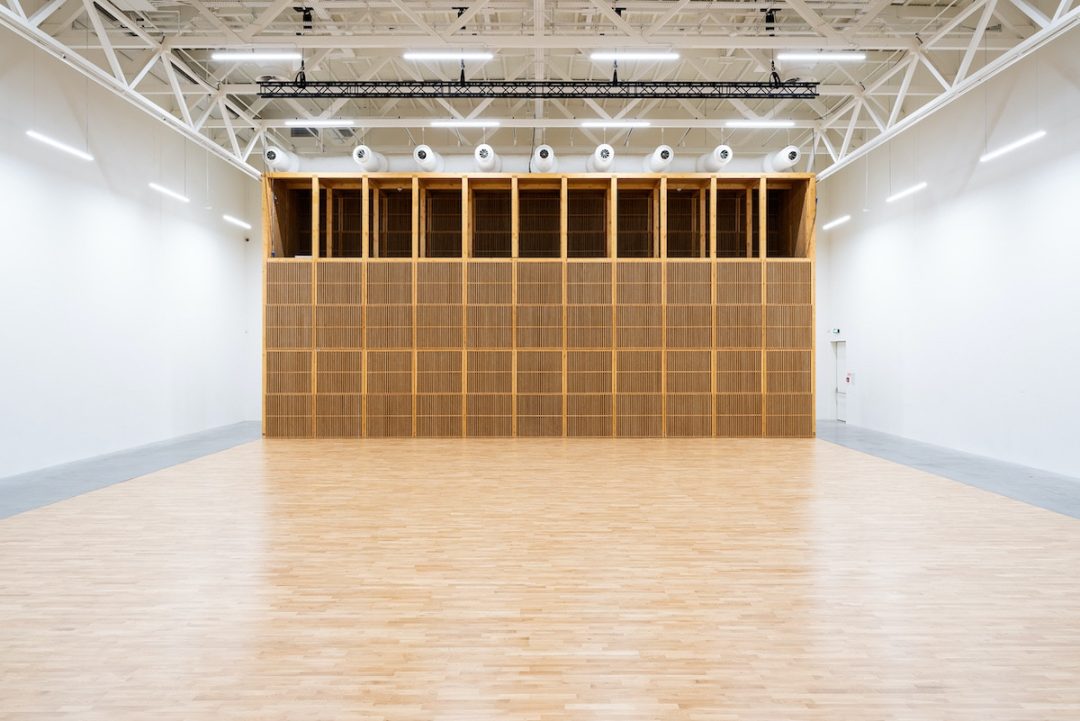
The Dance Pavilion is already a bustling, vibrant venue that is becoming increasingly popular with audiences. On the downside, the building has only one auditorium, with a maximum capacity of 230, which is used for all events. It is a bit of help that, thanks to the building’s location, it is suitable for hosting various outdoor programmes; during our visit, for example, we were able to attend choreographer Weronika Pelczyńska’s community performance Vistula, which was staged in the park behind the Dance Pavilion, situated on the riverbank. Meanwhile, the theatre’s small team is making some adjustments to its operations based on the experiences of the first few months. For the coming season, for example, they have not planned any new premieres; instead, they are focusing on keeping previous productions on the programme, as the longevity of contemporary dance performances is a problematic question – in Poland, as almost everywhere else in the world.
Following the success of the pilot programme, the venue has secured the funding required to operate for the coming season; however, for stability and longer-term planning, a more predictable funding cycle of at least three years would be ideal. Judging by the number of programmes and visitors, it is also clear that the establishment of the Dance Pavilion was justified and necessary, though due to the limitations of the space it cannot, on its own, meet the needs of the local dance scene and the wider community that has developed around it.
‘
The whole building is permeated by that optimism and momentum which is unique to new undertakings
As a visitor, however, little of these difficulties is apparent. Just as Renata Piotrowska-Auffret spoke with a twinkle in her eye about their achievements to date and their future plans, so the whole building is permeated by that optimism and momentum which is unique to new undertakings. Our visit coincided with another little triumph: the theatre’s own lighting rig arrived that very day – previously, they had been using hired equipment for their programmes. As I stood there in the auditorium, beneath the flashing, coloured lights, facing the excited technicians, I found myself hoping that the past few months at the Dance Pavilion would mark the first chapter of a long-running success story.