

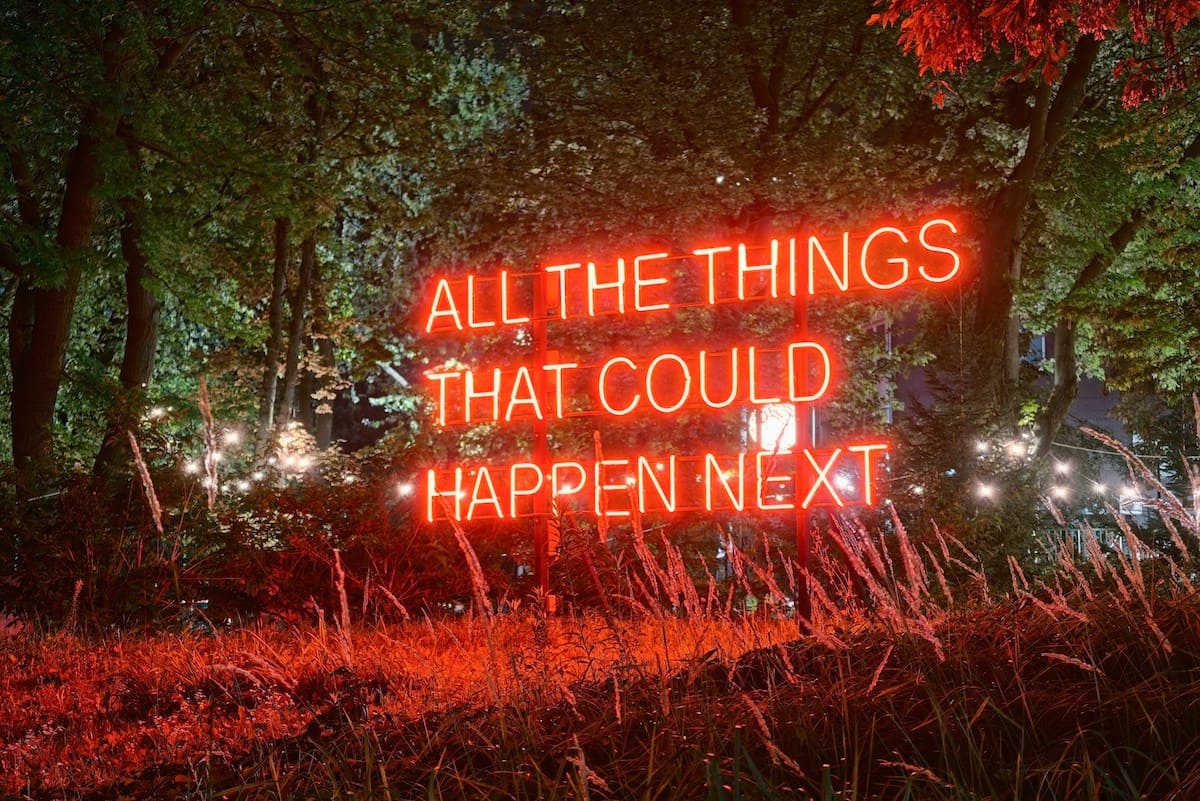
It’s September 2046, twenty years after the tenth and last edition of Generation After in Warsaw, The summer of 2026 had been the hottest on record. But as one of the festival’s performances had predicted, it would be the coldest summer of the next twenty years. They were not wrong. But what they didn’t know was how hellish it was really going to get.
The Fascist Wave that swept through the continent at the end of the 2020s ushered in the first Great Depression in Dance. Many of the field’s landmark theatres were forced to close, or to convert themselves into public institutions that ‘served the people’, as the motto of the AfD had it. Sadler’s Wells, the Volksbühne and Tanzhaus nrw were all transformed into data centres, Théâtre de Chaillot and Mercat de les Flors were repurposed by an international property conglomerate headquartered in Israel and specialised in the creation of luxury resorts for the Mega Rich, and International Theater Amsterdam morphed almost overnight into the headquarters of Google’s new Motion-Therapy Division. It all happened so fast that no one seemed to notice. And those that did were so consumed with trying to survive by working five different zero-hours contracts, to pay ballooning rents and astronomical bills (a result of the Second Iran War), that they had no energy left to put up a fight.
People vaguely remembered a time when the now disbanded European Union declared culture to be a human right. They talked about artistic mobility grants that allowed artists from all corners of the continent to forge networks and find audiences in places they had never even heard of before. They spoke of times when programmers and policy makers would craft ingenious ways to expand the reach of dance, to include as many historically marginalised voices as possible on the continent’s stages. They remembered producers and distributors working all hours to bring the most exciting new dance works to as many people as possible, even if it meant burying themselves in a burnout in the process. It was an era, they said, when everyone was committed to finding ways to make work less precarious, behaviour less transgressive, and artistic careers more sustainable. All this was now but a thin thread of memory in the minds of a few greying old curators. Walking around the overgrown and hollowed-out shells of buildings that once housed the European Institutions, you could sometimes find old policy documents in derelict filing cabinets, inscribed with well intentioned but chronically careful cultural directives that wanted to go far, but could never go far enough.
Warsaw, however, had managed to survive as one of a handful of City Island States, independently governed municipalities that had managed to gain independence from the Great Nation States of the Fascist Wave, preserving some shred of a chronically underfunded cultural sector in the process. The city’s once hip and well designed theatres, such as the Nowy Teatr and the Dance Pavilion, were now hellishly hot and poorly maintained, spaces where dancers with fungi flowering over their feet (training conditions had become swelteringly humid) would reminisce of times in which they could still get invited to an audition. Most of the choreographers still at work now used Apple’s latest hiring software iHire to recruit Human Dancers – a database containing the specifications of each and every non-AI dancer. All you had to do was to input the body type you needed – male, 188cm, caucasian, trained in ballet, modern and contemporary dance, easy to work with, obedient etc – and iHire would offer 40 suitable candidates within seconds. Even though each search would cost the software 2 litres of water to execute, this way of recruiting was deemed far more climate friendly than asking 200 humans to take a flight to Paris from 200 different corners of the continent. There were a few perks to the apocalypse, it seemed.
People sometimes remembered the good old times when they felt like they’d seen a show after having watched a 10-second reel of its most visually striking moment on Instagram. Now, with CultureBrain (Microsoft’s new tool designed to make culture more ‘accessible’), it was even possible to upload a show directly into your skull without watching anything at all, to feel exactly as if you’d been sitting in a theatre, even if you hadn’t left your bed in days. Trajall Harell, Tanz, and Tragédie were reduced to trails of computer code ticker-tapering through your brain, realer than any reel you’d ever seen. CultureBrain made it possible to feel the reactions of the hundreds of thousands of spectators, whose data had been mined to build the system, as they flashed through your dopamine craving veins.
The last dance critic had stopped writing in 2035, the last dance magazines having already run out of funds (and the will to go on) in 2029. Why would anyone ever need to read about a show if they could download everything about it directly to their brain in a split-second? CultureBrain did, however, come at a price: subscriptions started at what would’ve amounted to 259.99€ a month. This made it affordable only if you were part of the newly enfranchised Upper Middle Class. The 2032 Dramaturge Uprising tried to challenge this, claiming that such technologies were fundamentally opposed to the values of accessibility and artistic freedom upon which European culture was founded. But though the movement grew to include hundreds of thousands of dramaturges (it seemed like everyone in the Cultural Sector at the time was a dramaturge), it was quashed by the parties of the Fascist Wave just as it was getting off the ground. These technologies don’t change anything – went the official policy line – culture is still a human right, and now it is available and accessible to everyone, everywhere, at any time.
Yet the passion for Live Art that had fuelled the European cultural sector for most of the twentieth and early twenty-first centuries still burned in the hearts of a few bleary-eyed artists and art workers who resided in the City Island States, even if only a scattering of theatres still showed live performances outside these urban oases. In the late 2020s people had thought it impossible that one day dancers would be replaced by Artificial Intelligence. Literature: yes. Photography: sure. Music: of course! But live, living bodies moving around a stage, beads of beautifully human sweat pearling upon their foreheads: this was fundamentally human terrain. Almost everyone agreed with that.
And yet, almost as soon as this idea had formed, Meta (in heavy competition with Huawei) released the prototype of NijinskyOne, a dance robot with real skin, sweat and tears, trained to execute every dance move in the entire History of Dance with virtuosity, precision and bucketfuls of feeling. You could switch it on and off, you didn’t need to pay it, and it never got tired. La Monnaie had already bought an army of them after the last and final round of budget cuts, and had been showing Giselle on repeat since September 2033. The audience could enter and exit at any hour of any day and stay for as long as they wanted, all for the price of a single ticket. Some stayed for days, some even months or years (housing was scarce and rents had sky-rocketed). The leaders of the nationalist Fascist Wave hailed it as the Greatest Theatrical Innovation ever made.
Still, even before the Great Depression of Dance, people had noticed that the spectrum of possibility in dance had narrowed. As early as 2026, it often felt like artists were making the same shows over and over again, the same cliches ricocheting from one rehearsal space to another – another show about the tragedy of queer love, another show which should’ve just been an Instagram reel, another inclusivity project which was only accessible to people with enough time and money to be able to donate their labour for free. Do what sells, the market said. Take every opportunity you can get. Find your trademark and milk it. Squeeze every last cent out of your mediocre idea and network until you have the entire dance world on WhatsApp. And though we encourage you to take Risks, do be aware that any Risk you take is at your own risk. The risk of a Risk putting the nail in the coffin of a career hovered like a spectre over creative processes across the continent.
So it may not come as a surprise that after the fall of the now forgotten institutions that had brought this system into being, the dance artists who were still alive were actually somewhat relieved, even if they were poorer than ever. They knew they were never going to make a living from their art. That was crystal clear now. Some of them knew that they might not even live beyond next month’s rent instalment. And so a liberated FUCK IT attitude spread like a devilish little plague throughout the dance communities of the City Island States and people began producing works that would be hard to describe to you here because you do not yet have the body or mind to be able to comprehend them. Let’s just say they were daringly, dazzle-ingly full of dance. They were full of risk. They insisted. They persisted. They didn’t care if they failed. In fact, they drank the sweat of all those failures and turned it into life affirming choreographies, dripping with necessity. Everything had already been lost, thought the generation after Generation After, so there was nothing left to lose. What the hell were we ever worried about?