

Dance Umbrella 2026 opened with a question: ‘What if we redistribute our ability to decide where the centre is?’ At the festival’s launch reception at Sadler’s Wells East (itself a recent addition to London’s dance infrastructure), British Council’s Isabel Moura Mendes cited the festival’s ‘Curating in Context’ keynote panel discussion on dance curation – a question of who gets to define what is mainstream, and the institutional assumptions that maintain the status quo.
Dance Umbrella’s newly rebranded ‘Sightlines’ programme (formerly ‘Diversifying Curatorial Stewardship’) is one answer, providing career development for global majority, female-identifying and non-binary curators through curatorial opportunities. This year’s guest curator, Anthea Lewis, put Black British social dance and music cultures in focus with ‘Touch The Floor’, a one-day programme in the festival lineup tracing the social cultures, dances and spaces that have shaped British culture. Another answer is Dance Umbrella’s digital programme, providing online access to the festival’s digital programme of contemporary dance films, documentaries and artist talks.
Both are concerted efforts to expand how audiences and practitioners alike access and shape dance in a shifting landscape.
Lizzy Tan
Within a programme that included talks, films and performances both in person and online, our Springbackers caught up with some of Dance Umbrella’s live shows.
Mamela Nyamza: THE HERD/LESS
Sadler’s Wells East
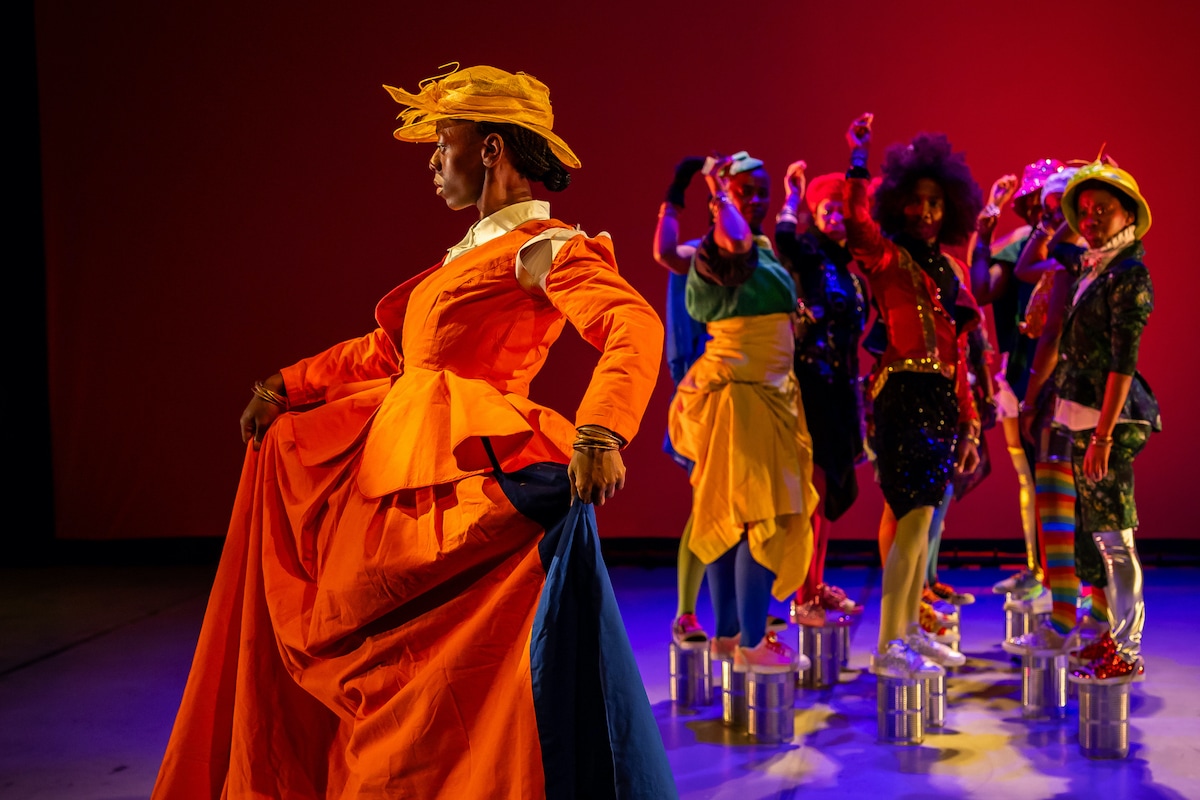
South African choreographer and 2026 Venice Biennale Silver Lion winner Mamela Nyamza’s THE HERD/LESS opened the festival with a bang and bright colours. Eleven vibrantly costumed dancers trudge and sway across the stage as one shimmering mosaic, tin cans strapped to their feet. The resulting score is both rhythmic and cacophonous, emphasising the shared power of bodies moving together and hinting at the dissonance that emerges when that unison unravels. The piece’s title is layered: a play on ‘herdless’, a leader without a group, or ‘headless’, the collective without direction.
A bleating whistle keeps the flock in check – their coordination is being managed, not chosen. The formations shift and splinter, and so does the soundscape – thundering percussion giving way to crescendoing vocalisations as the procession winds on. Suddenly, the stage is cast in a warm pink glow, and the anti-apartheid anthem ‘Paradise Road‘ plays. It’s the only moment the piece uses recorded sound, or where the lighting shifts beyond a bright white glare.
Then, two figures spin out from the group. One saunters against the flow in a voluminous orange, white and blue gown. In the post-show talk, Nyamza says this represents the ‘Oranje-Blanje-Blou’ of South Africa’s state-sanctioned apartheid era. The other character is dressed in an all-white suit, balancing an upright spear on their palm. This tenuous equilibrium introduces precariousness against the herd’s steady march. It also gestures to the symbolism of white in South Africa’s current flag – THE HERD/LESS suggests that peace and unity are a balancing act.
Lizzy Tan
Jack Anderson & Charlotte Mclean with Malin Lewis: not for glory
Cecil Sharp House
In not for glory, Jack Anderson and Charlotte Mclean interrogate their respective trainings in Irish dance and Scottish highland dance. What starts as a show of technical mastery becomes a reflection on practices that are inseparable from historic suppression and the modern competition circuits which preserve them.
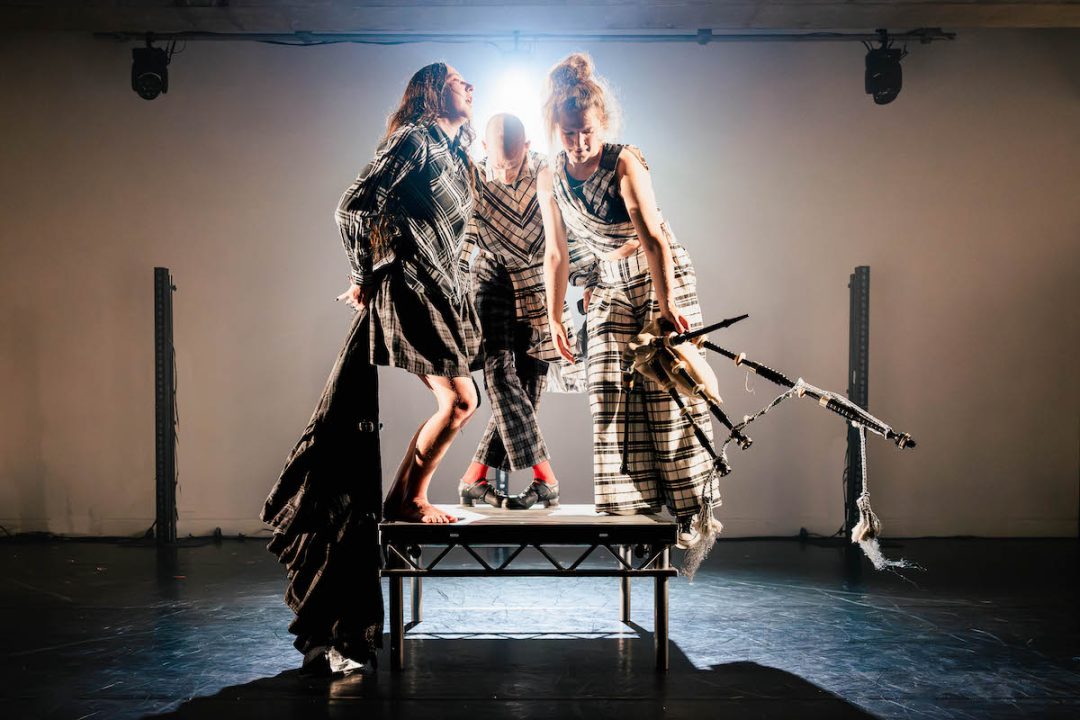
The piece opens with Anderson, Mclean and collaborator-composer Malin Lewis rotating in place on a raised platform. As a heavy bass throbs, feet dart and hover, shins fold like fans and knees jackknife. The music distorts and performers wilt across a second platform, giving the sense that time is warping and looping. Wry nods to Scottish tropes (Irn-bru, haggis), namechecks (folk dance revivalist Mary Neal, the performers’ teachers) and historic events (Scotland’s 1746 kilt ban, the Irish Free State) map the piece’s thematic territory.
What saves not for glory from becoming pedantic is Mclean and Anderson’s sharp sense of humour. Mock announcements (parking violations, dance competition announcements) scaffold looser, abstracted dance solos that both skewer the competition format and inform us on the performers’ backgrounds. Lewis’s approach differs: they treat the bagpipes less as a heritage object than as material to be dismantled and reassembled, aiming the instrument as if it were a gun, then disembowelling and reviving it with mock CPR.
Each performer’s deconstruction of classical forms ultimately tilt the piece’s gaze to the future rather than to the past. But if ‘not for glory,’ then for what? Anderson’s answer (‘for fun’) sits uneasily between inheritance and self-indulgence – a sweet but sticky middle ground for the three performers.
Lizzy Tan
Arno Schuitemaker: After After
The Place Theatre
Refreshingly, After After by Dutch choreographer Arno Schuitemaker communicates by material means – movement, sound, light, space, and their composition – rather than, as with so much contemporary performance, relying on a matrix of words, images and ideas.
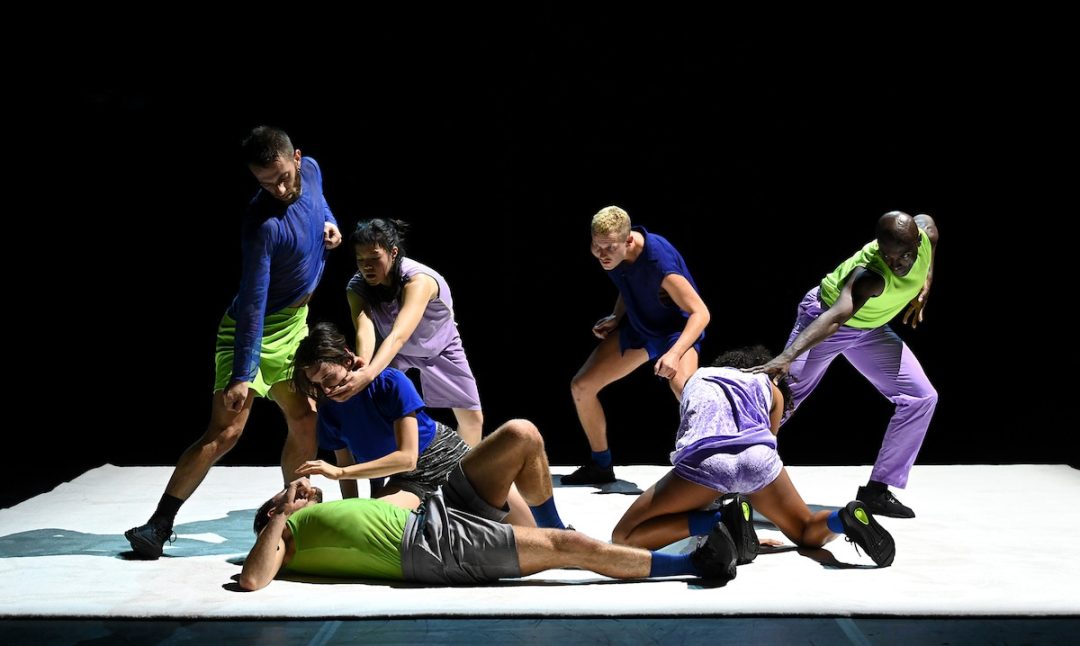
The composition is commendably clear; a sequence of scenes that starts with a horizon of light traversing a shadowed stage, and pivots part way through to cast a brightly lit rectangle upon the floor. Initially the dancers – seven in all, entering and exiting – are also shadowed, silhouetted, often obscured; after the pivot, they are more illuminated, revealing colour-coordinated costumes in azure, lime and lilac, and instead of being engulfed in darkness they cast their own sharp shadows. The ambience is clubby, and the pre-pivot music builds and builds upon its own insistent downbeat; post-pivot, the sound is more variable in tone, volume, speed and style.
And the choreography? Clubby too, but highly controlled: torqued torsos, planted feet, weight that pumps down through the legs or out through the arms. Each dancer is different, each distant, repetitively self-absorbed within their auras of clubland cool – yet unified by that downbeat, which galvanises them with evenly timed jolts of energy. And then there’s the pivot, after which they seem to face outwards or towards each other and their shadows. The feel is still of vitality constrained within structure, but now on a more human, interpersonal scale, and if the end is somewhat arbitrary, the sequence has been strong and fascinating.
Apparently, it’s based on a philosophical idea, which is fine: no one needs to know that for the performance to be as effective as it is.
Sanjoy Roy
Theatre-Rites & Miguel Altunaga: Eshu at the Crossroads
The Place Theatre
Joining forces for Dance Umbrella’s family-friendly offer are Theatre-Rites, leaders in puppet theatre for children, and Cuban-British choreographer Miguel Altunaga.
Eshu at the Crossroads takes inspiration from the west African Yoruba culture, specifically Eshu, the spirit of judgement, duality and crossroads. The foundations are laid for exploring good and evil, and the conundrum of a difficult decision. To the audience, however, the narrative feels blurry; I wonder how 8-year-olds are following while I muddle through myself.
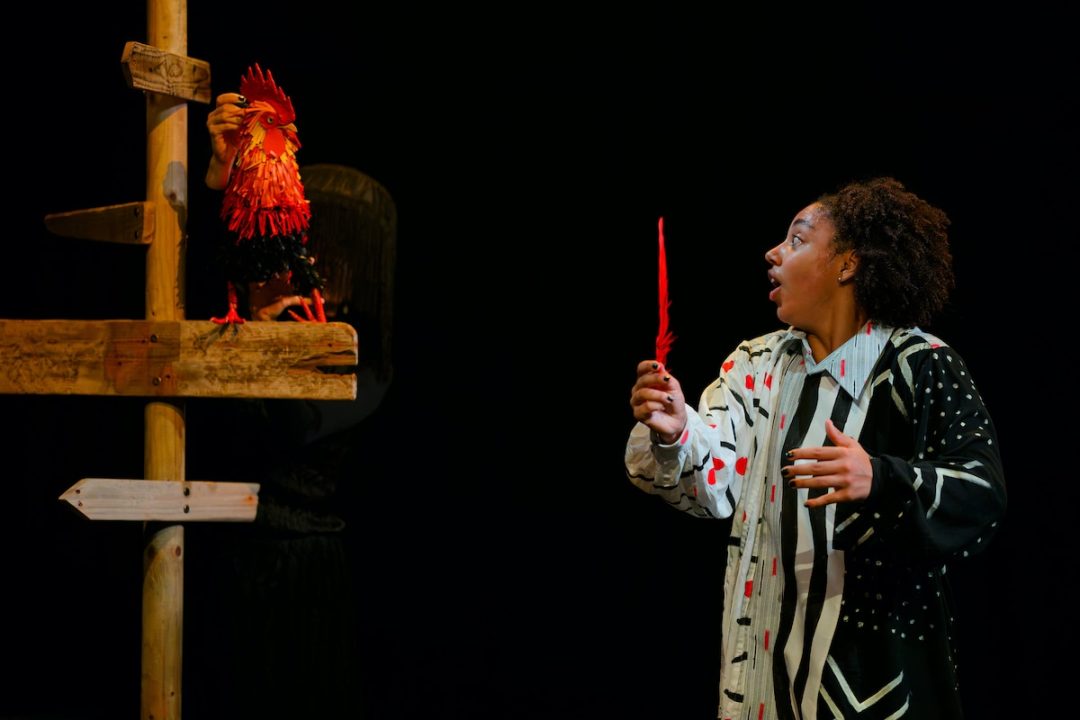
Xia Husbands is a cheeky, springy traveller, curiously without any luggage and instead nabbing bags from the audience. Edie Edmundson and Amari Webb-Martin, dressed head-to-toe in black tassel, play the trickster spirit who slinks and lurks at the crossroads with slippery intentions.
With every discovery comes a distinct physical language. Wooden crossroad signs send the travellers’ limbs into a jagged, geometric tangent, while the appearance of a white spirit instils in her the lightness of a sweeping feather. She dodges the pecks of a naughty puppeteered chicken while a black and red coat inspires a dual personality. Puppetry lends itself well to young audiences, who delight in a trickery of perspective so excellently manipulated by the trio.
The traveller eventually finds her way, still luggage-less but with a new friend by her side, and only slightly dishevelled. Eshu as a theme is rich and ripe with opportunities to integrate learning for young audiences, yet an undefined dramaturgy leaves children a little confused about the overall message. In the meantime, all ages can enjoy well-crafted theatre for the sake of pure entertainment; you are never too old for a little wonder.
Georgia Howlett
8–24.10.2026, London, UK
Dance Umbrella’s online programme of talks, films and performances continues through to 30 November 2026: danceumbrella.co.uk/festival/?eventfilter=&eventcategory=50 (including a recording of the Curating in Context panel)
For an interview with Arno Schuitemaker about After After, visit danceumbrella.co.uk/2026/10/14/in-conversation-with-arno-schuitemaker