

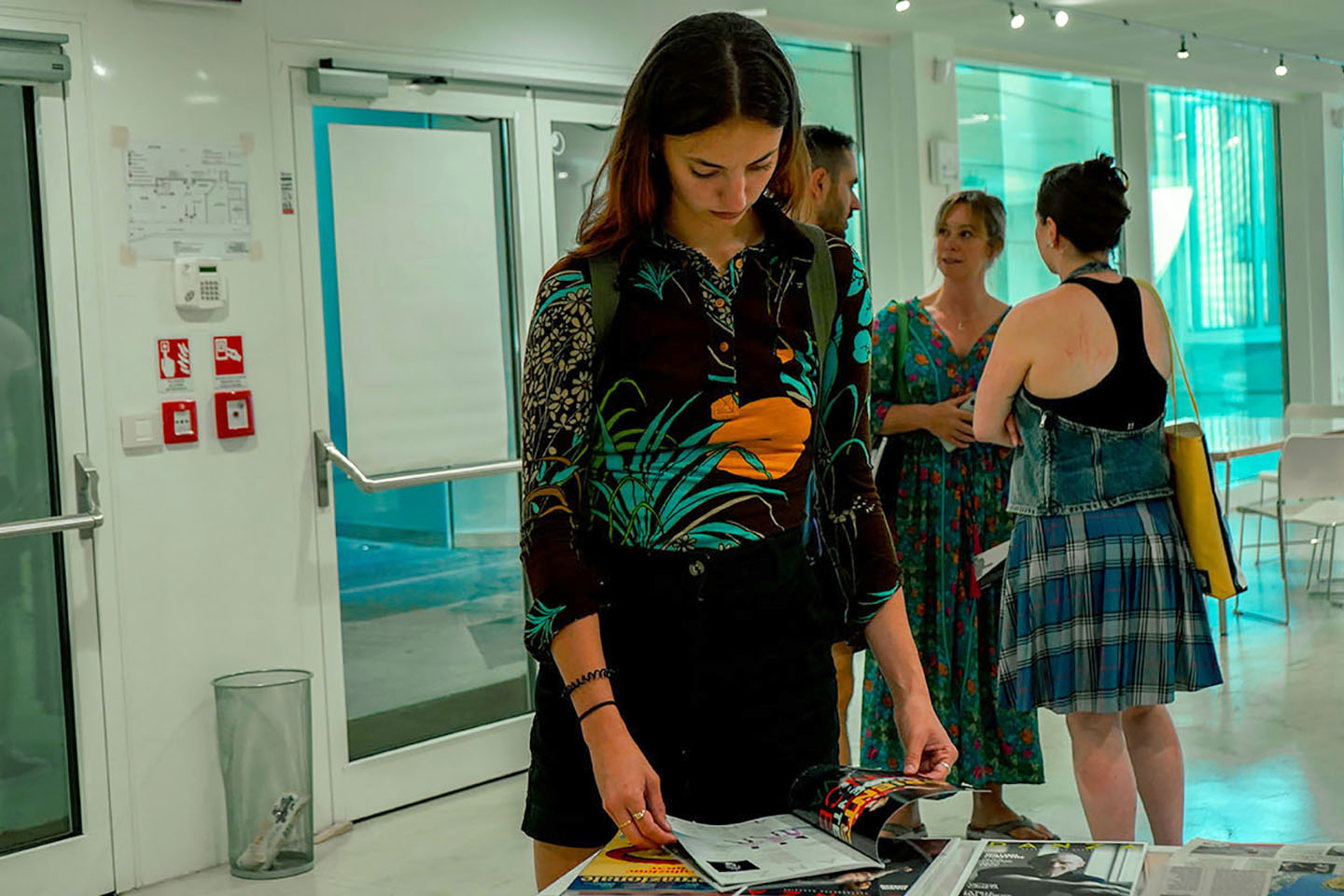
Every year, the quiet town of Rovereto in the province of Trento, Italy, comes to life when the Oriente Occidente dance festival takes place. Running this year from 2–10 September, the festival attracted dancers and performers from nearly 16 countries, this time also serving as the host for the Springback Assembly meeting, bringing together dance writing enthusiasts from 2–5 September. Here is my diary of the experience.
On the very first day, I got well acquainted with Italian culture, especially the transportation culture, when my two companions and I missed the entire programme because we couldn’t find the right train amidst the chaos of Milan Centrale station. We finally arrived late in the evening in the charming, tranquil city that strongly reminded me of Szeged (my home town in Hungary) just in time for the welcome drink.
The festival theme was ‘accessibility‘: making art accessible to all. The programme not only offered theatre performances but also included museum visits and city tours. The second day began at the MART Museum (Museum of Modern and Contemporary Art of Trento and Rovereto), the largest and most famous museum in the region. The building itself is impressively massive, providing a space not only for exhibitions but also for performances.
After visiting the exhibitions, we had a conversation with our Springback co-ordinator Gaia Clotilde Chernetich about the relationship between dance and museums. Gaia often collaborates with performers who take their shows to unique, communal spaces, one such project being Daniele Ninarello’s Nobody, nobody, nobody, which addresses the issue of school bullying. Based on his own experiences, Ninarello began working on the project with sociologist Mariella Popolla. They conducted movement-based workshops in various high schools, incorporating students’ stories and movements into the choreography. The performance was invited to the MART museum, where it took place in a space where the body itself becomes an object.
Following Gaia’s presentation, we took a brief tour to learn about Rovereto’s history. The Trentino region is located on the Austrian-Italian border, an autonomous region with nearly 3000 lakes, earning it the nickname ‘Little Finland’. Despite having a population of just 40,000, it boasts eight museums. This is due to the city’s industrial crisis in the 1960s, which was overcome through cultural development. In Rovereto, cultural institutions work closely together, a fact evident everywhere: the festival posters appear in shop windows to restaurant placemats.
The second day concluded with Nicola Galli’s performance Ultra. In a post-apocalyptic setting filled with mud and soil, strange anthropomorphic creatures move slowly. The stage, filled with smoke, is illuminated only by a few flickering LED lights reminiscent of skyscrapers. The eerie, alienating sounds assault my ears as I struggle to make out the dancers in the dim light. The figures slither past each other, fall, and then rise again. While the post-apocalyptic setting, Alien-like figures, and horror elements initially intrigued, the piece quickly became repetitive. Frequent, inexplicable blackouts became tiresome, and the piece felt much longer than its 40-minute duration.
On the morning of the third day, we returned to the MART for Diana Anselmo’s lecture performance Self-portrait in 3 Acts. The central theme was the relationship between the viewer and the viewed, presented from three different perspectives in three short videos. In the first, the camera towards our audience perspective, showing only Anselmo’s hands making signs. In the second, Anselmo faced the camera, becoming a viewed object, and in the third, Anselmo removed their hearing aids and stripped down to underwear referring to it as the ‘here and now’ perspective. After watching the videos, Anselmo spoke about their daily experiences with deafness, hiding it from others during high school, pretending to be ‘abled’. Throughout the performance, Anselmo shared truths about the everyday lives of people with disabilities and spoke about the stage as a space where different rules apply, as the theatre is a space of visibility, not invisibility.
The discussion that followed, and later continued in a seminar led by Sergio Lo Gatto, founder of Teatro e Critica magazine, revolved around the description of accessibility and disabled bodies. How should we write about theatre performances with disabled dancers? What language and tools are available for vividly portraying such performances? Should we even mention performers’ disabilities? We didn’t find clear answers to these questions, but Anselmo emphasised the importance for writers to meeting and talk with communities and individuals. Amidst these discussions, one phrase stood out: ‘Nothing about us without us!’
These topics led to the final performance of our stay at the festival, Go Figure by Sharon Fridman. In a dark space, a scooter circled slowly, the dancer lying on it slowly descending to the ground, his movements fluid as another scooter appeared, another dancer standing upright on it and offering a crutch to his partner on the ground. The core of the piece was the dynamic between the two performers (Shmuel Dvir Cohen and Tomer Navot). At the beginning of the performance, I tried to interpret what I was seeing, but I quickly became captivated by the interplay of the two dancers’ muscles and acrobatic movements. The crutch constantly reappeared as a metaphor throughout the performance, serving as a link between the two men, soaring high as wings, and becoming a tool of trust, balance and acrobatics. The choreography, as Fridman emphasised in the post-performance discussion, showcased the aesthetics of the body, highlighting how Cohen used and made his unique attributes visually striking. Go Figure provided a perfect conclusion to the discourse on disabled dancers because, from the very beginning, the uniqueness of the body was visible, yet it was the aesthetics, not the disability, that took centre stage.