


‘We call them “aperitivo performances”,’ curator Luisa Filippi quipped, ‘and they take place here in the courtyard of the museum.’ How tastefully Italian, I thought, as I imagined droves of locals, come 6 o’clock, descending on Rovereto’s museum of modern and contemporary art for an evening of music, theatre or (my favourite) dance. Oh, and don’t forget the Aperol Spritzes! And yet however thirst-quenching such cultural encounters may sound, the question remains: what is dance really doing in museums? Or, better yet, what are museums doing for dance? Perhaps it’s enough to simply lump two art forms together under one roof and call their meeting ‘dialogue’. The conversation between museums and dance is certainly not a new one – with Rovereto’s MART, as it is otherwise known, only following suit in the likes of MoMA. For all its popularity, though, there seems to be little to no appraisal of the ‘And…?’ If museums and dance are talking to one another, then what are they actually saying? Consider this year’s Oriente Occidente dance festival at MART a case study in question.
* * *
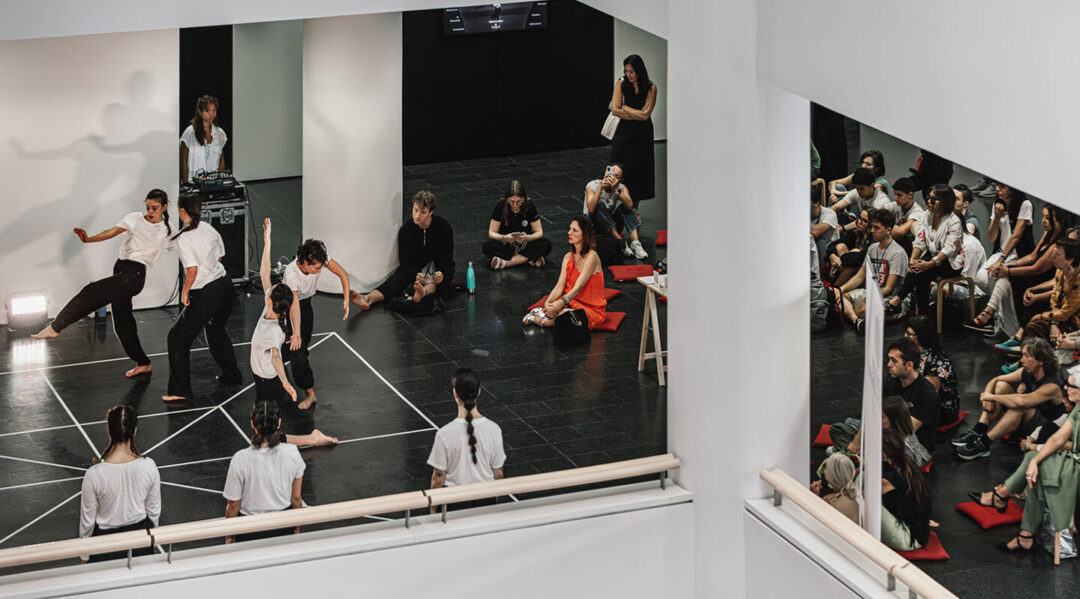
5 categories, 27 cards, infinite possibilities. Now, play! invites choreographer Nicola Galli, with his festival debut at MART Genoma scenico • Metodo. Only as the possibilities of his piece play out, with random members of the audience tentatively taking to the table at the front of the stage to pick and choose their cards for each category, it seems that no matter what compilation they come up with the possibilities are, well, not endless. Whether it be [one] dancer who [extends] in the [marginal] spaces of the grid-like stage for [five minutes] to the sound of [choral] music, or [three] performers who [twist] and [slide] along the [diagonal] for [1 minute] to the sound of [environmental], the dance itself remains much the same. A dance so characteristically ‘contemporary’ it soon feels somewhat clichéd. And yet there is something else happening here in the foyer of the MART — a foyer so white, bright, and aloof in its framing. A sort of taxonomization, or classification, of contemporary dance per se. As if it had been placed in a vitrine. An artwork unto itself.
* * *
Is that what dance is doing in museums? Taking its rightful place in the hallowed halls of the fine(r) art forms? Something about the interplay of Galli’s piece, and the conversations that spilled out of it – both with curator Luisa Filippi and dramaturge Gaia Clotilde Chernetich – told me that it was less about levelling the status of contemporary dance, and more about repositioning it as but one of many elements in a performance, which ultimately interact with one another to form a full-scale piece. As Gaia extended in her workshop on museums and dance:
Can we wonder what museums may become if they are regarded as dance performances/performative experiences? Can we review the museum as a performance where artworks, visitors, and spaces are the performers of our experience… where there’s no fixed observer(s) and no fixed observed?
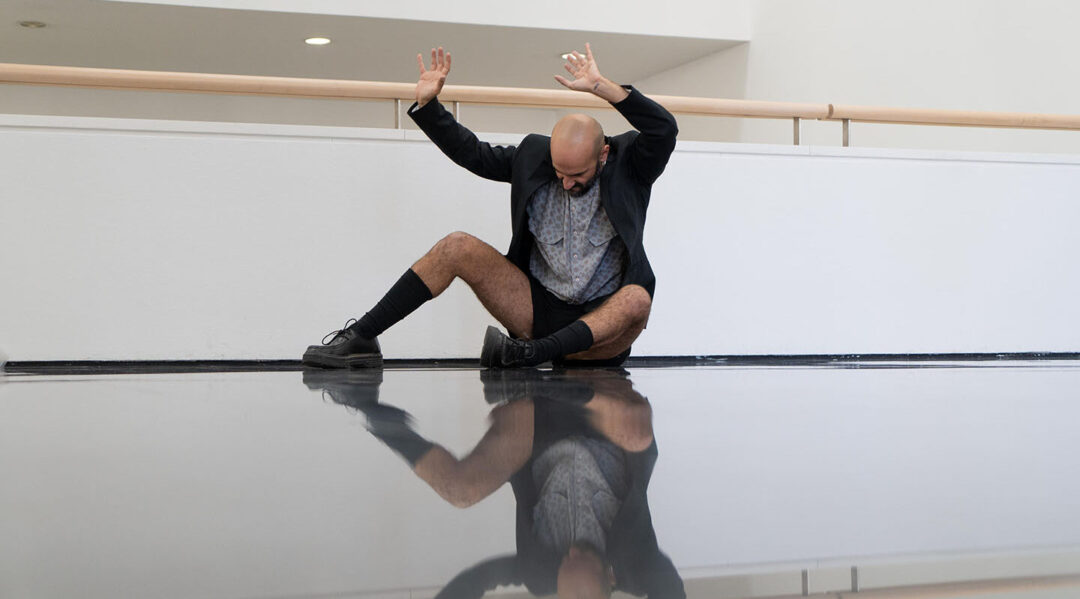
To help us imagine just that, Gaia then guided us through Daniele Ninarello’s artistic residency at MART, which resulted in a project called ‘Nobody nobody nobody – It’s ok not to be ok’. The project began in schools, she explained, in the form of workshops with teenagers that explored violence and bullying, and not only between peers, but also parents and teachers. Ninarello then took this ‘archive of movement’, as she described it, and combined it with his own embodied memories of bullying from school, rehearsing in an exhibition space dedicated to early 20th-century modern art, with all its ‘isolation, fear and violence’. When Gaia showed us the footage from the performance, however, there was no sign of the artworks she was pertaining to. Or, in fact, any works of art. ‘Nobody nobody nobody’ seemed to be nowhere in particular – installed, as it was, in a bare and nondescript corridor of the mammoth museum. As Ninarello lay face down, with his trousers round his ankles (an image so fierce it commits itself to memory), he could have been anywhere, indeed, lying back there, face down, on the concrete courtyard of a high school playground. And as he rose to his feet, to muster up cautious movements of counterattack, they could have been aimed at anyone. For, as far as I could see, there was nothing or nobody with which he was in dialogue, despite the piece claiming just that. In that blankest of blank spaces, there was frankly no context. An offensive, or was it a defence, in a far-flung and forgotten corner of the museum.
* * *
Which brings me back to Galli and his dance in the faceless foyer. The only dance, I must admit, that I saw in person. For it should be noted that Ninarello’s project had three manifestations: a performance for the theatre; a performance for the museum; and a durational performance. Perhaps the latter moved around the museum more than the recording let on – responding to, and rebounding off, the artworks? Of course, I can only go off what I personally encountered, which left me feeling overwhelmingly underwhelmed. And this is to say nothing of the dance pieces themselves, but rather the relationships that they purported to have with the MART. Where was the ‘conversation’ with the museum’s architecture, the ‘dialogue’ with its collection, and the ‘interaction’ with its art? I did not immediately see it. Although I did, at times, taste it. Like the flavour of an aperitivo.
* * *
Much like an aperitivo, the relationship between museums and dance at Oriente Occidente should be taken as a drink or snack before the main meal. While it may whet your appetite, it ultimately leaves you feeling hungry for something more substantial. Something that is going to see you through what is clearly a long-term, though not yet intricately explored, relationship. Still, I wouldn’t say no to an Aperol Spritz.