

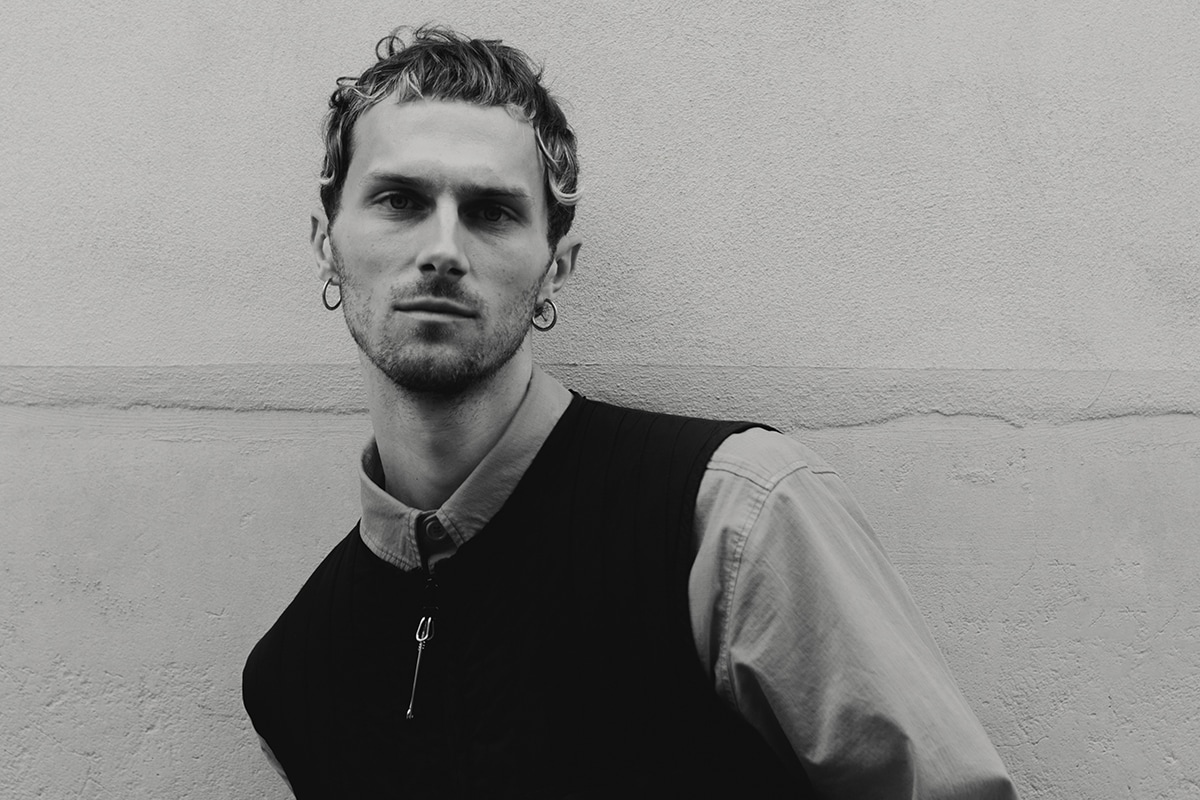
Connor Scott (1998) was born in and raised in Ashington, United Kingdom. In 2015, they moved to London to study ballet & contemporary dance at Rambert School. In 2020, another transition, this time to Lisbon, where they took part in the PACAP 6 programme in Forum Dança. Author of the works POOF (2023) and Cat-Gut Jim (2025), Scott’s interests range from embodiment practices, dance and folk music archives, to the quality of spiral in thought and movement. We spoke about meaningful encounters, deviant positions and Sid Vicious.
You grew up in Ashington, studied and worked in London until 2020 and moved to Portugal during the pandemic. How has that shift been for you?
My collaborations before 2020 were mainly with artists based in the UK. Post-2020, I continued some of those collaborations, but what I began in Portugal drastically shifted my attention to what I’m doing in a way that I think was very impactful. Marcelo Evelin, a Brazilian choreographer, is one of those collaborations, Sofia Dias & Vítor Roriz and João dos Santos Martins, all contributed to a way of thinking about bodies and dance.
I once watched you impersonate Sid Vicious, bass player of the Sex Pistols. You seemed possessed! Can you tell us more about that performance?
Yeah, the piece is called Vicious, by British duo Thick and Tight. They make a sort of ‘Cabaret Cunningham’ – their practice is actually very strongly related to Cage and Cunningham. They work with lip-synching as a form of embodying the interiority of a person. A really good way to describe what you saw is the one used by British artist Dickie Bow. He talks about it not being lip-synching but body-synching. Because in some way the lip-synch is a way to enter into the body of the other. When I embody this character I’m not becoming this character, it’s more the experience of the voice of someone that then permeates towards the body of someone else.
How does your embodiment practice inform your pieces? I’m thinking particularly about Catgut-Jim, where your body works as an archive of your ancestry, in dialogue with your fifth great-grandfather.
Catgut is the name of the strings of a violin*, and Jim is just a name that was very used in the Victorian era. This fifth great-grandfather of mine, Ned Corvin, I came across him when my grandfather, who passed away last year, had given me this book ‘Catgut-Jim The Fiddler Ned Corvan’s Life & Songs’ by music historian Dave Harker. This was in 2023, I was studying in PACAP, in Lisbon and at that exact moment, I was working with Marcelo Evelin, who has a huge practice of invocation. And I think a mixture of working with Marcelo’s practice and receiving this archive was a meeting point that was very charged.
While in Marcelo´s workshop, I had my personal invocation experience. I felt I was visited by Ned Corvin. I think I was focused on how to invoke a memory – that I don’t actually have – as a lived experience, which directs through me from an ancestral point of view. I realised something, at times blurry and intangible, at others tangible – my ancestor’s songs lyrics are still being sung in the northeast of England. So how to acknowledge what is and what connects me to a spiral quality of time? How do I think about the expansion of time?
Your practice gravitates towards the deviant qualities that dance can invoke. How much of your deviant position in dance is also a political gesture?
I think I have a fluidity that is naturally deviating from some kind of clarity. Sometimes structure is really hard for me to gain, but I have to say I experience things not as they come. I´m always expecting that there is something else to what just happened, so I´m looking for that kind of expansion and deviation. And I like this quality of deviation, I think it’s a very queer quality. Somebody asked me if I consider myself a queer artist and I would say I’m more like a deviating artist. I find it’s a very beautiful thing, deviancy. There’s no straight lines in nature, there’s no straight lines in my thinking or relationship.
That’s why I come back to this quality of spiral as something constantly deviating from direction. And I think it’s important as a quality to embody. My way of occupying my body is to embrace some of the deviancy of it, because our bodies are deviant. We’re frustrated because we don’t conform to the things that are already in place.
*Catgut is a strong, natural fiber cord created from the processed, dried intestines of sheep, goats, or cattle –never cats.