

Should we dance now, when the world is caught in the crosswinds of constant crises, gloomy geopolitical news and anxiety-inducing uncertainty? The role of art and its power to transform society has been a constant matter of debate over centuries. What can dance offer its time? What answers, or hopeful horizons, can it provide? The moving body is not merely functional; it also mirrors emotions, filters our experience, carries cultural codes, and acts as a social and political space that continuously adapts to change. Dance and its physical imagery can be universally eloquent, as they can be transmitted and received before and beyond verbal language.
It was with these thoughts and questions in mind that I arrived at this year’s Aerowaves Spring Forward festival – an important stage for European dance artists – in Guimarães, Portugal. I attended primarily as a practitioner and writer at Springback Academy, but also as an expat living abroad. I was physically away from my birthland, Estonia, yet I thought about it every day. As the Baltic states face growing geopolitical unrest, the abstract questions I had arrived with suddenly felt urgent and personal: how to live with constant uncertainty? How can one respond while being away? It was through this lens that the festival’s works landed, and two recurring preoccupations stood out to me: a desire to respond to urgent and past political developments, and a heightened focus on women’s experiences and perspectives.
Several works highlighted dance as a means of responding to political repression, or as an art form that has itself been shaped by it. Portugal-based and Luanda-born choreographer Fábio ‘Krayze’ Januário’s Musseque approaches Angola’s civil war not as history to be recounted; instead, it shows how the street dance form kuduro enabled embodied resistance and became a coping mechanism against a political regime. Inka Romaní’s solo work Volvamos al baile, from Spain, offers the perspective of the repressed. Through documentary materials, she examines how women’s bodies were subordinated and regulated under Franco’s nearly forty-year-long authoritarian rule, via mandatory group gymnastics and the suppression of traditional dance practices.
Throughout history, dance has been used as an extension of political regimes, whether to shape national identities or to project order, control and cultural dominance. What struck me in Volvamos al baile was the contradiction it depicted in women’s experiences: although rhythmic group dances were a form of bodily discipline imposed by the state, it still afforded the participating women a form of self-expression and a sense of belonging – a fairly similar feeling as the one highlighted in Musseque. It may well be that the body takes over when one is no longer able to speak about certain things, whether through political repression or the emotional weight of lived experience.
By contrast, dance artists Agnietė Lisičkinaitė, from Lithuania, and Igor Shugaleev, who is originally from Belarus but now based in Poland, zoom in on painful questions of belonging through movement and text. Choreographer Rosemary Butcher once poignantly pointed out, in an interview with dance dramaturge Guy Cools, that dance doesn’t deal with the past in terms of knowing the past: you have no knowledge of where someone has come from, unless it is described. In CLAP & SLAP, Lisičkinaitė and Shugaleev share an artistic process that relied largely on conversation, exploring the individual and collective guilt reflected in the fraught bond between their home countries. This relationship has been irrevocably impacted by Belarusian president Alexander Lukashenko’s rise to dictatorial power and Russia’s military invasion of Ukraine. Spoken dialogue provides the key to understanding historical context, but the choreographers also translate it into a powerful movement language revolving around a central, ambiguous physical gesture – a painful slap, or an appreciative clap? Through repetition and rhythmic movement, and through audience participation via an invitation to clap, the viewer experiences a dual position: a voyeuristic witnessing of self-punishment, and at the same time an endorsement of it through applause. The image is experienced both visually and physically – after prolonged clapping, the audience’s palms burn with a fierce, stinging heat.
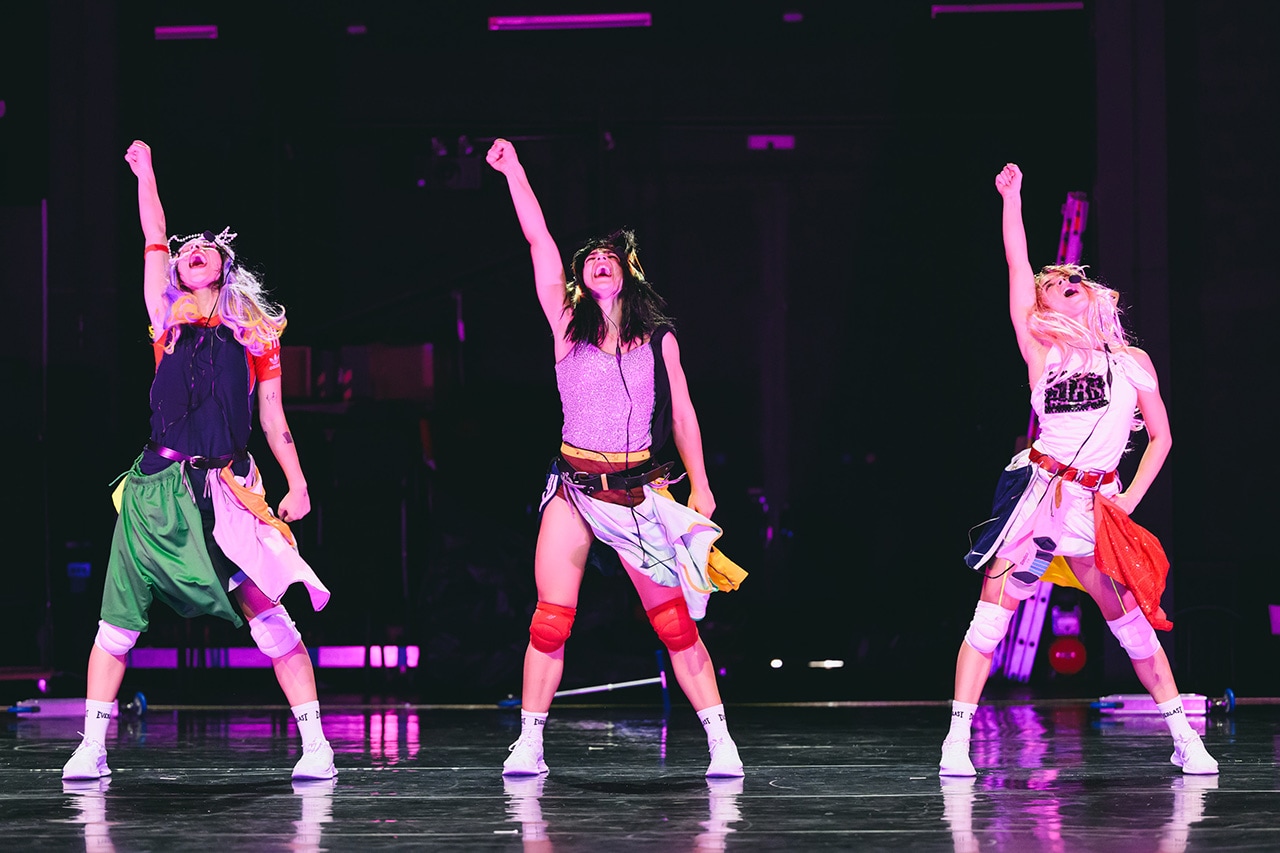
Understanding heritage and the past is key to understanding what we do today, and why we do it the way we do. In Chara Kotsali’s IT’S THE END OF THE AMUSEMENT PHASE, from Greece, three women take the viewer on a powerful, kaleidoscopic journey through the 20th century, in a marathon-like stream of scenes depicting individual and collective histories – all the way to today’s relentless drive for progress, which devours its own tail. Kotsali choreographs exhaustion, accumulating documentary and physical symbols on stage through a series of ruptures. When the stage becomes full, a stage technician arrives and sweeps the debris away with a large mop – but who is going to clean up our mess? The work holds space for mourning: for a future has been lost, consumed, or swept aside in the relentless march of progress. And yet, it does not close there. Out of that grief emerges a horizon of hope: we must still carry on with the rollercoaster of history, and find our own ways of coping with our reality.
Spring Forward offered many possible lenses through which to engage with it. For me, the 2026 edition became a platform for contextualising history and drawing it into dialogue with the present day. We come into being through our relationship with the time we live in, the people we share experiences with and the multiple ways in which our societies are influenced by the context. Perhaps dance can’t provide direct answers to political turmoil, but it can explore alternative perspectives and lend its voice to stories that have gone untold – yet can still be shared from body to body and land somewhere deeper in our collective and individual experiences.