

I hate to admit it, but I’m becoming increasingly addicted to my phone. Though I recoil on public transport when I see carriages of people staring into small screens rather than talking, and have been nicknamed “the phone police” by my family for never failing to point out when everyone’s got their heads buried in their devices, I can’t deny that the first thing I do when I wake up in the morning is switch on, scroll, and get sucked in.
For this reason, one of the main pleasures of being at Spring Forward 2026 was noticing how, over the course of the festival’s four-day run, my screen time plummeted. Occupied with rushing between shows, communal dinners, moderating panel discussions, writing reviews and giving feedback to this year’s cohort of Springbackers – aka, real life – there was no time to doomscroll through my usual algorithm of chocolate mousse recipes, astrological advice, and adverts urging me to make 2026 the year I freeze my eggs. (I’m not that old yet, am I?)
Unsurprisingly, I didn’t miss it. Part of the reason, however, was that the endless churn of online life was still present at Spring Forward – only now, instead of confronting it on a screen, we watched it unfold on stage. Nowhere was this more apparent than in Francesca Santamaria’s GOOD VIBES ONLY (beta test), in which the Italian performer-choreographer looped through recreations of viral routines from TikTok and Instagram.
Repeating them with increasing intensity and ever-shorter pauses between sequences, Santamaria eventually began to falter and fail. To me, the work commented on the banality and relentless repetition of online culture, as well as the exhausting pressure to appear effortlessly perfect within it. Yet the knowing bursts of laughter from the audience as they recognised familiar trends suggested that this type of content is what our brains have become accustomed to, and perhaps what they are most comfortable consuming.
Other works at Spring Forward didn’t directly reference social media, yet their compositional structures closely mirrored the dissonant barrage of stimuli it has become known for. Brianna Fritz and Solène Wachter’s Logbook saw the two performers sing English, French and German lyrics over one another and combine postmodern dance-like passages with sensual posing and karate kicks to a soundtrack of overlapping club bangers and liturgical chanting. Much like the experience of browsing online, after 30 minutes of cacophonic consumption, a singular, meaningful takeaway struggled to cut through the gratuitous noise.
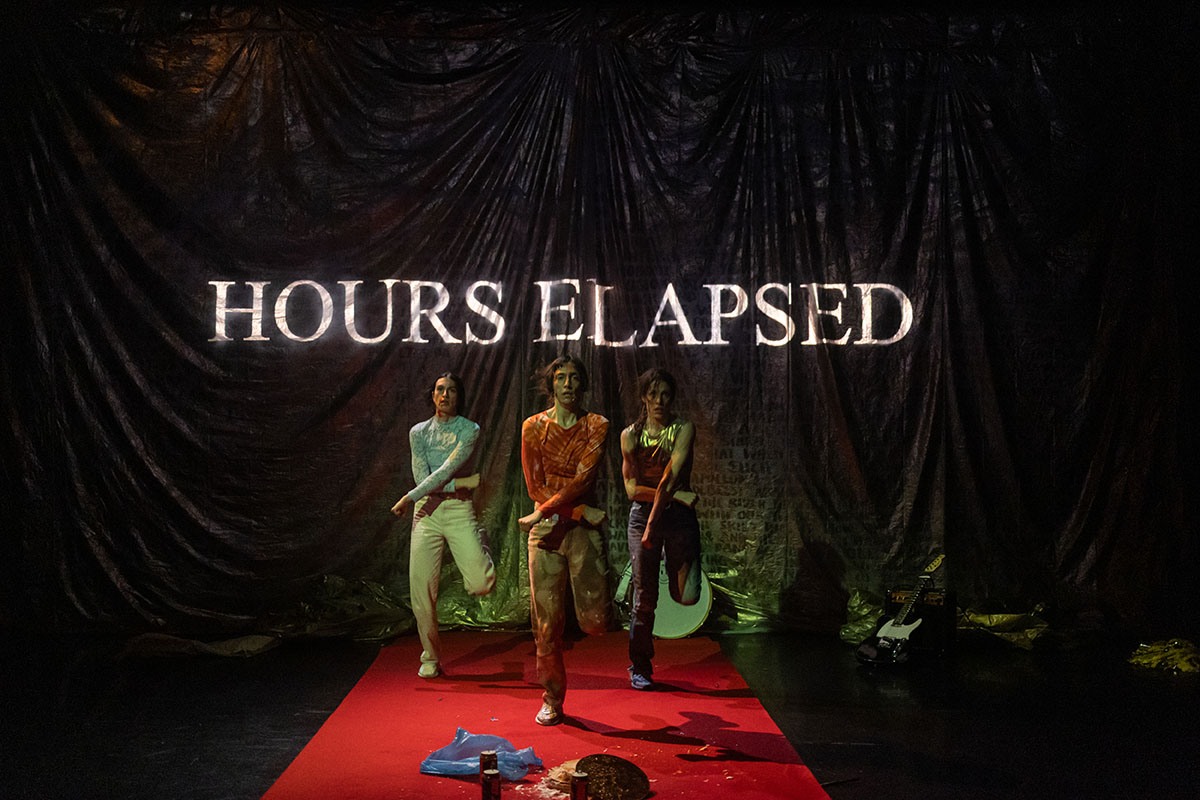
Chiara Kotsani’s IT’S THE END OF THE AMUSEMENT PHASE similarly cycled through fragmented scenes, working its way through a limitless supply of props – baby dolls, flags and cakes – which the performers discarded thoughtlessly after use, creating a post-apocalyptic landscape of debris across the stage. Here the point was clearer: projected and spoken lines listed wars, political disasters and pop culture moments in a sort of contemporary dance version of Billy Joel’s 1989 track We Didn’t Start the Fire, alongside birthdays and details personal to the performers. As such, the work became a nihilistic exploration of how the world has always been terrible, and of the human struggle to locate ourselves amidst the mess.
I’m a big believer that art should reflect the time it is created in. It naturally follows, then, that it is high time for online aesthetics to make their way onto dance stages. But what if you don’t like your times? Theatre, for me, has always been a place of escape from the digital world, to switch my phone (and myself?) off, and forget about whether someone has texted me back or not. The theatre is somewhere to share live, fleeting moments that only exist between performer and physically present audience, not to capture content to be shared to a digital audience of millions. Now, however, artists are actually encouraging us to take our device out of our bags to scan onstage QR codes – as happened in GOOD VIBES ONLY – or to use of phone torches to illuminate parts of the performance, as in Soraya Leila Emery’s TURN ON.
I can’t help but feel somewhat of a Luddite writing this. Yes, dance should reflect its times, but does that mean every performance should become a flipbook of discordant images akin to the never-ending scroll of an Instasocial media feed? Shouldn’t dance give us more time and space to interrogate and investigate, rather than merely replicate the ideas we don’t have enough time to process in our everyday lives? Maybe I should just have been born 40 years earlier. Then again, if I was, I’d definitely be too old to make 2026 the year I freeze my eggs.