

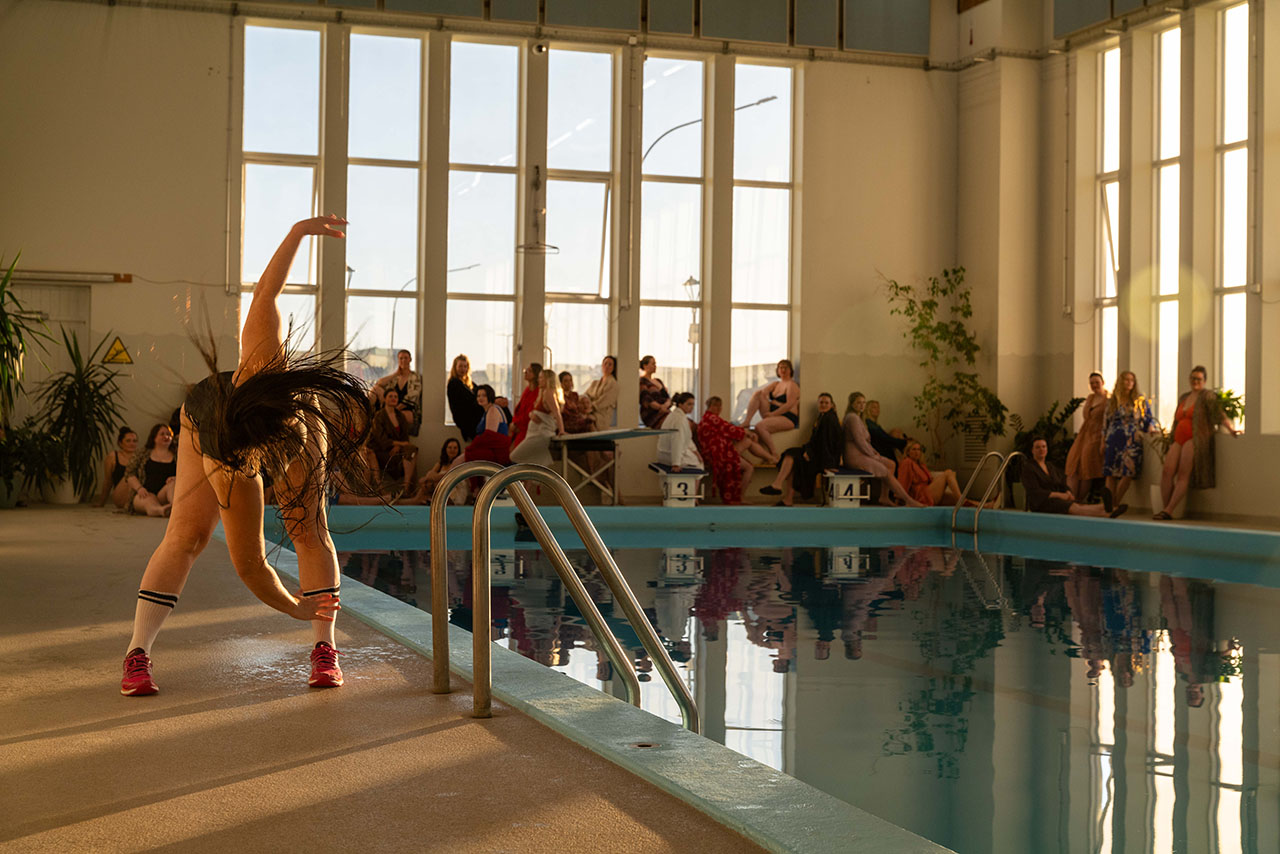
In many cultures, gender separation is the norm for thermal spas. There, women can relax among themselves; the male gaze is theoretically absent. In Femme Physique, the Icelandic duo Forget-me-not takes dance audiences poolside to witness the sense of community it can foster.
There was genuine warmth to this site-specific show in Guimarães, and not just because of the steam filling the spa. Snædís Lilja Ingadóttir and Sigríður Ásta Olgeirsdóttir always work with a local choir, here women of all ages; clad in polka-dot swimming costumes and bathrobes, they delighted in singing Portuguese songs and international hits by the likes of Enya and Simon & Garfunkel.
Ingadóttir and Olgeirsdóttir contribute the physical portion of Femme Physique, splashing around and performing 80s-style synchronized aerobics. There was appropriate irony there, the fitness routine reminding us that scrutiny over women’s bodies doesn’t stop at the door of a spa changing room. Yet the duo never quite bridges the gap between the choreography and the choir’s joyful performance, which ended with ‘Bridge Over Troubled Water’ – and a collective dip in the pool.
What do waffles, port wine, and a thermal spa have in common? Nobody quite knows, but this eclectic breakfast combination is how Icelandic duo Gleym-mér-ei, or Forget-me-not, start their piece Femme Physique / Konukroppar. After getting our snack and being guided through a steamy hallway, we arrive at the actual stage: a thermal pool surrounded by an all-female choir in white bathrobes. The intimate environment lends itself to a sense of voyeurism, and plastered on a glass wall are close-up photographs of body parts being massaged.
Femme Physique / Konukroppar attempts to offer commentary on women’s bodies in a silly and fun way, but the charm quickly wears off. Between Snædís lilja Ingadóttir and Sigríður Ásta Olgeirsdóttir accidentally splashing audience members, and – for some reason – doing an aquarobic workout on land, the performance is filled with little substance other than the water in the pool. Take out the Icelandic duo and the piece is just as interesting: in truth, the surrounding spa and female choir do much of the heavy lifting. Outside of them, the performance feels awkward and rehearsal-adjacent – hardly making a splash.
Femme Physique, by the Icelandic company Forget-me-not, pays homage to womanhood within the ritualistic atmosphere of a thermal spa.
In the Guimarães edition, the audience was greeted as friends by two dancers outside a historic thermal spa building. Inside, a choir of local women led the onlookers through steam-filled corridors to the poolside. A series of humorous and poetic scenes unfolded: the water serves for both purification rituals and commercialized fitness, while symbolizing femininity, fluidity and adaptability. The two dancers carry some choreographed scenes, while in others, the choir as a local community is central. Their chosen repertoire creates an almost sacred atmosphere, despite some dramaturgical and technical unevenness in the first half of the work.
The piece humorously comments on capitalistic wellness and the demands placed on the female body. Women have always faced pressure from visual media, even more so in the current age, which confronts them with demands that in reality are impossible to meet. Femme Physique celebrates real women, both individually and collectively, in all their natural diversity.
In Femme Physique, Snædís Lilja Ingadóttir and Sigríður Ásta Olgeirsdóttir from the company Forget-me-not have come up with a new genre: the intimate spa epic. Together with a local female choir, they stage an unapologetic critique of misogyny, body-shaming and the eternal race for perfection.
With site-specific shows, there is often the risk that the performance begins and ends with the choice of location itself. When it comes to this thermal spa, Forget-me-not have used its essential quality well: the pool as paradise — with its heady scents and panoramic green view — becomes an unlikely backdrop for the exercises the two central performers torment themselves with.
The atmosphere of a spa normally invites rest, and the choir of content women in swimsuits and bathrobes radiates vitality. Yet instead of joining in and using the power of water for joy, Ingadóttir and Olgeirsdóttir engage in incongruous aerobics. The contrast was simple yet powerful: women were created for pleasure, not for criticizing their beautiful, resilient, and luscious hips.