

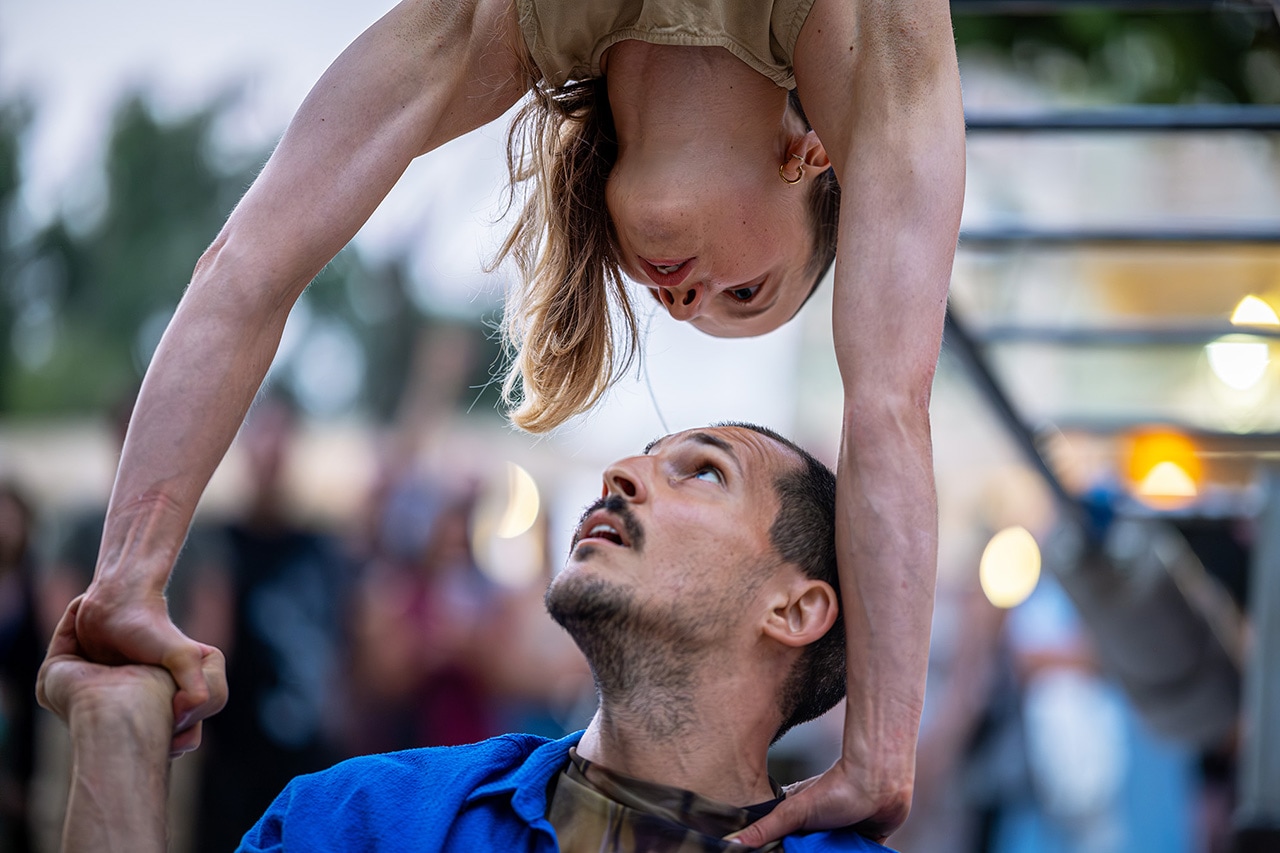
One is lonely, two is company, and three is all we could afford. Of the twenty dance works presented in the 2026 Spring Forward Festival, all but three featured three performers or less. Why does this matter – and what does it do to the dance?
Firstly, and unsurprisingly, making dance is expensive. Performer fees, venue rentals and travel costs comprise the bulk of most production budgets. ‘Asking artists to throw a work together in a few weeks is stressful and not conducive to good outcomes,’ says Anna Arthur, Executive Director of Aerowaves. ‘High-quality work,’ she explains, ‘typically requires several research periods, a rehearsal block of at least three to four weeks, and dedicated technical time for design.’
Developing work is nearly impossible without upfront, external support. Most dance artists earn below minimum wage from their practice alone, filling the gap with jobs that often leave little time or energy for the research and rehearsal that good work requires. The grants that exist to bridge this gap are shrinking in real terms – covering fewer rehearsal hours than they did a few years ago as inflation rises and public budgets tighten. The freedom to fail, essential for genuine innovation, has increasingly become a luxury.
All this to say – quoting the title of Greek choreographer Chara Kotsali’s trio at Spring Forward 2026 – IT’S THE END OF THE AMUSEMENT PHASE. Yet amusement, and experimentation, are prerequisites of serious work. And there’s a distinction between experimentation as a surface level aesthetic – think warehouses as performance spaces, the supposed subversion of audience directives and club culture as costume – and experimentation as a practice. Importantly, it distinguishes fleeting novelty from work that stays with you. A sarcastic, energetic critique of Western culture, capitalism and the illusion of progress, Kotsali’s piece was the brainchild of an artist whose formation spans anthropology, theatre and music – enough breadth to meaningfully examine societal failures as a subject.
Elsewhere, duets at the festival such as Scáling and Do Birds Dream of Flying? may have appeared spare in form, but were the product of years of embodied enquiry and collaboration. In Scáling, performers Markéta Stránská and Charlie Morrissey distilled minimally-produced weight-sharing into something that looked, from the outside, like telepathy. Meanwhile, Do Birds Dream of Flying? proved that a metal apparatus, handled with performance artist Inan Sven Du Swami’s practised precision, made co-choreographer/performer Mojca Špik float among clouds.
But now, to translate the Spanish title of choreographer Inka Romani’s Volvamos al Baile: let us get back to the dance. The economics of dancemaking determine the economy of the dance itself. In short: fewer bodies demand a different kind of approach. At Springforward, trios like Paula Rosolen’s NOICE/NOISE made use of hypnotic projections, thundering techno music and unexpected props like headgoggles to generate the spectacle additional performers might otherwise provide.
Solos are particularly tricky. Without exits and entrances, the soloist must work hard to renew the audience’s interest – an expectation that some works’ repetitiveness subverted, to varying degrees of success. In KINK, Amsterdam-based Nik Rajšek’s sullen prowl up- and down-stage provided the architecture for the audience to glimpse subtle changes in his emotional landscape; in GOOD VIBES ONLY, Italian artist Francesca Santamaria cycled through meme-orable TikTok dances until the joke curdled. In contrast, larger works like Angolan-born Fábio (Krayze) Januário’s kuduro quartet, Musseque, offered their viewers the pleasure of reconfiguration – for their eyes to move between animated performers and their braiding pathways around and across the stage. A wandering eye has its own thrills.
In choreographic convention, the solo reads as confession, the duet as conversation, and the trio as an introduction of conflict. Some works successfully leaned into the shtick at this year’s festival. Through performers Bast Hippocrate and William Cardoso’s tender negotiations of space on a rotating, plate-shaped pedestal, Joyaux Lourdement Sous-estimés demonstrated that difficult conversations about co-dependence and intimacy transcend words – needing dance to fill in the blanks.
Other pieces were flattened by conventional interpretations. By staging a conversation in which only one party has agency, Mizu’s duet between Satchie Noro and Élise Vigneron’s anthropomorphic ice puppet reads more as a work about manipulation than of climate change. Some found a secret third way: in Nigerian-Irish dance artist Mufutau Yusuf’s Proses On Neither Here Nor There, the body, a stretched shirt and weighted bricks are all part of one visual composition – meaning the work slipped free of the solo’s usual obligation to explain itself.
And finally, to cite Swiss-Morroccan choreographer Soraya Leïla Emer’s trio: TURN ON the political will. The EU is currently negotiating its next seven-year budget – the Multiannual Financial Framework for 2028–2034 – with a final agreement targeted for the end of 2026. Its new programme (AgoraEU) combining culture, media and democratic values could strengthen complementarities between the three, or dilute them if funds are not adequately earmarked. The headline figures are promising – 1.7 times larger than the previous budget, when programmes were separate. What happens next will determine not only what Europe-based artists can afford to say and to whom, but also how. The next decade’s economy of dance is at stake.