

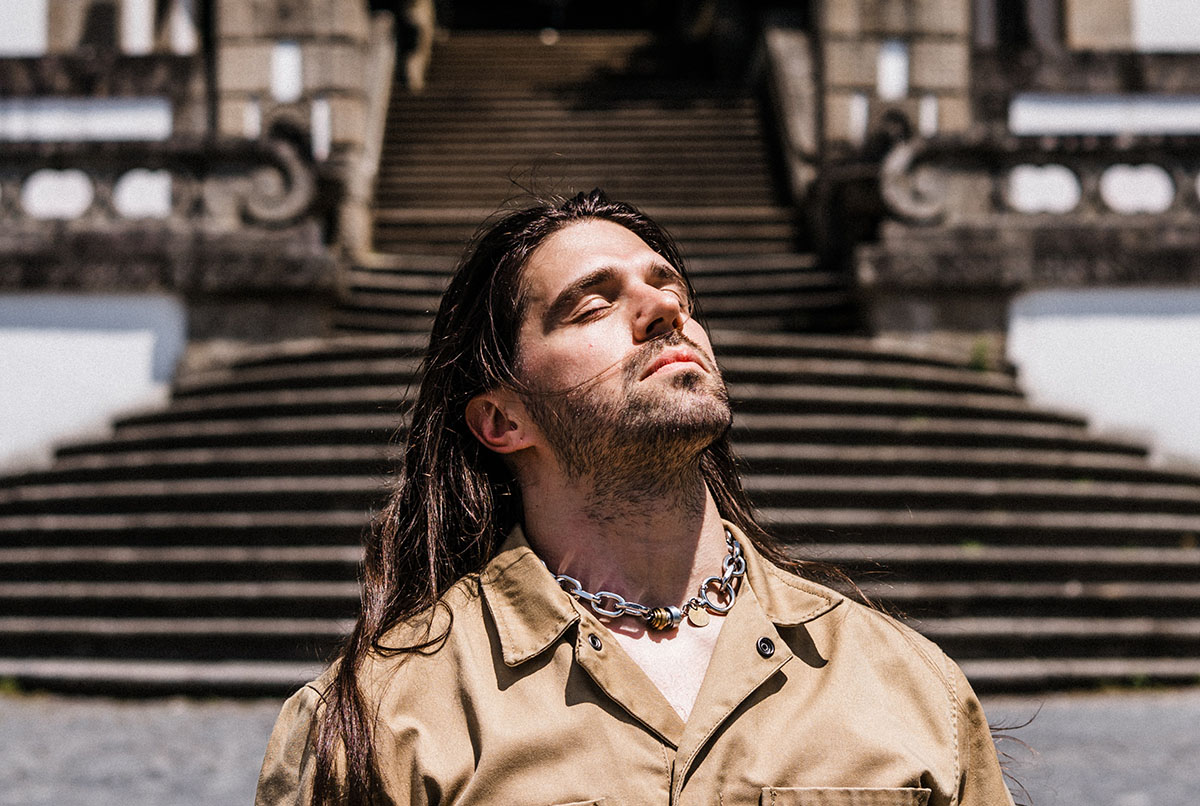
Working between dance, theatre and performance art, Júlio Cerdeira subverts expectations of practices found in daily life. An artist and educator who embodies research as a practice, he began his career studying theatre at University of Minho in Guimarães, returning to the city this year for Springforward Festival. In his choreographies, jiu-jitsu is not just self-defence, but a symbol of queer resistance; a child’s game is not play, but a means to find new possibilities for the body. For Cerdeira and his students, making art is about having something to say.
Your previous choreographies include props, costumes and materials – everything from duct tape to VR headsets. Could you tell me how you approach working with materials in your practice?
When I was doing my studies, we had to be very resourceful with what we could do, and how we would approach theatre and performative practices. So we used everything that we had. We had to find this poetic capacity and ability to understand objects, to understand how to make without a lot. We used a lot of spaces, we did a lot of site-specific stuff, and that really defined the way I started my career. [I’m interested in] experimenting with an object, the same as you do with a body – use it and reuse it and explore it the same way.
How do you experiment with your own body – or the bodies of your collaborators?
I always start from my experience and the experiences of the people that are working with me. That’s the most important part. And I only work on things that are really important to me. Making art is very difficult. It takes a lot of time, a lot of money. You get very tired after it, so I only do what I really want to do.
Actually, I need to. There are things that haunt me and I need to take them out and present them. That’s my first motivation. I find people that can help me with that and that can create with me.
Your works ŽIVE (The Living) and HIDE TO SEEK deal with social and political issues in unexpected ways. How do you work with difficult themes in dance?
HIDE TO SEEK is a good example. It’s also about how you present socially, and how you transform your body when you present yourself. It’s about gender, of course, but also this process of thought and how different theories perceive gender. When some of my students quote Judith Butler, they are sometimes saying something other than what Butler means. It’s important to know what you’re talking about. [These topics] are very complex and maybe one reference is not enough. You need to make a conflict between them so you can find your own perspective.
Your current work, Manual of Defence, takes a different direction than your previous work…
The title is also a pun on how we feel as queer people today in Portugal. We feel like we are in defence mode trying to protect our rights because they’re being taken away very quickly. I’m thinking of making [the piece] with codes like in language – language that is only presented by the body and the sound that you produce on the mic. We are always curating ways of presenting ourselves. That’s not blasphemy. Everything we do, even if curated, is extremely authentic. I say this to my students.
About your students – how do you see your role as an educator shaping the next generation?
I give them a lot of [references] that they can identify with. They can hate them – you can also define yourself by the things you don’t like. We talk about everything: the decolonisation of arts, queer people in the arts, women in the arts, the experience of the spectator, of the performer, different methodologies… Everything’s up for debate. It’s important for them to feel motivated to make art – to feel like their art is important and they have something that’s good to say.