

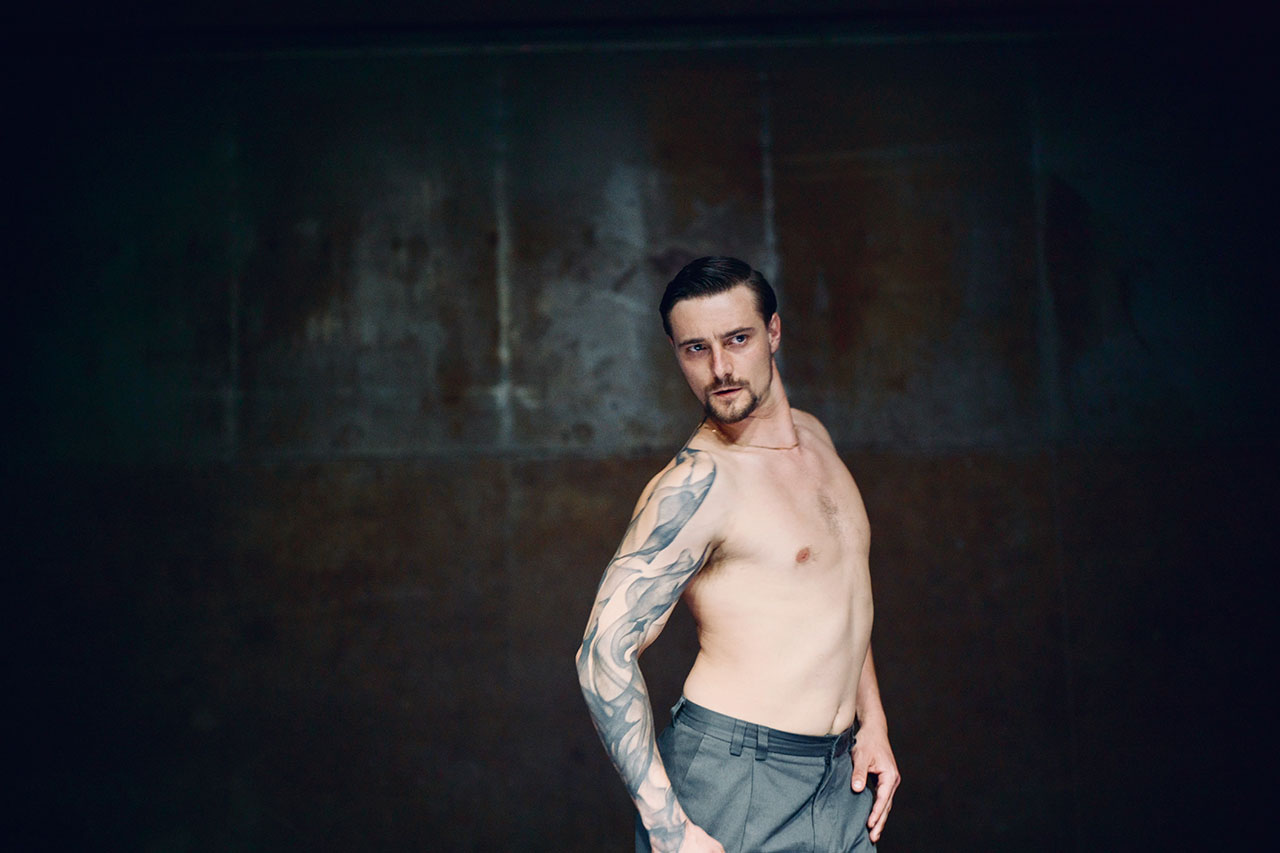
If your kink is Berlin leather exorcism, Nik Rajšek has just the dance for you. KINK sets the scene studiously. There is a maddening electronic score; a tight pair of black pants; rippling abs. Looking mysteriously high and uncomfortable, the Slovenian-born performer glides left and right, back and forth, his body undulating forcefully to the beat. The pattern repeats with slight variations – a jutting shoulder here, a full-body contraction there, as if a foreign entity had taken hold of him to chassé the demons away.
Clubbing-inspired works have been a dime a dozen in the European dance world for the past decade, so the bar is high. Rajšek never quite meets it: while musically precise throughout, the part he plays feels overly familiar. Dubiously, the programme notes describe KINK as ‘questioning’ and ‘sharing’ power with the audience. Onstage, in a dark auditorium, the performer actually holds the power; no kink-shaming, but this time around, there wasn’t much pleasure in enduring it.
Nik Rajšek’s KINK starts off with a sceptical gaze into the audience. Shirtless in shiny black pants, Rajšek walks towards us as if he were putting himself on display. At the edge of the stage, he forces his body to turn, his flesh starting to tremble. He backs up, the lights dim, and it begins: the first body roll dominoes down his body. Travelling up and down the stage, he devotes himself entirely to pursuing this one movement.
Sweat flies off his forehead and drips down his chest. The aggression in his body grows as he attempts to contain the repeated movement. Occasionally we see a glimpse of a smile: not of pleasure, but of commitment. KINK explores what it’s like to submit your body to a carnal desire, and not being able to contain it. Rajšek’s dedication is admirable and entertaining, but he pushes the limits of his body for a cause that remains mostly unclear to the rest of us.
A tattooed, muscular male dancer stands upstage, bare-chested, a thick metal chain around his neck. He scans the audience – looking both seductive as well as suspicious, frightened, vulnerable. He walks downstage to a threatening ambient hum and slowly rotates in various poses, a microscopic tremor running through his body.
KINK seemingly plays with the back and forth between dominance and surrender, yet Nik Rajšek’s gaze and movement language suggest something controls him. Digitally processed drums create rhythmic structure, with gradual tempo shifts. The composition is minimal: blackouts separate scenes in which he glides upstage and downstage in a mesmerising snake-like motion, gradually adding sudden jolts. There is still doubt in his eyes: the movement and music seem to be in charge of him.
KINK aims to explore power and control, but lacks the eroticism that the title initially teases. It primarily exhausts the performer’s body, submitting him to external forces. As the soundscape dissolves after a climax, with the panting dancer alone on a brightly lit stage, his vulnerability is what the audience is left with.
A work about dominance and surrender, KINK uses throbbing techno and repetition to drain its performer. Throughout, Rajšek strides aggressively downstage, his torso surging over bent legs, before he marches back to begin again. What initiates this movement is not quite clear. Is Rajšek in control? Or is he being dommed by the music? His face shifts between pleasure, discomfort, and even shyness as the ritual intensifies.
The conceit of voyeurism as kink, or performance as voyeurism, reads a bit on the nose. However, the honesty of a dancework that focuses on depletion is enticing. What is being used up – the performer’s energy and the audience’s attention – resonates more strongly than any excavation of extreme compliance and the edges of negotiation. In the end, Rajšek’s changing expressions are what we’re really looking at. They are a window into a vulnerable inner world, but the movement is too composed to see it fully.
The lights come on. A man is standing upstage, with shabby leathery pants and a tattooed arm, projecting brutality. He starts walking straight towards the audience. His eyebrows are arched and form a wrinkle on his forehead. He looks sad, even pathetic. Still brute-like, but a little less so now.
He turns around slowly. His shoulders go up, as if he were shy or ashamed. The chain on his neck gleams. He walks back upstage, then starts walking again, his eyebrows no longer arched. He starts rippling his body, opening his rib cage sharply to make his shoulder blades meet. In KINK, Nik Rajšek offers such a repetitive pattern of glides and curves, back and forth and side to side, that it starts looking obsessive. It felt like he was imprisoned in his own body, with nobody to save him except the audience, if only they would gaze at him lovingly.
I probably could, but my only kink is arched eyebrows.