

Spring Forward has never really behaved like a neat container. It functions as a showcase format within the Aerowaves network, bringing together choreographic practices from across Europe into a shared programme of performances across venues and programme positions. But the idea of a ‘shared programme’ is never neutral: order, positioning, and context shape what stands out, what gets compared, and how meaning forms between works. Pieces become readable through their relation to what surrounds them, and by the quiet pressure of comparison that builds across the programme.
Over four days, attention is repeatedly reset. What is seen is displaced by what has just been seen, and perception starts to rely on accumulation rather than isolated moments. Engagement shifts between immersion and distance, depending on how tightly each piece constructs its internal logic.
Instead of following a single line through the programme, my selection below is shaped by watching across the full span of Spring Forward rather than the order in which works appeared. It reflects what stood out, what didn’t fully hold, and what registered more clearly when seen in relation to the wider programme.
The three works that most clearly held attention approached performance through very different strategies. Francesca Santamaria’s GOOD VIBES ONLY (beta test) turns online positivity into a looping stage structure, where affirmation is repeated until it empties out and exposes its own exhaustion. By translating the mechanics of social media to the stage, optimism is revealed as a rehearsed social gesture rather than an emotional state. Solène Wachter and Bryana Fritz’s Logbook builds a layered field of movement, sound, and light, where elements sit side by side without hierarchy, producing perceptual drift. Sacred and everyday references coexist without distinction, allowing different cultural registers to occupy the stage on equal terms. Clap & Slap by Agnietė Lisičnikaitė and Igor Shugaleev returns focus to the body, where conflict emerges through relation, tempo, and impact. Rather than remaining at the level of discourse, conflict is negotiated directly through the performers’ physical encounter.
Elsewhere, questions of memory and community appear through embodied forms tied to lived histories. Inka Romaní’s Volvamos al baile draws on the Valencian fandango, where dance carries cultural memory into the present body, reactivated through performance. The work treats tradition not as something preserved, but as something continually activated through dancing. Musseque by Fábio Jorge Januário moves through kuduro and other urban forms, where migration and postcolonial histories are held in physical intensity rather than narrative structure. Celebration and violence remain in constant tension, reflecting the histories embedded in the dance itself. Joyaux Lourdement Sous-estimés by Cie Bast Hippocrate works through intimacy, building meaning through touch, where dependence between performers becomes its material and where closeness structures attention. Their shared physicality gradually expands into a reflection on wider forms of community and care.
Not all works land with equal clarity. WIRED by Marie Kaae generates strong physical and musical energy, but its elements remain loosely connected. Transitions between movement, live music, and vocal performance never fully settle into a coherent dramaturgical line. (titre provisoire) by Johana Malédon builds a dense visual and sonic field, but its accumulation of references remains unresolved. Its striking stage presence ultimately relies more on layered imagery than on the development of those ideas. In TURN ON, Soraya Leila Emery opens a participatory frame around female pleasure, but the structure feels predetermined and unresponsive to audience scale or reaction, assuming a level of engagement not fully tested in practice.
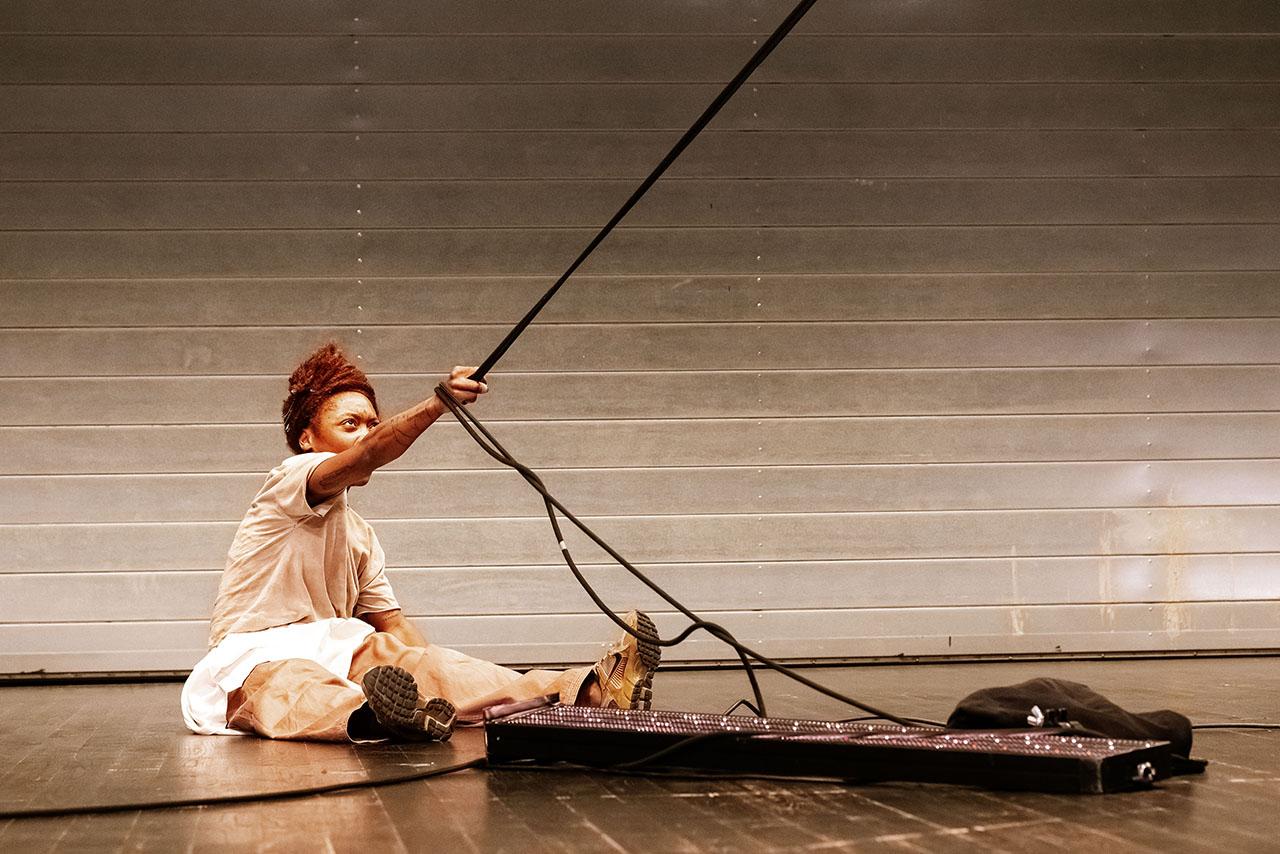
A recurring thread across the programme appears in works that explore transformation through changing states of the body. Rather than treating it as a theme, these pieces reveal how duration, physical demand, and attention can alter perception. In Nik Rajšek’s KINK, an obsessive return to a single movement impulse gradually pushes the performer towards exhaustion, as the body moves into a state of visible psychophysical strain shaped by gaze and projection. What unfolds is not simply physical fatigue, but a gradual shift in the performer’s mental and physical state as the action itself becomes the work’s central material. Where KINK pushes transformation towards exhaustion and limits, Femme Physique approaches the body through a different register — one of openness, collectivity, and renewal. A piece by duo Forget-me-not takes place in a swimming pool spa – a space already framed by bodily transformation – where, together with a local female choir, the duo build an ode to the unapologetic female body, with transformation emerging through water, movement, and collective presence in a light, open register shaped by the space itself.
Across these modes of viewing, connections emerge not from a single organising logic, but from how works sit next to each other and are read in relation to one another. Meaning is produced through comparison and repeated attention across the programme, where each piece shifts slightly depending on its context. Rather than following a fixed line, the selection is shaped by these changing constellations – by how works are grouped and how they come into focus through comparison, changing from one encounter to the next.