

During the Spring Forward festival I woke up early, battling jet lag to head down for breakfast. On the second morning, the news was dominated by Putin’s Victory Day parade on Red Square. His speech lasted nearly an hour; it wasn’t until I checked the reports later that I learned four of the marching units included North Korean troops. The grand spectacle broadcast to the world was, in fact, pre-recorded footage used to substitute for a real display of weaponry. Modern warfare is indeed a difficult game to play.
By the third day, the news shifted to a cruise ship stricken by Hantavirus. The vessel docked in Spain, where a small quarantine boat approached it in isolation to conduct a ship-wide inspection. The media gathered on the shore, their lenses uniformly aimed at the ship’s exit.
It has been a long time since I felt this close to the world. It isn’t that international news doesn’t reach my country; rather, when nestled in the safety and comfort of home, one’s senses tend to revolve around work and its social networks. We instinctively let ourselves off the hook, quietly surrendering our connection to the globe. This ‘opening up’ during this trip is not just about watching performances, instead, it is about recalibrating my antennae to sync with the rest of the world.
Returning to Spring Forward, the selection criteria mean most creators are young contemporary artists from Europe. Choreographers of this generation have largely moved beyond the pursuit of pure aesthetics; instead, they treat the body as a ‘mobile archive’. They use movement, simulation and structural frameworks to respond to truths that language cannot reach, or those that were once forbidden to be spoken.
Valencia choreographer Inka Romaní, dressed in traditional Valencia costume paired with Salomon sneakers, used repetitive folk dance movements in her piece Volvamos al baile. Humorous captions on a screen warned the audience that the steps would remain unchanged for the next five minutes, encouraging them to focus on the story the subtitles were telling. Through her body, she sought to release history. These rigid, gymnastic movements were once tools used by the Francoist regime to control the female body. As a soloist, she sprinted across the stage, while the background text humorously explained that the original version was meant for six dancers, but due to budget constraints, she had to tour alone. Constraints, it seems, are timeless; all she can do is keep dancing – and keep speaking.
Greek choreographer Chara Kotsali opened her piece, IT’S THE END OF THE AMUSEMENT PHASE, with a trio engaged in a frantic, pre-apocalyptic dance. Moving to iconic pop hits passed down through generations, the three dancers performed awkward and humorous line dances, summoning entertainment classics from specific eras. Bursts of laughter erupted across the audience at different moments, reflecting a map of ages and awakening memories of different times. As excitement gave way to exhaustion, they continued to dance without pause, challenging the audience’s senses in a marathon-like feat. We watched as dance shifted from a brainwashing tool of propaganda into a response to the present, the individual, and the future. When entertainment no longer entertains, it suddenly becomes a variant reflection of history. As the audience endured the wait for the final act, and as the dancers exhausted both emotion and stamina, the piece embodied the contradictory relationship between individual and collective history, as well as a cycle of rising and falling tides.
I was particularly struck by GOOD VIBES ONLY (beta test) by Italian choreographer Francesca Santamaria. The show began with an announcement welcoming photos and videos, immediately stamping the action with a Gen-Z label. Within self-taped frames (reminiscent of the vertical crop of social media), the dancer replicated viral video content driven by background music. With every ‘swipe up’, her body switched movements, emotions, and facial expressions. She gradually became a ‘product-like’ Barbie – never missing a beat, never showing fatigue, never appearing unprofessional – serving as a sophisticated satire of modern consumerism and the social media generation. At the end, she lifted her top to reveal a QR code on her belly, walking into the audience with exaggerated poses and inviting everyone to scan and connect. Opening the link revealed not just a simulated social media profile, but the classic rhetoric of ‘donating’. (Want more? Buy her a coffee.)
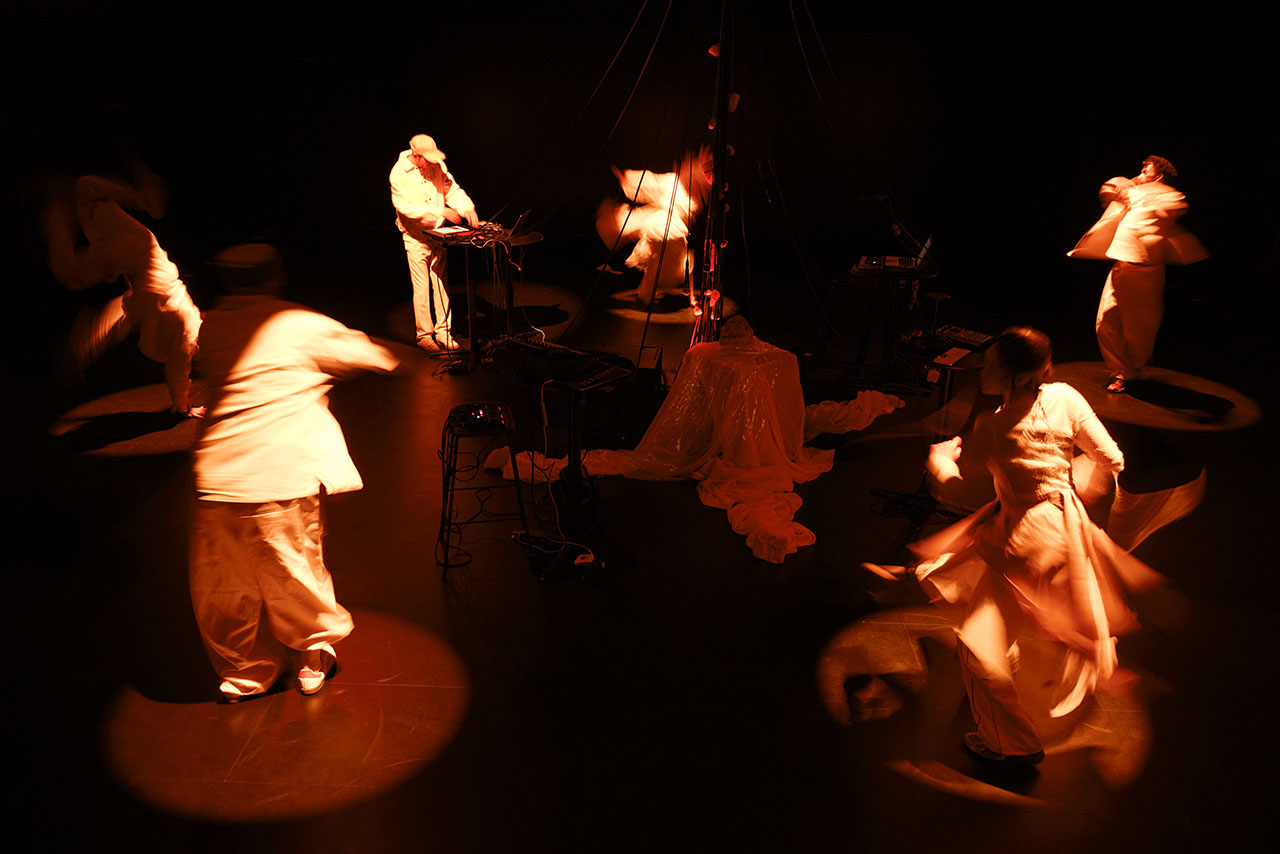
Finally, WIRED featured dancers from Denmark taking turns to move with the music, using their bodies as a display of ‘artistic weaponry’, showing the audience their precision, control, power and ease. Utilising African-American dance languages, they explored and tested boundaries, allowing music and dance to link everyone’s physical senses across oceans and borders. By the end, observations of the world, social issues, and current problems were thrown back to the newly connected crowd through spoken word. As the world demands so much attention, action, and human intervention, the question was posed: ‘Can I count you in?’ The lights dimmed, the curtain fell, and the words became seeds, planting the opportunity for action in our hearts while bringing this intense four-day festival to a powerful full stop.
The stories, visuals, sounds, and power carried by the body over these few days culminated in that single call to action. Dance may seem to say nothing, but between the movements, rhythms, and mediums, it has said everything.