

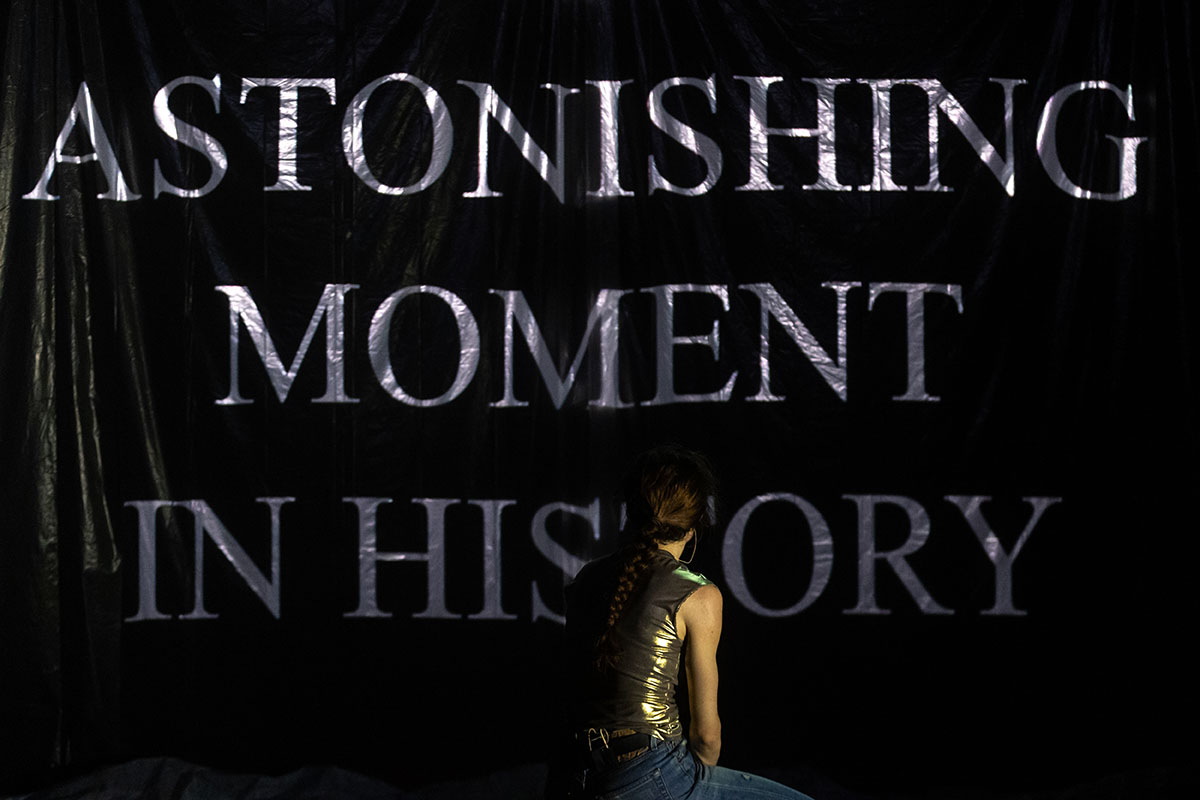
Let’s face it: the world as we know it is on the verge. We all feel it as we read the news, talk with friends, doomscroll at night. These sentiments – of instability, precarity, and dreadful anticipation – permeated the Spring Forward 2026 Festival. As an example, just take the titular question of this year’s talk, facilitated by Emily May: Why dance in times of conflict? Adding my small contribution to this big question, I believe dance offers a unique access to politics. Through movement, plasticity and visuality, the body registers stories alternative to the dominant narratives, becoming a palimpsest of past and present that coalesce into a future; a transducer for history that simultaneously rewrites it. But this ability to counter often disembodied politics ceases if we envelop the body in text – something which pervaded the festival’s performances.
Language is increasingly failing us in articulating the present. Every day we reenact a paradox of becoming accustomed to words that otherwise shock with their tremendous weight: ‘war’, ‘genocide’, ‘fascism’. At the same time, we cannot stop using them, as they hold accountability for the reality of today. Add to this the algorithmic nature of ubiquitous AI: programmed to predict what words will satisfy its user best, language is becoming a site of desensitisation. The intermediary quality of affect – the ability to evoke strong emotions by a sole utterance of a word – is replaced by the immediacy of signifier-signified. Algorithms effectively reduce the abstractive register of semantics into a mere mode of encoding information; as if there was only one answer to any question.
The pointiest critique of postcolonial theory is that it reproduces the Anglo-Saxon monolingual hegemony. What epistemologies and departing points hide in the body that moves without retorting to text? In times oversaturated with numbing directness of language, the dancing body may function as a realm of ambiguity; its movement, gestures, and, yes, language, carry that which is unspeakable. In this sense, dance potentiates the capacity to imagine alternatives, mediating between the here and the abstract, facilitating exercises in thinking and imagining otherwise. But this immense world of possibilities is nullified when the body is embedded within the textual realm. What could be a stimulant to our collective imagination becomes reduced to a one-dimensional flattening that eerily resembles the codifying operativity of LLMs. If a performance relies too much on textuality, it functions as just another algorithm, where every gesture is bound to a word, imposing an interpretative framework that does not go beyond a simple representation of gruesome reality. Must we limit ourselves to this simple mimesis? Through its disavowal of text, can’t dance provide a continuity – between the real and the imagined – that goes against the cold logic of language?
Of course, there are examples where language works in a performance or even becomes a necessary tool for the body to resonate with new meanings. This is achieved through the reversal of body/mind dynamics: it is the body that envelops the text, destabilising or even denouncing its logistics. Here are some examples: CLAP & SLAP gives us the textual context necessary to understand Lithuanian/Belarusian tensions following the Russian invasion of Ukraine. But after a discussion that turns futile, performers Agnietė Lisičkinaitė and Igor Shugaleev tellingly resort to the self-flagellating act of slapping their backs, pointing to language’s shortcomings in verbalising their guilt, frustration and fear. In Fábio (Krayze) Januário’s Musseque, the dancers subscribe to the Glissantian ‘right to opacity’ by consciously choosing not to translate the Angolan Portuguese they communicate with. Stripped from the possibility of relation through language, we are invited to connect through the shared embrace of Kuduro dance that resists colonial impositions. Lastly, in Chara Kotsali’s IT’S THE END OF THE AMUSEMENT PHASE, language becomes a neurotic poetics that gives rhythm to the bodily movement. The performers voice the excess of capitalist production, which their bodies actively counter in synchronised choreography, elucidating the constant conflict between mind and body.
But it is Mufutau Yusuf’s Proses on neither here nor there that impresses with the deliberate omission of language. His reliance on limited props – a few bricks that hold down a corner of the white T-shirt the artist wears – tells a powerful story of wrestling with the burden of the past and the simultaneous need to address it when breaking free. Still, this is one of many possible interpretations as, unbound to any text, we are encouraged to embrace the world offered by the performer and turn it into something that is ours. A body that resists text births differently within each viewer; it springs with detours rather than one hegemonic direction.
As Spring Forward has shown, in times of conflict dance reinvents itself – but maybe it shouldn’t do so by overly relying on performative lectures and textual mimicry. Quite the opposite, perhaps today’s task for dance is to provide another language, capable of destabilising the unwavering dogmas of politics. Just a bit: spin by spin, clap by clap, brick by brick.