

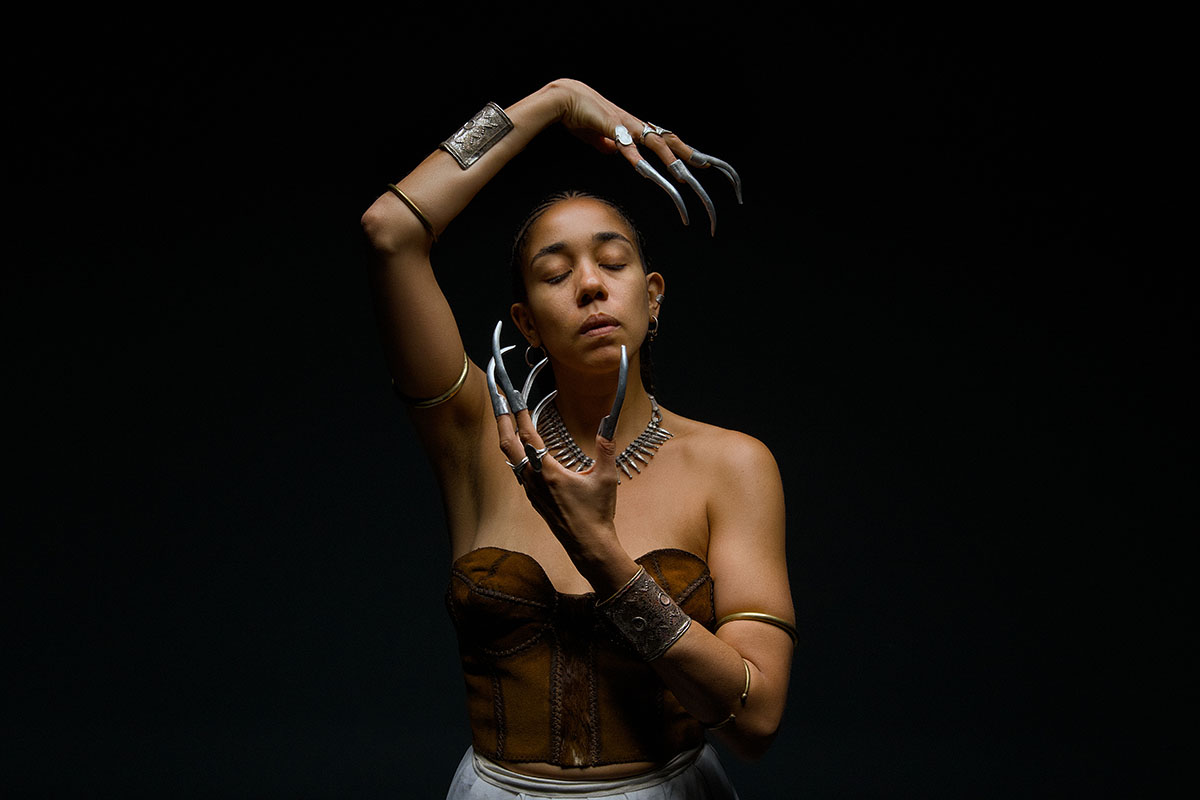
The Portuguese-Brazilian dancer Wura Moraes is used to the complexities of working with the past, the present and the future. By delving into her own family’s dance archives, Wura has grappled with loaded questions: How do we look at our own histories? Which voices are preserved in existing narratives? How can we equitably move forward?
During this year’s Spring Forward Festival in Guimarães, Portugal, Wura sat down to talk about her life, the archival work involved in her project Confluências, and the lessons it might hold for our future.
How were you introduced to dance?
I grew up here in Portugal, in Amarante. My father was a dancer, and our house became a kind of artistic residency, with people coming from all over. My mother was also a cultural producer, so it was really interesting to be in the middle of nature and have these people with very creative practices constantly coming and going. I had a lot of freedom to dance, to sing, to move.
What was it like for you to witness that environment as a child?
I think when we are kids, we just embrace it, right? We feel free to express ourselves. It was very moving for me when I started doing research into my family’s archives and found film from my mother’s camera.
I found this beautiful video filmed in Germany, where my father was rehearsing at an artistic residency. He was super focused on his work, unbothered by the fact that I was crawling around and trying to learn from him. It was quite moving to realize that I learned to walk in the studio, that dance has been there since the very beginning.
Dance has taken you from Portugal to Brazil to Senegal. How did you end up going back to Porto to work on your family’s archives?
During Covid, all my projects started to crumble. But I did have work in Portugal. Coming back, I realised my mother had kept this archive – pictures, journals, videos of my father. There were detailed scripts of pieces he created, and some he didn’t make. I asked myself: what happens if I expose my body to all of this now?
I realised that this archive is a small dimension of myself and my history. But it was intertwined with a bigger history. My father’s history. A history of migrations, of movements. The clashes between Portugal and Brazil. A hegemonic history, and a peripheral history. I also wanted to understand the richness of our dance history in Portugal, which has been tossed aside from the main timeline of dance history.
It wasn’t heavy, but instead quite fascinating and energising. When you pull at the strings of your life, you find a huge network. You begin to tell a story, and many other voices come forward. People from the present. People from the past. What kind of perspective can we open for the future with that?
What was the process like in creating your first work, within this larger project Confluências?
The first creation was a lot about dealing with grief. It was the first time I exposed myself to the archive. And as I was doing that, I was realising I hadn’t really acknowledged the death of my father. I think when you are eight years old, it’s very challenging to process such a loss.
It brought back everything that I had rejected: the pain, the loss. So it was a very charged piece, very sensual as well. It was one of the first pieces I really wanted to do in a black-box space, in the sense that I really wanted to create this controlled environment where we could zoom in on something many of us try to avoid.
In your next work, Reverberations, you now use your uncle’s archive – how do you feel your archival work is changing over time?
It’s a new moment, a new chapter. My plan was that my uncle and I would do a duet next. So I did interviews with him. Unfortunately, one month before my premiere, he passed away. It had a huge impact: I had to go through the process of grief again. I dedicated myself to now assembling my uncle’s own archive, talking with people, collecting things.
What moved me was looking at what we share – my uncle, my father and I. I felt the urge to celebrate that, so it was no longer about coping with grief. There is a very beautiful saying in Brazil, that when you die, you are enchanted: encantados. What is enchanting us that goes beyond death, beyond loss? What is still vibrating here? What do they still have to say? The echoes stay with us as long as we remember, as long as we don’t let them fall into oblivion. That’s the reverberation: you drop something, the sound is no longer there, but there are still these waves. They are still connecting with us.