

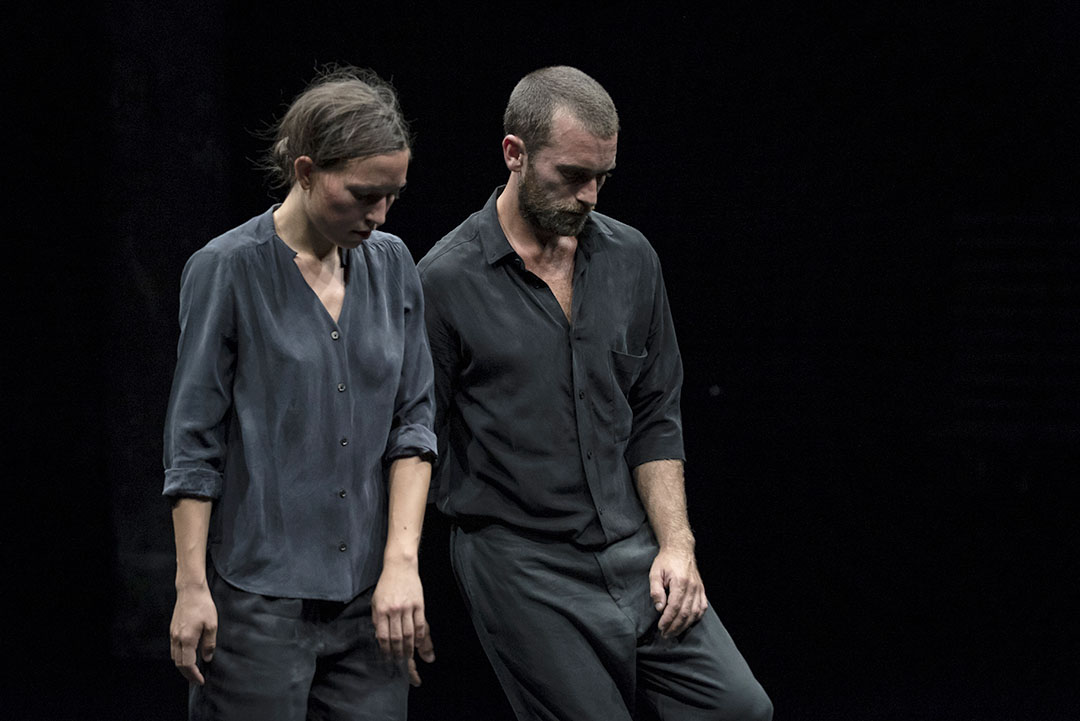
Belgium is a small country but a big hitter in the contemporary dance world, and over the last 30 years or so has become a magnet for dance artists from all around the world. Each year, the capital hosts the Brussels Dance! festival, the seventh edition – ‘1 city, 2 months, 18 venues, 80+ talks & shows, 180 performances’ – stretching throughout March and April 2022. More a conglomerate of different seasons than a masterminded programme, it nevertheless offers a window – or rather, windows – onto the dance scene(s) in Brussels.
For a few days in late March 2022, a group of 10 Springback dance writers gathered in Brussels, partly for a Springback meeting but also to attend some performances – principally those from the In Movement season at Les Brigittines, a ‘playhouse for movement’ built around a former 17th-century chapel, with studio, residency, performance and exhibition spaces; but also from the LEGS season at La Raffinerie, a former 19th-century sugar refinery, now the Brussels branch of the Charleroi Danse choreographic centre; and to watch classes and choreographic presentations of third-year students at the famous PARTS school.
At La Raffinerie, dance history was something of a theme. Louis Combeaud’s ‘Embodied Dance History’ workshop used talk, video clips and (crucially) practical movement exercises to guide us through a story of western dance history – a canonical one, to be sure, that was offset by other histories in performance: Dominique Duszynski’s autobiographical solo Else, a poetic re-membering of her years with Tanztheater Wuppertal Pina Bausch; Cabaret Welbeek, an uproarious evening with Alexandre Paulikevitch, drawing upon the traditions of baladi as well as making them his own; and L’opéra du villageois by Cameroonian Zora Snake, deploying earth, salt, plastic and Snake’s own body in a contemporary ritual that re-presented burial by colonialism.
Meanwhile at Les Brigittines, we wrote immediate responses to a programme of short performances. You can read these here, together with a response to seminars by sustainability expert David Irle, co-author of the recent book Décarboner la culture, on ecological transition in the performing arts sector.