

‘We are the string quartet on the Titanic.’
The line, dropped by Brazilian curator Nayse Lopez during the Forum talk Hospitalities as Responsibilities at the Lyon Dance Biennale, had the kind of sting that makes you sit up straighter. Her point: in a world both literally and politically on fire, art risks sliding into irrelevance if it remains passive, if it fiddles politely as we head towards catastrophe.
If that’s the danger for artists, what about critics? The artist-critic dyad has long been cast as active versus passive, doer versus commentator. With arts magazines folding, budgets slashed and dance writing increasingly reduced to a side hustle or a hobby, maybe it’s time to ask: what makes a critic’s work more than just an ornamental soundtrack? What makes it hospitable – not in the sense of offering tea and biscuits, but in the sense of being relevant, rigorous, and relational?
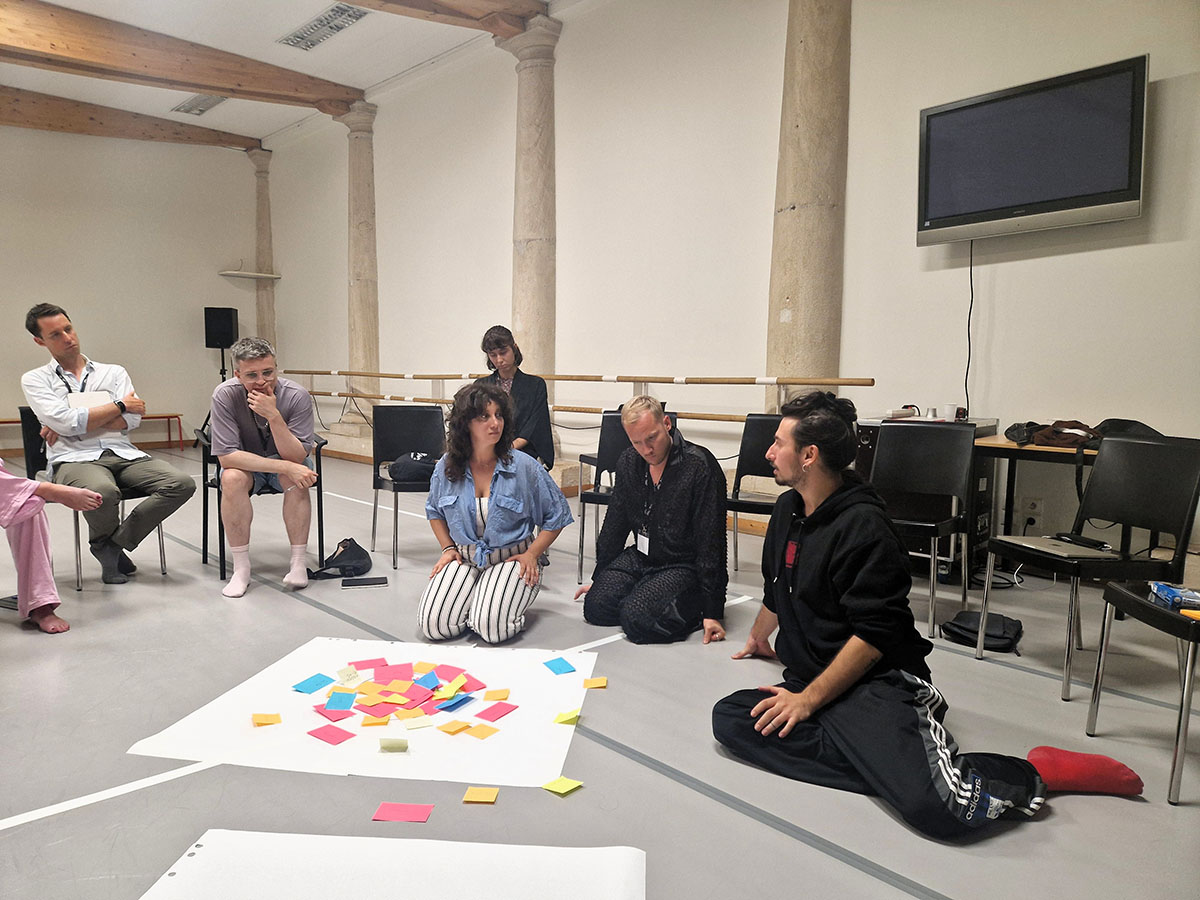
That was the current running through our Springback Assembly discussions in Lyon. Hospitality, we discovered, is a slippery word, but the definitions that stuck – care, responsibility, reciprocity, labour, creating space(s) – point to ways through which criticism might reinvent itself as something alive, not just keep being perceived as an afterthought.
Hospitality is always relational, it comes down to two roles: host and guest. But in criticism, who plays which? The artist invites us into their world, the critic hosts the audience in theirs, and the roles keep swapping. Maybe that’s the point: a hospitable critic has to be willing to move between roles, to hold the door open, sometimes to walk through it.
Reciprocity
A performance is an invitation. The artist throws energy on stage, the critic has a choice: to meet it with equal energy or to let it dissipate. Reciprocity is about returning something of value – interpretation, perspective, even disagreement – to both artist and public. It’s not flattery, it’s not parasitism; it’s the intellectual and emotional exchange that keeps the circuit alive.
Care
Care doesn’t mean cuddling the work. It means attention. It means taking the time to actually see what is there, not what we want to see. Care is writing a sharp critique precisely because you took the work seriously. To care is to resist the lazy polarity of ‘good’ or ‘bad’ and to ask more nuanced questions: what does this piece want? What does it risk? Where does it land?
Responsibility
The question of responsibility should especially be raised in small national dance scenes where everybody knows everybody, and where critics are often also curators, dramaturgs, sometimes even makers. Hospitality here means grounding ourselves in the ethical and deontological backbone of our profession, actively seeking to avoid conflicts of interest. It also means recognising that silence is not neutral. Choosing not to write about a work – whether because of ethical boundaries, irrelevance or sheer refusal – is itself a critical act. Absence of words can carry as much weight as presence.
Creating space(s)
Through its use of language, criticism creates spaces that the performance itself can’t. A hospitable text opens a door: for the artist, by situating their work in a broader conversation; for the reader, by offering ways to engage, whether they saw the piece or not. That space can be generous or confrontational (ideally both!), but it should never be empty.
At the same time, words can only go so far. Carrying Rainer Maria Rilke’s Letters to a Young Poet with me in Lyon, I kept returning to a passage that felt uncomfortably close to what we were circling around: ‘There is nothing less apt to touch a work of art than critical words: all we end up with there is more or less felicitous misunderstandings. Things are not all graspable and sayable (…) and most unsayable of all are works of art, mysterious existences whose life endures alongside ours, which passes away.’ Rilke’s reminder is that our writing, however sharp, will always be partial, provisional. Hospitality in criticism may mean knowing when to step back, when to leave a work its mystery.
Labour
Hospitality is not free. It’s labour. Too often, criticism is seen as post-factum judgment, sterile and detached. In reality, it’s work: of watching, questioning, contextualising, writing. To see criticism as labour is to recognise its power dynamics. Who gets to speak, who gets heard, who gets published. A hospitable critic is one who works to bridge, not to barricade.
So: what makes a critic’s work hospitable? Perhaps the willingness to refuse irrelevance by staying in dialogue with artists, with audiences, with the times. To write not as the polite soundtrack to a sinking ship, but as a bridge that others can cross. In a fractured, suspicious world, hospitality may be the critic’s most radical tool. Not as decoration, but as survival – and not survival in the narrow sense of keeping criticism alive as a profession – though that, too, is under threat – but in the deeper sense of keeping art connected to its public.
Seen in this light, perhaps critics are not the string quartet on the Titanic after all. Perhaps we are closer to the ones pointing out the iceberg, or to those who insist there is still meaning in playing, even as the ship lurches. Either way, our role is not ornamental but insistently present: to accompany, to alert, to sustain the sense that art matters even in crisis.
That is why a hospitable critic should never pretend to have the last word. Their task is to keep the door ajar, the dialogue alive, the ship noisy with questions rather than mute with resignation. For if art risks irrelevance when it turns passive, criticism risks the same. Hospitality, then, may be the way out – not an escape raft, but a way of staying on board, together.