

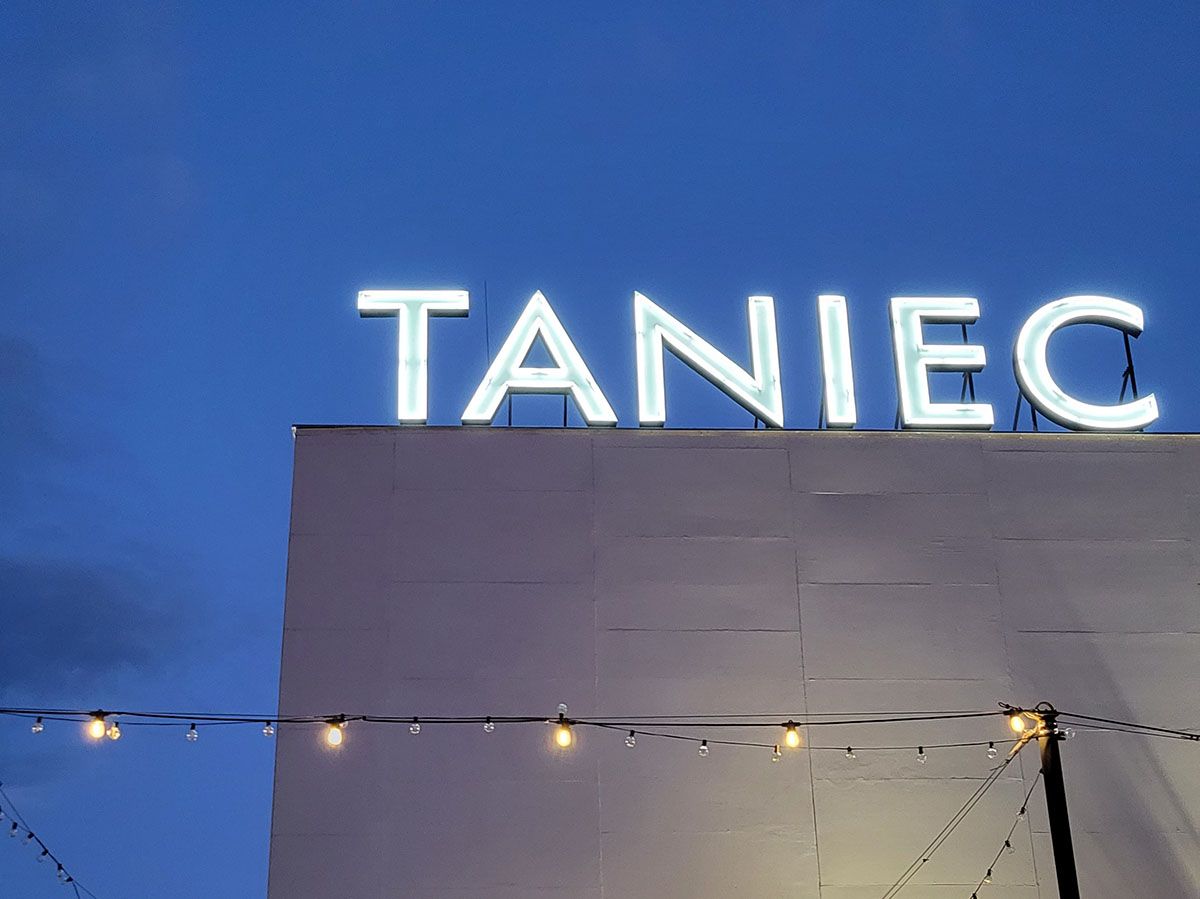
At night, the word TANIEC glows above the Vistula river. It is difficult to miss.
TANIEC means DANCE.
Six large letters of glowing white neon stand on top or the façade of the Pavilion of Dance and Other Performing Arts, announcing: dance happens here. This is a place for bodies to move.
Neonisation
Warsaw knows something about neon: coloured illuminated signs have been part of the city’s visual vocabulary for decades. After the destruction of the Second World War, neon became one of the ways the city used to rebuild its image. At the end of the 1950s, Warsaw entered what became known as the period of ‘neonisation’: a deliberate attempt to illuminate a city that had spent years in darkness. Signs appeared above cinemas, restaurants, shops and public buildings. Architects and visual artists were commissioned to design signs for individual buildings as well as entire streets. Their designs were far from the functional lettering we usually see in advertising. They were elaborate, humorous and highly stylised. They didn’t merely tell people where to go – they gave the city colour, rhythm and, after dark, another visual layer. Neon was not just decoration – it became part of the city’s identity.
And then, gradually, the lights went out.
As Poland entered the economic crisis in the 1970s, maintaining the signs became increasingly difficult. After the collapse of communism, many were discarded or left to deteriorate. The high costs were not the only reason: neon carried associations of a political and economic system that the people wanted to leave behind.
Time passed, growing political and emotional distance from the communist period and allowing Warsaw to reassess what was inherited from that era.
In the first decade of the twenty-first century, artists and researchers began treating the disappearing signs as part of Warsaw’s cultural heritage. Notably artist Paulina Ołowska argued for the value of the signs as works of art in their own right, rather than simply remnants of the past. A campaign to save the city’s neon grew, eventually contributing to archives, restorations and the establishment of the Neon Museum in 2012. Today, the museum’s collection includes more than fifty large signs and hundreds of individual letterforms, while many signs are restored in their original locations.
A neon for dance
Warsaw’s old neon signs were designed to catch the eye. Their colours and forms interrupted the darkness of the city. They told people: cinema, hotel, restaurant, shop. The new neon over the Pavilion says: TANIEC.
DANCE.
Inside the Pavilion, dance has a home.
The Pavilion of Dance and Other Performing Arts opened in 2026 in a building whose renovation was conceived specifically around dance and performance. The neon is part of the building’s new identity, marking its entrance and making its function legible from the surrounding public space. Curator Renata Piotrowska-Aufrett, during a tour at the space wants to make sure: ‘Have you seen the neon? Let’s go see the neon!’ There is a large highway close by and they wanted to make sure that everyone driving by could see the sign, she explains.
DANCE.
It is a remarkably direct gesture. A statement of a whole community that wants to be seen. The Polish dance community demands to be seen. A statement towards authorities and policy makers, but also a statement towards the city: Dance is claiming space in its urban flows, in its everyday life. It is claiming the attention of the people. They don’t need to follow contemporary dance, they don’t even need to intend to go inside. But when people pass by, they can’t miss it.
DANCE.
This gesture matters, as dance is constantly looking for ways to extend its reach beyond its established audiences. To see a dance performance in a theatre, you generally have to decide beforehand that you want to see one. You find the venue, look at the programme, book a ticket and arrive on time. The theatre asks you to come to dance.
Public space and site-specific performance have the possibility to change that relationship: not simply taking dance out of the theattr, but allowing it to enter the visual and social life of the city. A performance in a square, on a street, on a river bank or under a bridge might meet people who have not planned to encounter it. Walking home, sitting on a bench, cycling past, the performance comes to meet you. You may watch for five minutes or stay until the end. The encounter may be brief and not lead anywhere further – but for a moment, dance has entered your everyday landscape.
Vistula
Vistula, a site-specific performance by Weronika Pelczyńska presented by the Pavilion, takes its audience on the riverbank and asks us to encounter the river through movement and listening. Wearing headphones, we move through the landscape, listening to narrated text, instructions and sounds gathered from the river environment. A group of performers, members of a women’s choir, dressed in vibrant coulours, softly guides the experience and adds more auditory layers. Their bodies, along with ours, become part of the performance.
Around us, another audience: the people passing through, hanging around. I wonder how they perceive this colourful group of people with headphones prancing around and lying on the grass. This group of bodies moving in a way that is slightly different from the ordinary choreography or the riverbank. Maybe they stay indifferent. Maybe some curiosity is sparked.
And perhaps that is enough.
Bringing dance into public space is not only about attracting more people into dance institutions. It is about making DANCE part of people’s ordinary experience of the city.
Just like the neon sign does.