

Every autumn, from September to November, the Romaeuropa Festival takes over the city with its wide network of venues and ever-shifting energy. Now in its 40th edition, the festival feels less like a neatly curated programme and more like a living organism – open, flexible, and quick to respond to the world around it. Performances are not presented to prove a single theme; they appear as encounters, sometimes smooth, sometimes messy, showing how artists today deal with urgency, exhaustion, hope and creative risk.
This spirit is especially vivid in Ultra REF, the festival’s platform for hybrid forms. Here, dance meets theatre, text meets sound, ritual meets technology. Genres rub against each other in productive ways, creating sparks rather than boundaries.
Into this landscape two Springbackers arrived – Greta Bourke and Dmitrijus Andrušanecas – on a mission to discover new work and report back with fresh impressions. Across the performances we saw, a number of shared questions began to emerge. How does a body carry or resist the stories placed upon it? What happens to identity when it is shaped by algorithms, communities, desire or history? How do performers handle visibility and vulnerability in a world that both demands spectacle and distrusts it? And what kinds of connections – intimate, collective, ecological – still feel possible in unstable times?
Romaeuropa does not offer answers. Instead, it lets each work speak and gives audiences room to follow their own paths. Its strength lies in this openness: a belief in artistic variety that allows unexpected resonances to appear simply by placing works side by side. — DA
Performances

Qudus Onikeku, Terrapolis
Teatro Argentina, 14.10.2025
The initial impact of Terrapolis by Nigerian choreographer Qudus Onikeku is impressive. Picture 16 performers – 11 dancers and five musicians – and a larger-than-life narrator who strides on stage in flamboyant costume with a clicking instrument, calling us to attention and guiding us through the themes of the work.
The opening phase, symbolising the harmony between human beings and nature, is upbeat. The dancers’ movements are at once joyous and reverent as they emit happy cries and yelps; long plaited hair flying, hands raised in praise, legs stamping in unison, a dancing circle united in celebration.
Yet beneath this buoyant energy lies a gathering darkness. ‘Harmony is like a clay pot,’ the narrator tells us, ‘beautiful but fragile.’ The performance shifts into a meditation on the exploitation of nature. The joyous cries turn to anger, the dances fracture and the air grows thick with rage. The stage becomes a space of protest and mourning, as the dancers brandish and stomp totems to protest the consequences of resource extraction and greed.
The earth-coloured costumes, made with primary materials and loosely draped, are in perfect affinity with the themes of the piece. The rhythm of the music drives the pace – a blend of drums, guitars and voices that draws the ensemble into one cohesive entity.
Towards the end, the narrator asks: ‘Have we forgotten harmony?’ I wish we had been allowed to reach that reflection for ourselves. There is too much preaching in this show which has ample potential to deliver its message through movement.
The most radiant moment comes after the show has ended, when the cast returns to the stage and starts to celebrate their performance together. Their spontaneous joy reveals what Terrapolis has been attempting to convey all along: the power of connection, rhythm and the collective spirit to heal a troubled world. — GB

Louise Lecavalier, Danses Vagabondes
Teatro Vascello, 16.10.2025
Canadian dance icon Louise Lecavalier continues to test the boundaries of the body and the imagination with Danses Vagabondes, a 60-minute solo that is as much a journey through movement as it is an act of endurance.
The auditorium is only half full, but there’s a palpable sense of anticipation. Entering in a long, black-hooded tunic, Lecavalier kicks off her runners front stage and steps into a square of light like a boxer entering the ring. Behind her is a white pixelated backdrop that flickers and shifts like a living organism.
Lecavalier’s signature energy is immediately evident: her figurative dance language is jerky yet fluid, controlled yet explosive; she’s a bird, a butterfly, a scissors. Her bare feet glide to and fro across the floor, while the sharp angles and twitchy gestures of her hands and arms somehow coalesce into a graceful whole.
The relentless beat of the music drives her forward. The choreography becomes more confrontational once she throws off her cloak to reveal a bomber jacket – she’s a puppet pulled by invisible strings, a raver lost in trance, a woman wrestling with her own vitality. We can’t take our eyes off her.
Towards the end, fatigue shows. Lecavalier pauses, breathing audibly – a rare and human moment from a performer known for her superhuman physicality. Yet she pushes on, propelled by an inner rhythm and a bright steel-guitar pulse.
Danses Vagabondes is not a crowd-pleaser but a raw, hypnotic self-portrait. After decades of innovation, Lecavalier is still asking questions and finding answers between dance and the void. — GB

Francesca Santamaria, GOOD VIBES ONLY (the great effort)
Mattatoio, 17.10.2025
The national premiere of Francesca Santamaria’s GOOD VIBES ONLY (the great effort), the second chapter of a trilogy, is an attempt to preserve individuality within the hyperactive stream of information that defines contemporary life.
Surrounded by bright stage lights, the performer (Santamaria herself) appears as an idealised avatar, shimmering in a white costume with exaggerated hips and arm muscles, her deliberately artificial make-up reminiscent of Pat McGrath’s ‘glass skin’ looks.
The DJ, Juan Claudio Averoff Rico aka Ramingo, acts simultaneously as stimulus and algorithm, shaping Santamaria’s reactions. The music shifts abruptly – from classical compositions to pop-culture staples, from ‘Gangnam Style’ to Sia’s ‘Unstoppable’ – forcing constant adaptation. Each track activates a new movement vocabulary, as Santamaria enacts countless trends, memes and fragments of dance history in rapid succession. The Ramingo’s T-shirt sequence (‘feat. me as the algorithm’, ‘an algorithm with a dominant gaze’) reveals his controlling role.
As the tempo of the music accelerates, Santamaria’s glossy façade begins to crack, revealing audible fatigue and resistance. Her collapse at the end prompts the DJ to ‘recharge’ her, turning the moment into a metaphor for consumerist logic; her decision to sing is a brief assertion of autonomy. Although Santamaria’s movement quality is precise, her acting occasionally lacks conviction, drawing attention toward the more sharply defined figure of Ramingo.
Presented within the Ultra REF platform, GOOD VIBES ONLY (the great effort) recalls other contemporary explorations of visual culture and digital overload, such as Trailer Park by Moritz Ostruschnjak, yet Santamaria focuses on the tension between mechanical responsiveness and human vulnerability. The body she constructs, continually responding to shifting stimuli, becomes a metaphor for unstable identity shaped by technological pressures, leaving a final question: can a person remain themselves in a world governed by algorithms? — DA

Vittorio Pagani, SUPERSTELLA
Mattatoio, 18.10.2025
Five, six, seven, eight.
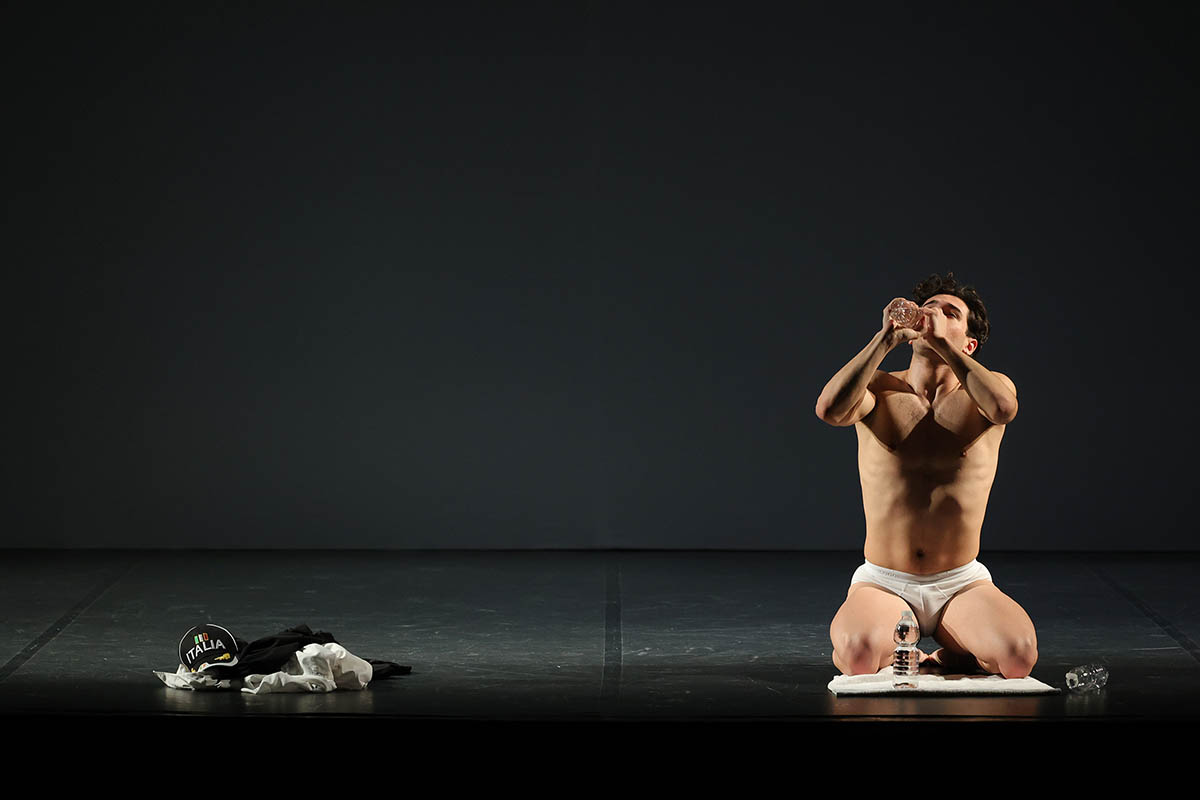
What would you choose if you were asked: option A, an Adidas hoodie, or option B, Adidas track trousers? This playful vote opens SUPERSTELLA by Italian dancer and choreographer Vittorio Pagani. The audience votes for the trousers – a decision that determines his outfit.
The stage holds four neat piles of garments, water bottles and accessories. The lights go out, a melody plays, and from the darkness we hear Pietro Angelini speaking from Federico Fellini’s 8½: ‘Could you choose one thing, only one, and stay faithful to it?’ On the projected screen, a hand appears receiving a coin – as if paying for the show that is about to begin. A recorded crowd roars as glimpses of a naked body flash on the screen. He stands up, takes a few steps, runs, disappears – and moments later emerges from the wings onto the stage.
Five, six, seven, eight.
Throughout the performance, texts written by Pagani and quotations from Fellini appear. Here he declares: ‘I want to design this show so that your thirst may be quenched, your hunger satisfied, and your applause ignited.’ His movements are precise, his poses echo both pop culture and Renaissance iconography. His choreography develops recurring motifs that shift in meaning as each chapter unfolds – for example, a gesture resembling a nearly perfect Roman statue. ‘Would you like it to be brighter, more provocative, more poetic, more innovative?’ he asks. ‘Or would you prefer it to be a meditative space for peaceful discussion, where silence speaks louder than words?’
He progresses through sections – Superdance, Superdark, Supervoice, Supernova – dressing and undressing to reveal temporary selves. The movement language, rooted in ballet technique, oscillates between precision and vulnerability. Projected time markers – from ‘5 minutes later’ to ‘4.54 billion years ago’ – explode the sense of a time frame, and Pagani draws infinity with his feet, as if drifting through the cosmos. A brief echo of Fellini’s 8½ reinforces this sense of perpetual re-beginning.
In the climax, Pagani undresses slowly, turning like a drifting particle, and discards all four piles of clothes – shedding each assembled identity. Putting on the trousers shown at the beginning, he returns to the initial question: are his choices autonomous or shaped by the systems that surround him? SUPERSTELLA emerges as a reflective meta-performance in which creation, the body, and time appear as unstable structures, continually rewritten as the artist searches for a place of selfhood within an ever-shifting universe.
Five, six, seven, eight.
— DA

Matteo Sedda, Fuck Me Blind
Mattatoio, 19.10.2025
Two men stand centre-stage in black shorts, t-shirts and trainers, their eyes locked as we enter the theatre. Very slowly they begin to move, tracing deliberate, circular paths, their fixed gaze never faltering. The pace gradually increases as the music grows louder and faster, the circling expands and the motif of pursuit and retreat unfolds, leaving unresolved the question of who leads and who follows. This is a quintessential piece for in-the-round staging.
The circle of movement expands, criss-crosses and contracts as the dancers enact the complexities of their relationship: they hiss and spit at each other; they spin around and around with their arms around each other’s shoulders; they smile and flirt; place their hands on each other’s cheeks tenderly; they play choking games and hang out their tongues in a ruse of sexual innuendo.
Just as we get accustomed to this rhythm, the music slows down, the bass increases, the lights grow dim and the dancers hold on to each other, still moving in a circle. This is the most poignant moment in the piece, exposing the vulnerability of intimacy and the ultimate need for physical connection. In the very end, they spin together faster and faster until they become a blur, a visual symbol of togetherness.
Fuck Me Blind is a story of human intimacy condensed into precise gestures, punctuated by varying degrees of physical proximity. Inspired by Derek Jarman’s hauntingly honest autobiographical film Blue, Matteo Sedda says his aim is to create a hypnotic experience and he succeeds. The deliberate, orbiting paths and the constant eye contact create a tension that gives the piece a sustained physical and psychological impact. — GB
For more from Romaeuropa 2025, see also our review of Moritz Ostruchnjak’s NON+ULTRAS