

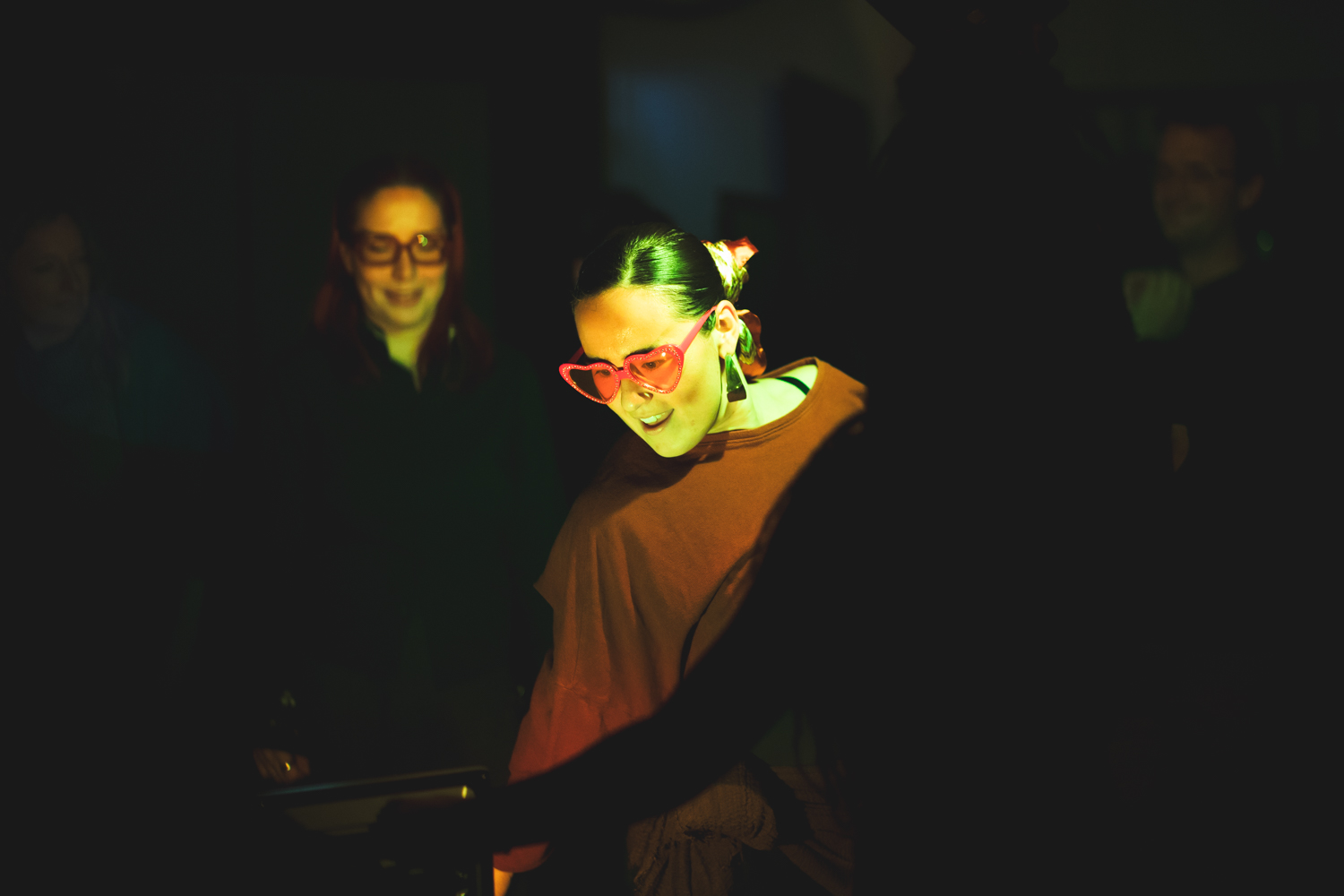
JR: What You See Festival (WYS) hit its 8th edition between 19 and 23 November 2025. Maintaining gender diversity as its main focus, it has developed relatively quickly from being a small project in Utrecht’s Theater Kikker to a renowned event on the Dutch performance calendar. Inspired by the Italian Gender Bender Festival (Bologna, 23 editions and counting), WYS defines itself as ‘positively activistic’ and inviting, hoping to be a weaver of knots in the social fabric.
This year’s edition was a special one as it marked the first of Annette van Zwoll (also a Springback writer) as artistic director. The deputy of founder and director Vincent Wijlhuizen from the start, van Zwoll took over the role earlier this year, opting for continuity but also underscoring the potency of the festival as an enabler of debate. To put actions to words, and under the motto ‘Keepers of Humanity’, WYS 2025 curated a strong international performance programme, as well as several side-activities, lectures and multidisciplinary initiatives to trigger conversations and support local makers and students who wish to explore the politics of (queer) identity.
‘
The politics of identity are lit up and pulled at, thrown across and defended from different angles
What started as a festival focusing on giving queer voices and bodies a space to be visible and heard is thus becoming more and more an arena where the politics of identity are lit up and pulled at, thrown across and defended from different angles – without avoiding the sharp ones. This welcomed paradoxes and tensions between notions such as safety and risk, or inclusion and exclusion – and triggered vivid conversations among the trio of Netherlands-based Springbackers who bring you these texts.
RD: Such dualities were reflected in the dramaturgy of the programme itself which swung from ‘in-your-face’ to ‘by-your-side’. If WYS 2025 is anything to go by our current landscape of makers, whether they be well-established or just emerging, seem to be toying with the possibilities of intimacy and consent through creations that don’t just break but demolish the fourth wall. Confrontation, participation, conversation; touching, talking, taking to the stage; the pathway of this year’s performances through which we three Springbackers traversed had us constantly renegotiating our place as spectators. As the boundary between stage and seating became ever more blurred, the question of the curtain rising on the next performance was not ‘Are you ready?’ but rather ‘Are you in?’
Some artists wove this into the fabric of their performance – think Silvia Gribaudi’s Suspended Chorus, her raucously humorous exploration into the collective bond that can be (and really is!) forged between performer and audience. Some artists used open invitations to get viewers involved in their matter – think the welcoming performance lecture 4 Legs Good from Claire Cunningham, and her encouragement for the audience to share in a tactile interaction with her crutches.
Spurred on by the post-Covid desire for radical connection, or perhaps by a fatigue with the patronising over-coddling of spectators, WYS 2025 was a joyous resituating of the audience; a call for a more collaborative conjuring-up of performance. Through workshops, work-in-progress sharings, conversations and shows, Utrecht’s annual festival of gender and identity kept us figuring out if, how and why we were truly in.
Contents / Forms
Click on any tab below to find your way in to What You See 2025
The Brazilian trans sisters co-forming Irmãs Brasil come out on stage as animal-like characters carrying a distinctly mythical and queer energy in Eunuchs [also reviewed here]. Untamed horses, mermaids and nymphs inform their physicality, but instead of taking from them the usual motifs of seductiveness or mystified freedom, they have selected other, darker traits.
Naked, they gallop on stage, circling a raggedy, dirty plastic curtain that serves as their only piece of décor. Naked, they crawl over the floor (and the audience), willingly unaware of conventions or any notion of personal spacing – as befits a demigod or a horse. Naked, they look aloof, not-here while they violently contort their bodies, but are also not afraid to lock eyes with the audience as they drool over them, sniff at their faces or take their hands to place them on their own breasts.

Larger questions on consent inevitably become part of the experience. Irmãs Brasil’s performative contribution to this conversation touches upon the paradoxical relation between safety and risk, and is as conventionally edgy as it is refreshingly difficult to read. It’s a bold and critically appreciated choice as the festival’s opening.
Let’s clarify something at the get go: there’s nothing new in what they do. Making audiences uncomfortable by going beyond the socially acceptable has been in trade for over a century. As I was looking at them pulling sharply back each other’s cocks to hide them, to ‘castrate’ themselves, I had to think of several experiences where my senses had been challenged in similar ways. I remembered how nakedness, violence or sexual play on stage has enraged or utterly bored me when offered as a wannabe-nihilistic middle-finger to the system. The offence didn’t come from nudity, rather from the waste of shared time for absolutely no other reason than the satisfaction of the adolescent whims of (yet another) spoiled, often white and mediocre maker. At other times I was positively enervated, and felt my suffering touched a deeper poetic or political goal. One example: Maguy Marin’s Deux Mille Dix Sept, during which my ears were literally tortured for almost two hours by an offensively loud and scratchy soundscore. The goal? Impede spectatorship’s comfort. A sound (pun intended) dramaturgical choice for a performative attack on the links between neoliberalism and fascism.
Eunuchs clearly falls under the last category. Despite the trigger warnings uttered repeatedly beforehand, the show did stir the pot of the festival. Several audience members left, and the mood in the post-talk-turned-runway led by Amber Vineyard (mother of the House of Vineyard) was quite gloomy and not very populated. Festival sources confirmed: emails were sent, complaints were uttered.
During our own discussion about the show, however, both Sid and I appreciated the value of seeing precisely these trans bodies (appalling to many, scrutinised and judged by most) dressing themselves with the status of menace and peril that befalls them – as does the mermaid and the horse. Nakedness and the breaking of boundaries here not as a performative prank, but as an act of empowerment and a weapon of self-defence. The plastic curtain, a symbol of precarity, can also be read as a statement: ‘this is how naked we stand in this system’.
By reclaiming the reaction their being provokes and throwing it back at us, Irmãs Brasil don’t reinvent the wheel, but do invite our struggle with discomfort to be put to empathetic use. The choice is ours: do we stay or do we go? Do we focus on being offended or do we try to overcome it and engage with their intentions?
RD: Whilst also grappling with themes that teeter on the difficult, uncomfortable, and the embodied, Robin Nimanong is one artist in front of whom I’ve had to question my place as audience member. Whether in a London theatre, or the corners of a less traditional Amsterdam venue, I have always enjoyed encountering Nimanong’s choreographic practice. I am pulled in by their interdisciplinary world of techno-futurism, which is cleverly imbued with a sharp knowledge of decolonial and queer theory. As such, I was disappointed to miss Children of Zeus – an artistic research project produced in collaboration with visual artist Valentina Gal that was shared as a work-in-progress with the audiences of WYS. So I decided to get to know this research through the eyes of my fellow writer Sid, via a line of nosy questioning…
So Sid, inspired by the spirit of our ‘Are you in?’ red thread, is there an aspect or a moment of Nimanong and Gal’s collaborative research that you found the most inviting or tantalising?
SY: The first part of Children of Zeus felt very calm. The performer, Qiqi (Qiyun Zheng), who stayed by themselves for the entire presentation, moved slowly inside a water basin, lily pads floating around them. The composition, the slow movements, and the soundscape in the background created a meditative atmosphere that, in hindsight, was the thing that drew me in. Something about taking that time felt like an invitation for the audience to really look, observe, and be present in the space. Later on we moved through what felt like different ‘chapters’ of a performance that lacked transitions – and therefore lost me here and there. Not strange for a work-in-progress sharing though.

RD: You’ve conjured up quite the slow and meditative scene here. I know that at least for me I am feeling the pace of our modern climate – it’s becoming ever-more difficult to carve space to think on the themes with which Nimanong works. Using art to create spaces that act as short inhales, pauses, feels almost like a form of activism – saying no to pressing forward as usual without taking time to consider the past. The space of the studio and the context of a research sharing feels like the ideal container to wrangle with these ideas.
In fact, a defining prerogative of WYS is to place works-in-progress like ‘Children of Zeus’ alongside full-scale performances. Particularly in the case of this body of artistic research from Nimanong and Gal, what do you think this offers to the festival programming?
SY: Nimanong references many queer and decolonial elements within this piece, many of which, I can imagine, are unfamiliar to a large part of the audience. Mixing vogueing from the queer ballroom scene with elements of Thai heritage, Nimanong, in collaboration with Gal’s scenography, manages to create an atmosphere in which you become aware that you are not ‘in’. You might not know the references being made, nor what they mean, but you’re invited to look, whether you understand it or not. As an audience member, you are then asked to decide whether to push back against what you don’t understand or to stay open and engaged despite that uncertainty.
RD: Your description of using their practice to invite the audience ‘in’ to something potential unfamiliar strikes me, mainly because artistic research projects, especially those still in the ‘research’ phase, can often tend towards the opaque and ideational – which can make a relationship with a working audience difficult to negotiate.
How was this navigated in Nimanong’s performance, and to what extent did you feel involved in the research?
SY: Reflecting on your response, I realise that being a spectator of this work wasn’t necessarily about being invited in, or even being able to fully be ‘in,’ but rather about accepting that you are there, witnessing the research unfold. In a way, simply being there allowed me to engage with the work on its own terms, noticing textures, rhythms and gestures that were still in formation.
The rest of the presentation included entertaining moments; however, as a work in progress, not all elements came to full fruition. This raised the question: were there moments in which I didn’t feel involved because I was unfamiliar with their meaning, or because they were still undeveloped and therefore ungraspable for any audience member? Either way, that ambiguity became part of the experience – a reminder that artistic research can be as much about presence and openness as it is about comprehension.
Just as Sid invited me into her experience of Nimanong’s work, so Jordi and I attempted to invite Sid into Claire Cunningham’s performance-lecture 4 Legs Good. Sid listened patiently as we conjured up the performance through shared memories and our experiences over a cup of tea nearby the Theater Utrecht. Although rambling and emotional at times, this recollection was essential in pinpointing the pertinent themes that constitute my own reflection below.
Three notebooks are standing to attention, facing away from the audience. A dismantled pair of crutches lounge in a semi-circle on the periphery of the stage. Upstage right, two chairs wait patiently for their guests. The stage is set, occupied, commanded even before our performer enters. The animated nature of otherwise perceived inanimate objects is central to Claire Cunningham’s 4 Legs Good – a performance-lecture that meanders through anecdotes, demonstrations, and diary entries to conjure up a history of Cunningham’s distinct movement style that she calls Quanimacy, and at the same time draws us into the dedicated and vibrant life of this influential figurehead in the UK’s performance landscape.
With its origins in the work of scholar and disability activist Julia Watts Belsar, Cunningham tells us, Quanimacy is a portmanteau of ‘queer’ and ‘animacy’. It is a word, an ideology, a movement technique that captures the unique oneness that Cunningham feels with her chosen mobility technology – her crutches. It is with these two, she explains, that she finds herself navigating her queerness. She is in somewhat of a queer relationship with them, and when she describes her motions as she performs, she is rarely ‘I’ but rather ‘we’ – ‘we click… we take our time… we arrive’. Even when they might appear to not be beside her, there they are, propping her up like a stool from behind or tucked at her side when she takes a seat to read directly from a notebook. Cunningham’s honest and intimate description of her crutches is what gradually pumps them with warmth and life as the lecture progresses. As she stands static to speak, her gestures send her crutches into their own particular choreography as they reach away, swing towards, and pirouette around her arms.
They’re ‘vintage’, she says fondly. She’s added pink and blue stripes to them for no reason other than to match her outfits. They like the attention, she remarks as they crowdsurf through the audience. Cunningham’s descriptions and familiarity are sharp – she is funny. Opting for the framework of a performance-lecture means that we spend time in Cunningham’s words: her ideas, reference points, concerns. And she slices her sentences with the kind of humour that transforms this from being an instructive presentation into a warm and inviting sharing. She addresses the audience with the geniality of an old friend: we’re here with her in this relationship, we are beckoned to touch, listen and accept.
Yet her humour is well balanced and the dramaturgy, which time-travels from Cunningham’s present-day practice to formative memories, flows through chapters that are driven by more moving anecdotes. We are introduced to characters from Cunningham’s life such as American artist Bill Shannon, and the late choreographer and movement artist Jess Curtis, both of whom she developed close relationships with. More than just spoken memories, these artists are conjured before us through a movement dialect that sees Cunningham ‘float’ with her crutches, hovering above the ground with the gravitational memory of Curtis, or through skating, gliding, and ‘cowboying’ across the stage in the style of Shannon.

Awash with a verbal catalogue of Cunningham’s stories and movements, there is one moment that stands out to me when, Cunningham explained, words could no longer serve her. Slipping to the floor, she begins a silent trio between herself and her two pairs of crutches – a demonstration of her distinct contact improvisation practice that she developed in her times without a partner. It is hypnotic. The crutches are bodies that rest on Cunningham’s neck, shoulder, ankle. Simultaneously they support her in organic ways, lifting up her torso momentarily before gently guiding her back to the floor.
Later that evening, Jordi and I find ourselves still beguiled by this moment. Over our tea, we regale Sid with its impact: how its timing infused the performance lecture with well-crafted intimacy, how Quanimacy transformed from theory to embodiment, and how in this moment we were both mutually in.
A white stage, black curtains, some randomly placed stage lights and Silvia Gribaudi. The house lights are still on when she enters, the audience still settling. Gribaudi casually asks us to read a synopsis of the piece, interrupting the reader every other sentence to clarify, rush them through or tell them they’re wrong. Predictable, but with Gribaudi’s comedic timing, hilarious. I guess the performance has started…
No clear cue has been given, the house lights stay on, and just like that, the typical conventions of going to a performance have been dismantled – we don’t get to hide in the dark and just watch.
As in a game of charades, we are prompted to name her movements, ‘roll, jump, turn turn turn’ – and as we name them her choreography grows, and it becomes unclear who is prompting who. Is she moving because we tell her to, or vice versa? Does the performance exist because we (the audience) says it does, or because the performer performs it? Gribaudi exposes a fragile mechanism of spectatorship – a performer depending on their audience, the audience depending on the performer.

However, I don’t have long to ponder over this question, because Gribaudi is moving on. She undresses, from a wholly white outfit to nude coloured underwear. She performs intricate choreography, sings opera and keeps us on our toes with genius timing and unexpected comedic elements. She emphasises the way her body moves as she distorts it, accompanied by facial expressions, inciting a chorus of laughs from us. Beneath the virtuosity and humour, these physical exaggerations invite us to look more closely at the body itself, how it is seen, judged, and understood.
At the core of Suspended Chorus [also reviewed here] is a reflection on how aging bodies are perceived, particularly within the context of dance. Gribaudi’s body is clearly marked by age – something uncommon in a dance scene that is plagued by the idea that a body ages out of professional dance after turning 30. Her body is not framed as deficient or nostalgic, but as expressive, capable and powerful. She demonstrates that movement does not lose its communicative force with age, rather it gains a complexity.
Suspended Chorus is not the only performance in the What You See programme that questions the way we see bodies. Where Eunuchs by Irmãs Brasil had interrogated the visibility of bodies habitually subjected to scrutiny by impelling the audience through explicit provocations and invasions of personal space, Gribaudi takes a different approach: humour. It is effective – disarming rather than confronting. Laughter is her strategy for holding our gaze and allowing her body to remain present without apology. Through laughter we remain comfortable, while simultaneously we reprogramme our relationship with a body presented to us on a stage. Gribaudi gently but firmly exposes the conventions that govern who is seen, and how, transforming familiarity and wit into tools that subtly unsettle expectation.
RD: And so, after a handful of days and nights spent jostling through the WYS bonanza, we finally reached our terminal stop. Queer Chronicles #2 – named as such due to it being the second year that WYS has descended on Stadsschouwburg Utrecht’s main hall – was the last event we were to see, boasting not one, not two, but three presentations across the 1.5 hour slot. A three-course meal of sonic, visual and embodied performance. There was the intermittent upbeat music from the f/x collective PARRA.DICE, a screening of a short digitised cartoon touching on themes of gender affirming care by Ni(e)k van der Meulen, and the community dance project Crowded Bodies XL from the Italian choreographer Daniele Ninarello. These large portions were imbued with palette cleansers that arrived in the form of presentations from festival curators and volunteers. One of which stuck with you – right, Jordi?
JR: Yes indeed, it triggered a feeling that had been creeping up on me during the whole festival. The itch took shape when festival producer Rick Busscher delivered their palette cleanser (loved the description, thanks Becca), a chronicle deepening the motto of the festival, ‘Keepers of Humanity’. Faced with the heaviness of the current news cycle, Busscher said how hard it is to be human in the times we live in. But: wasn’t it always hard? Moreover: isn’t humanism the frame within which we can embrace the hardship of having to deal with difference in the first place? The idle notion of a harmonious world is problematic and not helpful – whatever the thoughts ruling it. Busscher’s speech confirmed my wariness over the motto: ‘keepers’ sounds too much like ‘protectors of the realm’ to me. To keep is to defend, to protect, to prevent contamination. How does that rhyme with the concept of ‘positive activism’ WYS signs under, and with the well-curated and diverse, provocative and irony-clad programme we saw? Or indeed with humanity itself – if we embrace humanity as something messy, mestizo, multiple…? Any thoughts?
SY: I struggled with this too, despite reading the motto in the sense that queer and other marginalised people often end up preserving humanity through their care and their survival. But I struggled with how the motto was presented – it felt like the performances of the Queer Chronicles evening placed more emphasis on why we need to be the keepers of humanity, and less on actually being the keepers. I felt this in particular when the horrid state of the world – specifically for queer people – was mentioned and repeated often throughout the evening.
I found myself thinking, rather cynically: I already know that. I live through it every day. Not to say that it isn’t true and that there aren’t people who need to hear this, or find comfort in it. However, it made me think of a quote by Alok Vaid-Menon, a writer, artist and activist: ‘when you spend a couple of centuries of attempted eradication you get kind of bored with being depressed. It’s just a major buzzkill […] and then you begin to realise, actually, maybe part of the oppression is keeping you miserable.’

This led me to question the purpose of reiterating the state of the world in such a literal way. Where does it bring us?
Alok goes on to explain how joy and comedy bring people into a space of expansion and possibility: ‘what’s profoundly rebellious when you’re a marginalised person is recognising that people might have the ability to take away your rights, to take away your safety, but they can’t take away your joy.’
With this in mind, the joyful and relaxing intermezzos of PARRA.DICE felt like the strongest moments of the evening – a reminder that joy is the one thing no one can take from us, regardless of the attempts made.
JR: Yes, I can subscribe to this too, thank you Sid! Of course I can read ‘keepers’ as a nourishing term, loaded with love. And I agree, the artistic expressions that stayed with me over the weekend were the ones which used joy or humour as a weapon: Silvia Gribaudi’s Chorus, Tim Schouten’s disarming empathy against the odds, even the dry irony accompanying Irmãs Brasil. And PARRA.DICE’s hits of course, to which I swung too. But what all these performances have in common is precisely that they aren’t defensive, overprotecting, or ‘safe’. On the contrary, they are made at the offence, expressing strength through vulnerability. They invite people in, but they also push people out, confront, cross boundaries, exclude, don’t ask for permission or forgiveness.
When are you truly in? This is where we started. To exclude cis-men in an f/x music collective – as PARRA.DICE did – is a political choice that claims, conquers, and keeps certain spaces for certain people within the current system. Equally political is the choice to invite a diverse representation of bodies and forms of expression beyond the norm on Utrecht’s main stage (as happened in Crowded Bodies XL, made with local members of the LGBTQIA+ community)…
SY: I’d argue that up to Queer Chronicles #2, most of the performances weren’t ‘safe’; they didn’t coddle the audience, rather they searched for the boundaries in the room and pushed them, sometimes crossing them. I’d argue that they created ‘brave spaces’, acknowledging that you can’t always guarantee true safety in challenging conversations. Maybe this is why Queer Chronicles #2 felt so different. Up till then, we felt ourselves being pushed, challenged, and triggered. The safety of Queer Chronicles #2 felt, all of a sudden, tonally harmonious. For a festival that thus far had been so invested in pushing boundaries and refusing ease, the emphasis on safety and affirmation felt underwhelming.
In the end the festival got me thinking about important subjects like consent, safety, queer joy, embodiment and more importantly the question of how we engage with these topics and discussions. So, maybe what What You See teaches us is that humanity lives not in safety, but through paradox: inclusion by exclusion, care through risk, and joy as a form of resistance.
JR: Saturday afternoon, my poor time-management and a delayed train bring me to the door of Theatre Utrecht over ten minutes late. I’m sweaty and out of breath when I enter the small studio where Tim Schouten is presenting the outcome of his two week WYS-Research residency.
Later, I will hear about the first part of his work-in-progress showing: a rather comical theatrical depiction of himself dressed up as a priest-superhero who supports and encourages a young child to embrace and accept his homosexuality. But I don’t see that. I sit down in a corner trying not to disturb, and look around while Schouten is already talking about his process. The room is draped with colourful veils, aiming at a temple-like ambiance (crowned by a shabby stained glass piece made by himself during the residency). Yet another example of the playful path he has chosen to follow. Coming from a period of mental health issues, he tells us how he really envied to stay within a sense of not-knowing, making space for possibilities to just emerge. But there was also a lingering theme, the urge to work on a very personal subject: his balancing act between queerness and evangelical faith.
The chosen method of work apparently opened up the space for him to write from the heart: A monologue, read out loud to us, in which he describes his coming out in front of his church-community, the ways in which some of its members tried to ‘help him through the difficult path’ that followed, and how he understood that that was not the kind of help he needed once he fell in love for the first time. I thought I was going to vomit from sheer rage, my whole body maxed-out in tension as he stumbled through his surprisingly warm and empathetic words.

The comeback of the thriftstore-costume-superhero, clumsily making us all dance Macarena-style when he was done reading, reminded me of how simple yet essential the cathartic power of dance can be when called upon at the right time. Schouten is very much a Dutch stick with legs and no rhythm, and maybe that’s why his dancing was so disarmingly effective. The bottling up of rage was averted. Playfulness, pleasure and hope prevailed.
RD: Much like Jordi, one of my highlights from WYS 2025 also swayed me away from stage productions and towards the studio sharings of the WYS Research platform. Perhaps this shared attraction towards the informal sharing suggests a more general desire for programming that creates space for an insight into the artist’s process; a desire for the less polished and more honest, inviting and collaborative. Or perhaps it speaks instead to the fact that Jordi and I are self-professed research nerds…
Whatever the case, I’d pluck out a very precise moment when, following their deep dive into the uses and limits of pleasure and fun, the performers of the collective SERIÓÓS pulled back the curtains of the studio to reveal a palimpsest of ideas and inspiration that have fuelled their two weeks of experimentation. Walls sprawled with vinyls, handwritten lists, mindmaps, tables of books, bowls of oranges; small sentiments and memories of their research into the joys and tensions of pleasure.
Gathered in the centre of this circular studio, with my blood still pumping following SERIÓÓS’s invitation to join them in dancing as if we might have found ourselves in a night club, I felt as if I might truly be inside the collective brain of Jasmin Deekman, Fiona Dekkers, and Meis Köster – the three incredibly versatile performers who make up SERIÓÓS.
SY: Without piling on too much, I too must confess I enjoyed the informal sharing of the research projects the most this week. I find the informal way of sharing a thoroughly enjoyable experience. In those of both Tim Schouten and SERIÓÓS I felt incredibly moved. Perhaps, as Rebecca says, it’s more honest. There is a certain level of rawness and potential that still exists before a piece is rehearsed to ‘perfection’, before it is meant to be given to an audience. There is an unpredictability in what will ‘show up’ in terms of feeling and reactions of those around us. To me these sharings encapsulated the feeling of What You See best. Foregrounding curiosity over certainty, a focus on sharing and truly being together.
19–23.11.2025 Utrecht, Netherlands