

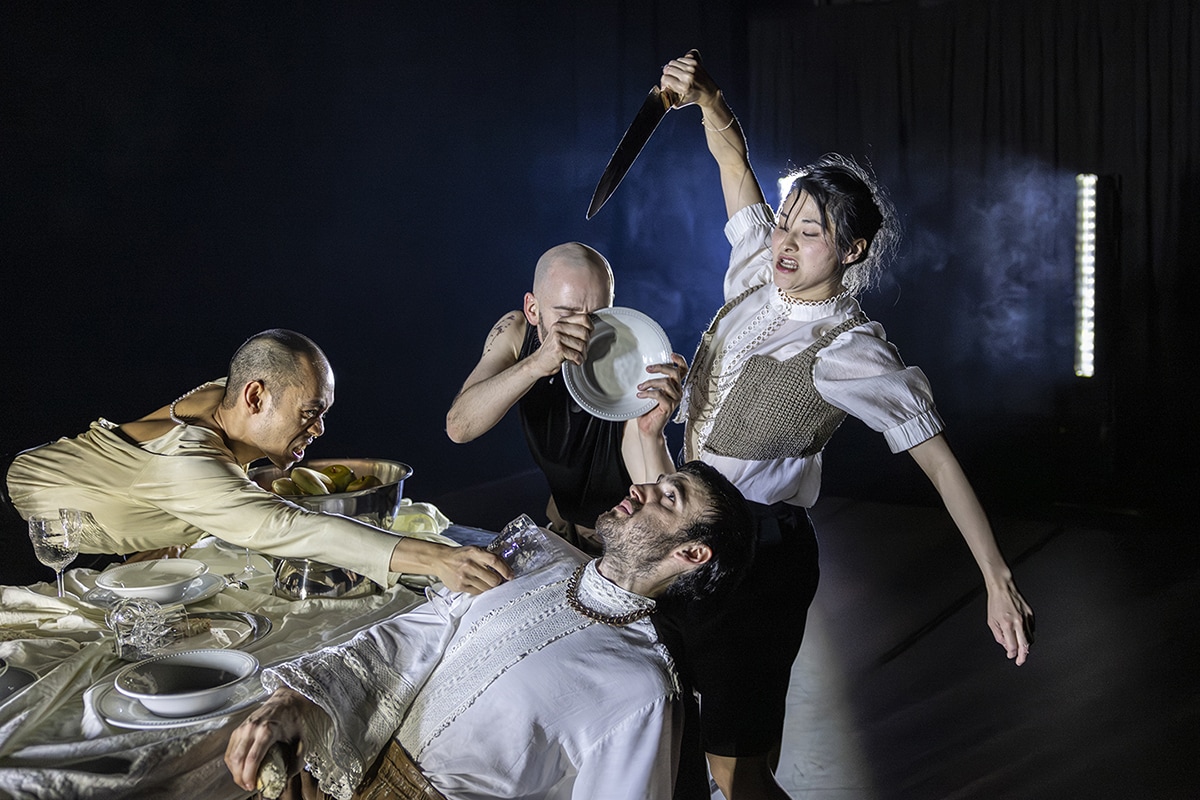
In May Fall for Malmö-based Skånes Dansteater, Aristide Rontini stages a world of appearances and disappearances, where theatrical playfulness shapes – and sometimes limits – how intimacy can unfold.
On stage hangs a deep red velvet curtain on a curved rod, giving the feeling of a stage upon the stage. The scale is unusual; it is hard to decide whether the theatre is shrunk or enlarged.
The division between the auditorium and this half circus tent, half puppet theatre, suggests a distance which, the moment the light fades up, is broken by dancer Samuel Denton who, with impeccable timing, strides from the front row onto the stage. Naked arms appear through slits in the curtain, plates and oversized butcher knives are presented. A glass of water is poured into a dancer’s mouth. Characters present themselves through physical sketches of longing, clowning, romance and sex. The curtain promises mystery by default – a veiled fantasy of what might be going on behind it – and yet this promise is repeatedly interrupted by comedy, flattening rather than deepening anticipation.
The programme notes describe ‘a world where bodies and things appear and disappear’. Indeed – but the question is whether the format of comedic tableaux is compatible with the choreographer’s parallel ambition to portray human desire for love without sacrificing darkness and depth.
‘
Romance, death and comedy unfold largely within the same cartoonish tonal register
May Fall is built from short scenes that sketch multiple relationships and individual states. Romance, death and comedy unfold largely within the same cartoonish tonal register. Overall, the theatricality is heightened, creating the slightly twisted sensation of watching a children’s show that is clearly not meant for children. Madeleine Månsson’s serious and sincere presence does contrast with the surrounding stylisation, offering brief sanctuary from the comic relief. In one duet, her partner adopts a wheeled chair of his own, briefly transforming the wheelchair into shared choreographic material.
Despite the skill of the ensemble, the episodic structure rarely allows material to develop, leaving characters flat after brief introductions. The format recalls the logic of contemporary ‘shorts’ and ‘reels’: we keep scrolling toward the next scene, the next person, the next relationship. Hazuki Kojima’s lonely solo on the table is a notable exception. Here, the gaze is allowed to rest, offering a rare sense of continuity within the otherwise fragmented whole.
The costumes, designed by Maja Svartåker, match the collage style of the performance by combining different historical eras with contemporary details: t-shirts and ruffled blouses, jewellery and leather shorts. A reference to Giuseppe Arcimboldo’s famous painting Vertumnus continues the interest in visual collage, and although the fruity humour can feel blunt, several other well-placed moments of strangeness disturb expectation and maintain engagement.
The final scene offers release: a decadent banquet where food, wine, sex and violence merge in meticulously choreographed slow motion. The sequence breaks stylistically with the rest of the work, evoking a cinematic excess reminiscent of Federico Fellini’s Satyricon or Peter Greenaway’s The Cook, the Thief, His Wife & Her Lover.
May Fall reveals a choreographic fascination with bodies as carriers of layered images, yet its recurring insistence on interruption and disappearance prevents these images from fully unfolding. ●
Ingeborg Zakariassen’s trip was supported by Skånes Dansteater
30.01.2026, Skånes Dansteater, Malmö, Sweden
For tour dates, visit: www.skanesdansteater.se/en/may-fall
Choreography in collaboration with the dancers: Aristide Rontini
Dancers: Tomáš Červinka, Samuel Denton, Facundo Ebenegger, Hazuki Kojima, Michael Marquez,
Madeline Månsson, Marion Rastouil
Dramaturgy: Gaia Clotilde Chernetich
Music: Vittorio Giampietro
Set design idea: Aristide Rontini
Lighting design: Jesper Berger
Costume design: Maja Svartåker