

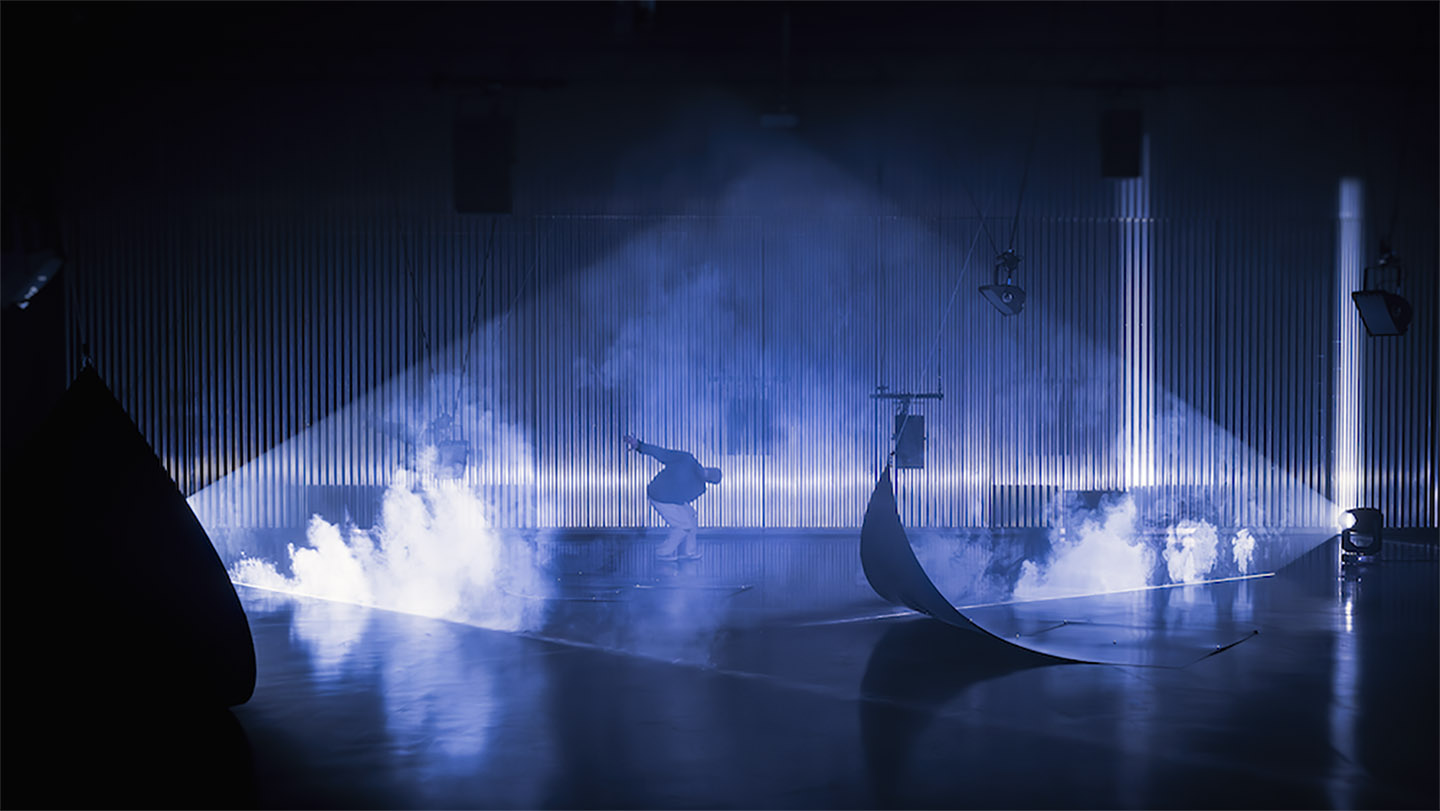
TECTONIC escapes traditional notions of dramaturgy or performativity: choreography, sound and light are treated as equal agents, creating a landscape to be experienced with all senses.
Inside the large hall of Copenhagen’s Dansehallerne, with its arched ceiling and garage-like backdrop, three large metal plates lie across the shiny floor, edges bent slightly upwards, like waves frozen in time. Smoke pours from a machine in the corner, activating the air around the solitary dancer – choreographer Mirko Guido – lying diagonally, face down, simultaneously relaxed and alert, heels lifted and toes pressing into the ground; ease and discomfort coexist in his posture. As the light warms, the space answers with a muted bass recalling a distant techno, or perhaps the muffled rumble of an approaching earthquake.
The middle of Guido’s body rises slowly, appearing almost non-human, as if something beneath him were pushing him upwards. This evolves into slipping, sliding, and crawling backwards on all fours. The movement seems instinctual rather than choreographed, expressing the duality between calm acceptance and increasing force. It’s rare to see such a committed blurring of the line between initiating action and being pulled into movement by external forces. What unfolds feels less like a self-aware subject than a body undergoing processes of transformation and adaptation – making visible processes that are usually imperceptible to the human eye.
This is mirrored in the music, created by Fredrik Arsæus Nauckhoff in close dialogue with the choreography, merging Icelandic field recordings with machine sounds. Rather than representing nature, it produces a sonic pressure field where geological and artificial sounds merge into a single immersive composition. Guido’s breathing gradually enters this landscape, reinforcing the work’s insistence on physical presence.
Almost unnoticed, the metal plates – designed by Olga Regitze Dyrløv Høegh in collaboration with Guido – have risen and are now suspended by nylon threads, adding a vibrating dimension to the landscape as the dancer drifts into the background, redistributing attention away from the human body.
‘
The body experienced from within, while simultaneously appearing as part of a larger whole
Thomas Zamolo’s lighting guides the work throughout, offering shifting atmospheres, from soft daylight to filmic, post-apocalyptic intensity. Towards the end, cones of light become the main drivers of movement, exaggerated by illuminated smoke, in stark contrast to the metal plates casting quiet, pyramid-like shadows across the back wall.
As the one solitary human inside this artificial landscape, Guido presents an ongoing investigation where psyche is not explained or performed, but simply present. By placing his body – using only movement and breath – alongside the animated metal, Guido plays with the subject/object perspective, awakening a quietly phenomenological one: the body experienced from within, while simultaneously appearing as part of a larger whole.
Towards the end, a sense of rhythm escalates: sound and movement become increasingly choreographic as light and music merge into an industrial, techno-inflected intensity. Darkness and lights follow each other in rapid succession, time seems to speed up as the plates lift fully off the ground. After the blackout, what remains is a tension between vulnerability and force. Something has shifted – beneath us, and within the room. ●
Ingeborg Zackariassen’s trip was supported by Dansehallerne, Copenhagen
01.02.2026, Dansehallerne, Copenhagen, Denmark
Tour to Italy and Sweden in autumn 2026, check for updates: www.mirkoguido.com/tectonic
Concept, choreography, performance: Mirko Guido
Scenography, costume design: Olga Regitze Dyrløv Høegh
Costume assistant: Laura Viltoft Overgaard
Metal plates kinetic choreography: Mirko Guido with Olga Regitze Dyrløv Høegh
Lighting design: Thomas Zamolo
Composer: Fredrik Arsæus Nauckhoff
Rehearsal director: Arika Yamada
Curatorial and artistic advisor: Linus Gratte
Dramaturgical sparring: Karen Lambæk
Executive producer and company manager: Csongor Szabo
PR and Communications: Fabienne Pauly-Tanski
Co-production: Dansehallerne (Copenhagen, Denmark), Bora Bora (Aarhus, Denmark)
Residency partners: Åbne Scene/Godsbanen (Aarhus, Denmark), Milvus Artistic Research Center (Knislinge, Sweden), Dello Scompiglio (Lucca, Italy)
Supported by: Statens Kunstfond, Aarhus Kommune, Augustinus Fonden, William Demant Fonden, Beckett-Fonden, Aage og Johanne Louis-Hansens Fond, Wilhelm Hansen Fonden
Motion design equipment supported by: Wahlberg Motion Design
Production: Mirko Guido – Shifting Thoughts