

Now in its 13th year, the annual contemporary dance festival Onassis Dance Days (ODD) presents works by local and international artists, curated each time around a central theme that loosely connects the selected performances. Spread over four days, with the same programme repeated each day, this year’s edition focused on the relationship between the familiar and the unfamiliar – and on what emerges, shifts, or resists definition in the space between the two.
As one of the most visible and networked cultural institutions in Greece, Onassis inevitably sets expectations. Against this backdrop, the predominance of solo works – three out of four – narrows the range of formats (although Efi Goussi’s video installation ‘Tectonic Riders’ was also shown during the festival), while the overall curation is also scaled down to four artists from five or six previously. It is also significant that three of these four are residents of the Onassis AiR programme, which raises an unavoidable question: is ODD gradually becoming an extension of Onassis AiR, a platform where works are supported from research through to final production and presentation? Or does it still function as an open festival, receptive to artistic proposals beyond its own ecosystem? In other words: is ODD primarily a space for the familiar – for artists already embedded within the institution – or does it still leave room for the unfamiliar to enter and unsettle it?
Still standing
Elena Antoniou is a Cypriot dancer whose work has appeared in previous editions of ODD. Her latest piece, ODE, is a duet that takes on femininity and the act of reclaiming space through the female body – a work she describes as ‘a bodily poem’. The audience is seated or standing on all four sides of the stage, bringing viewers physically close to the performer. When we enter, she stands at the centre, wearing a flared beige leotard and boots that echo the 1960s. She is joined by musician Maria Spivak in white jeans, a blue-grey fitted T-shirt and heeled boots, holding a guitar that shifts between instrument and prop. Although her presence is meant to function as a dialogue with the dancer, this relationship never quite materialises: Spivak remains peripheral, unable to meet Antoniou’s intensity.

Antoniou, by contrast, commands the space from the first moment. She stands firm, almost immovable, staring straight ahead while stamping her foot against the wooden floor. A microphone underneath amplifies the sound, turning it into a steady pulse – variously metronome, war drums, or heartbeat. The rhythm never changes, yet slight shifts in her posture alter how it is perceived: polemical, tender, insistent, breathing.
Her body carries layers of memory and experience. At moments, it evokes collective histories, icons and struggles; at others, it moves through deeply personal states – orgasm, birth – that unfold into something shared. Through repetition, she builds a rhythm that slowly draws the audience in. The body appears powerful and resistant, yet also tired, exposed, and wearing down. Antoniou moves very little, working instead through small, slow changes in posture that accumulate over time. Muscles are visible. Breath shifts the abdomen. Legs tremble as the body moves through cycles of strain, collapse and renewal.
There is no attempt to disguise effort. Antoniou’s body grieves, takes pleasure, claims space, loses it, and claims it again. Even when she resembles a statue momentarily brought to life, she remains committed to the action of stamping – to persistence as practice. Forms emerge and dissolve, some recognisable, others resisting familiarity. What holds throughout is presence: a body that insists on being here, now, and on its own terms.
Layers of remembering
Greek performer and choreographer Katerina Foti returns to ODD with (REST IN) BLUE, drawing on personal memories that have shaped her identity, filtered through a distinctly nostalgic lens – and the colour blue. From the outset, a distance is established between performer and audience: a blue perforated construction mesh separates stage from viewers, tinting the entire space and partially obscuring visibility, blurring reality with recollection.
On stage, a semicircle of objects wrapped in layers of embroidery evokes domestic histories: grandmothers’ homes, village life, habits and gestures that feel increasingly familiar but also distant. The scenography, together with the persistent blue hue, firmly situates the work within a recognisable atmosphere of nostalgia. Foti herself is similarly covered in embroidered fabric. At first, only her hands are visible. They perform small, repetitive actions – wiping on a towel attached to her costume, briefly recalling gestures from traditional Greek dances – accompanied by a well-known Greek traditional song subtly altered in its sound.

For much of the performance, Foti remains at the centre of the semicircle, methodically removing layers of embroidery from her body and from the surrounding objects. As the fabric is lifted, boxes emerge from underneath, marked with handwritten names, suggesting the act of packing up or moving on. The process is slow and deliberate, unfolding without urgency. As she uncovers herself, she first appears in a traditional dress, before moving on to change again – this time into casual, contemporary style: a sparkling jacket, a Walkman, oversized headphones. Her movement vocabulary remains rooted in the initial gestures, now reframed through a present-day body that keeps glancing back toward the past even as it moves forward.
By the end, it feels as though we have followed the unfolding of her memories as they pass through her mind, arriving finally at a present moment. The materials and references are immediately legible, and the work clearly communicates the personal and collective stories it draws from. Yet while the choreography carefully peels back layers of time and symbolism, it never quite reaches a point of exposure that risks vulnerability. The memories remain intact, narrated rather than unsettled. The choreography unfolds in a descriptive mode, supported by theatrical elements and repetition. While it traces a personal and collective story with consistency, it keeps at a distance those moments where memory might become fragile or transformative.
Near the end, a phone rings. It is her sister. Foti answers and walks casually offstage, continuing the conversation as she exits – a gesture that gently collapses the theatrical frame and brings us back to the present.
The primitive and the aesthetic
In his first choreographic work, dancer Efthimios Moschopoulos brings a strong physical presence into a semi-lit, carefully composed environment of electronic sound, props, and ritualistic pacing. Titled FAE – the Greek word for ‘eat’ – the work carries a double charge: an instruction, but also a gesture of care, echoing the familiar phrase spoken on returning home, where eating becomes part of a ritual of looking after one another. The stage is sparse but textured: stacks of hay are placed around the stage and a scarecrow-like structure stands at the back, grounding the space in something rural and animal.
Moschopoulos enters diagonally through near-darkness, wearing only a grey garment and holding animal bells. He is slow and deliberate, and with each step it becomes increasingly difficult to keep the bells silent. The sound is produced by the body itself, through effort and strain.

To the right, a table balanced on two legs becomes a makeshift projection surface. A video shows a lamb in labour, while on the floor nearby Moschopoulos re-enacts the labour through trembling. Whether animal or human, the body oscillates between exposure and control. Later, the back of the stage becomes a screen, on which appears an awkwardly composed scene: a long table covered with white tablecloths, two plant pots, and an abundance of fruit. The image recalls a wedding table – groom and bride implied – yet is strangely placed in what resembles an open field, familiar from rural Greek landscapes. As animals enter the filmed scene and begin to eat the fruit, the image breaks down. At the same time, the earlier makeshift projection table is repositioned on stage as an actual table laden with fruit. Moschopoulos eats from it voraciously, saliva visible, swallowing loudly. What was carefully staged is slowly undone. What is decorative or aestheticised through contemporary culture is released into use, appetite and decay, returning to something closer to rural life and animal presence.
The performer repeatedly shifts between human and animal states, at times resembling a goat, at others invoking queer erotic codes. The performance feels ritualistic in tone, driven by concentration and restraint, yet its references multiply. While Moschopoulos’s skill and commitment are undeniable, the work resists settling into a clear proposition, making it difficult to grasp what is ultimately at stake beyond the display of transformation itself. The question it leaves open is whether the so-called primitive body can interrupt or fracture contemporary life – or whether it, too, risks becoming another aestheticised image to be consumed on stage.
I am not afraid to die
Marlene Monteiro Freitas is no newcomer to the world of dance and performance. She returns with NÔT – meaning night in Cape Verdean Creole – a work that fully embraces her chaotic, subversive universe, loosely inspired by One Thousand and One Nights. What Freitas draws from the story is not its narrative, but its urgency: Scheherazade telling stories in order to stay alive.
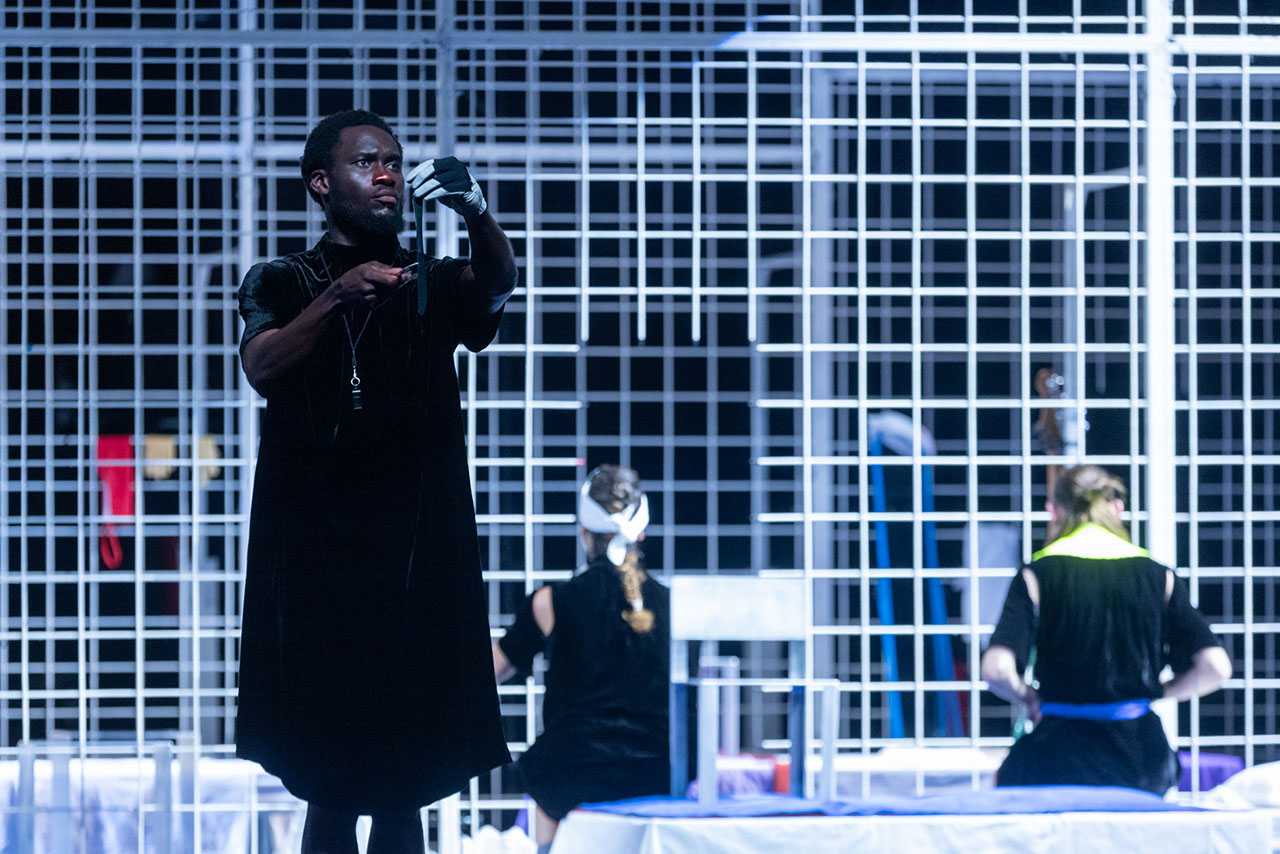
From the outset, the stage is dense and overloaded. A long white fence cuts across the space; three beds sit to the left; water pitchers, chairs, masks and vividly coloured costumes fill the scene. Props accumulate, but they are never static. Sheets torn from the beds become drumsticks; washing baskets turn into musical instruments; objects are constantly repurposed, reinvented, pushed beyond their intended use – much like Scheherazade’s storytelling itself, which must keep transforming to survive. Everything moves, and everything produces sound, generating a rhythm that is energising, relentless and infectious.
The performance unfolds as an all-at-once experience: humorous, touching, nightmarish, excessive. Performers enter and exit in rapid succession, with moments of direct communication with the audience that recall mime, ritual and confrontation. As always, rhythm guides the work and music plays a crucial role in shaping the atmosphere and tempo, blending opera, rock and live sound into a breathtaking score.
The work is carried by an electrifying ensemble of performers who sing, play music, mime, and dance. Beneath its excess and humour, it is driven by an existential urgency: telling a story becomes a way of staying alive. One of the most striking presences on stage is the participation of Mariana Tembe, a disabled performer, integrated as a force within the choreography itself. This inclusion feels neither illustrative nor symbolic; it is structural. If one were to invoke crip theory here, it would be less as a framework than as a lived condition of the work – disruptive, unapologetic and transformative.
NÔT is a story of violence, endurance, struggle and insistence. Yet what remains most compelling is Freitas’s capacity for subversion: even as the work veers toward the gothic, the apocalyptic or the grotesque, it slips into sensuality, humour, or something quietly absurd. Chaos never fully collapses into despair. Storytelling becomes a strategy for survival.
The atmosphere is dreamlike and nightmarish at once – dense, frightening, exhilarating. Emotions circulate freely: fear, laughter, exposure, loneliness, togetherness. They arrive and dissolve as they do in real life, without hierarchy or resolution. The work closes with a striking live performance of Nick Cave’s ‘The Mercy Seat’, leaving us with the line: ‘But anyway, I told the truth, and I’m not afraid to die.’
Overall, this year’s ODD foregrounds the body as primary material – not as an abstract idea, but as a point of return. Across the programme, the body emerges as a site through which the present is questioned: what keeps us alive, what propels us forward, what binds us together in temporary or lasting communities, and what shared histories continue to hold – or fail – when the lights go out. This insistence on the body can hardly be read in isolation. It resonates with a world marked by ongoing wars, environmental and humanitarian crises, the rise of neofascism, and renewed pressures on human rights. At the same time, the rapid development of AI technologies throws the body back into focus, not nostalgically, but as something irreducible – a material, vulnerable, and increasingly political ground. ●
05-08.02.2026, Athens, Greece