

ARC for Dance festival is now in its 17th edition, irrefutably having grown and secured its presence as an Athenian cultural institution. Its programme spans in two weeks, covering shows of diverse scales and interests, from outdoor performances in the context of ‘Arc Hood’ to studio presentations to ‘Prime Movers’ – a section dedicated to choreographic experiments for dance artists who are not yet established. ARC has always had a sort of itinerant approach in the city, occupying different theatres and focusing on neighbourhoods that may be underrepresented in the map for downtown dance audiences. Arc is after all a word for trajectories, for bridging, for merging diverse media, styles and tastes. Below, a personal, not exhaustive selection of works, which illustrate ARC as a festive, placated curatorial frame for dance works despite its thematic title, ‘Ruptures’.
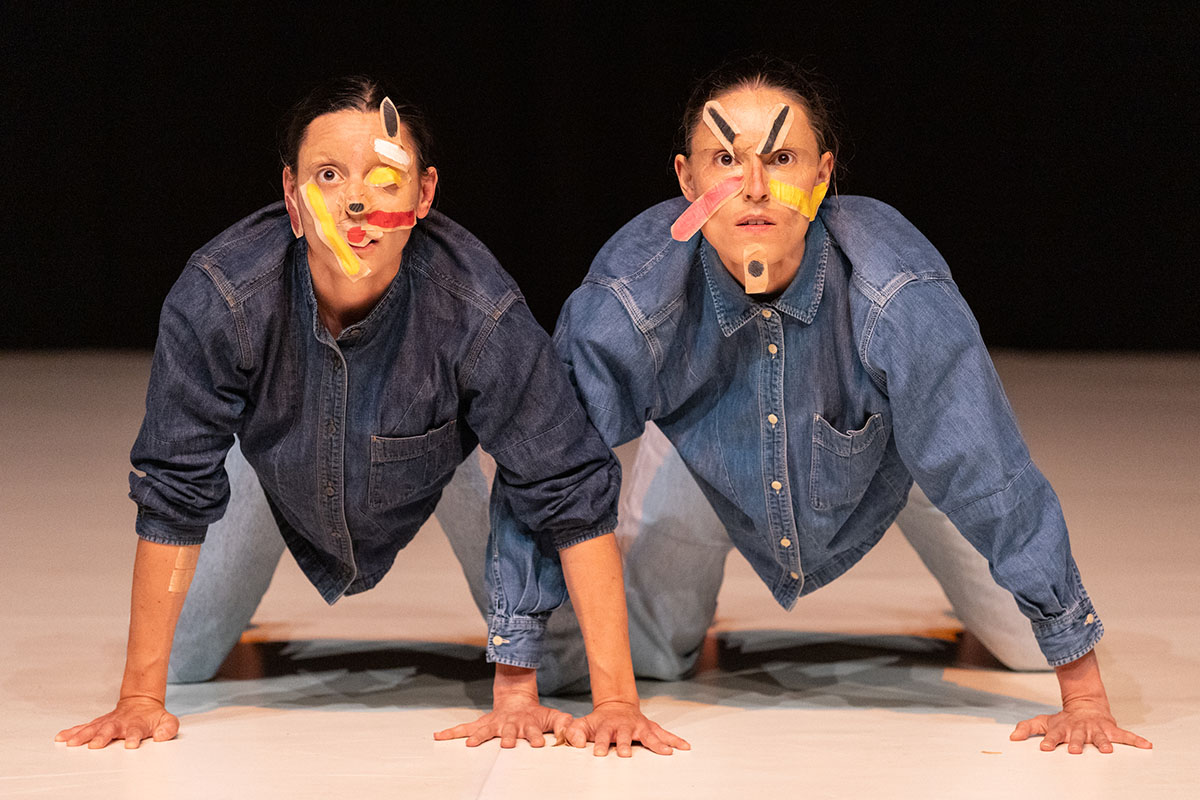
I can’t say if the face could still be seen as a mirror to our souls, but for the duo Les Idoles (Lise Messina and Chandra Grangean), the face is indubitably a canvas to play with, to explore the inexhaustible variety of facial expressions, to attempt a sort of dermal ‘excavation’ in order to reveal the plasticity of its sur-face. The two performers stand motionless centre stage. Their torsos slightly inclined and faces looking apart; they wear jeans, blonde wigs and glossy red lipstick. They look a bit like Cindy Sherman’s imagined, off-grid characters, their gaze dispersed and almost freakish, accentuated by the white noise. Everything in Reface is about nuanced gestures and facial textures and not so much about embodied loudness: the wigs become puppies, the luscious lips get eaten, a nose gets exfoliated that you wonder how much is left underneath, and all the while a parade of not-so-familiar faces. In this carousel of characters, facial expressions are moulded within seconds, prosthetics come and go, indigenous masks, gargoyles, medieval faces flash before your eyes.
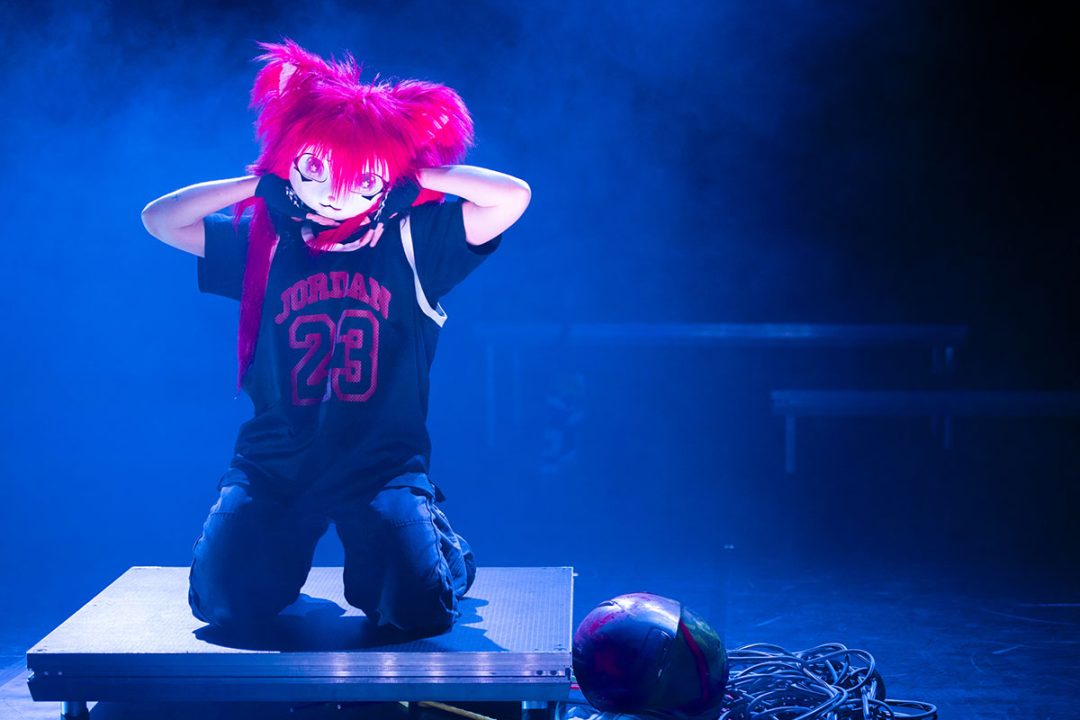
Off, Off by and with Despina Sanida-Krezia has an underground, street vibe to it. A corridor of light pierces the darkness and an anime character with feline traits comes down the stairs. They carry a helmet, a metallic cricket bat, a keffiyeh, their quirky looks charged with ambiguity: feline cuteness and slinkiness turn into b-boyish fierceness once the headpiece is removed, chest popping and arms gesturing rampantly to the music. ‘All eyes on me,’ we hear them say, the phrase unmistakably evoking the anti-war cries for the occupied Palestinian territories, and as in real life, getting lost in the constant flux of violent images and disheartening breaking news, Sanida-Krezia now physically wrestles with an over-abundance of references and styles. Caught between fakeness and realness, they run around with their arms signalling victory as a scorer, they use the bat as a guitar showing a bit of grunge weariness, they make every physical action a blender of conflicting emotions; they fall and rise, not necessarily as a phoenix, more like an angry fist raised to the sky. As nauseating as the flickering references are in the virtual world when we indulge in doom scrolling, they seem to have a similar effect on stage, leaving a sense of vacuousness in the end. The performance registers this unsettling and playful ease of interchanging moods but ‘off’ may ultimately read as a bit more evasive, missing the sustained, arresting quality of ‘staying with it’.
All’arme by Ginevra Panzetti and Enrico Ticconi for the Croatian Studio Contemporary Dance Company, explores the Janus-faced aspect of choreographic discipline: from individual agency and self-expression to dance as mass ornament and embodied suppression. Like the mirroring of the words, arme (arms) and alarm, movement patterns in this piece eerily mutate or morph into unexpected hybrids, creating a web of historically persistent connotations. A woman enters the stage holding a flashlight. Soon more will follow, gradually creating a meander of trajectories between the members of this peculiar sextet, turning this game of light and shadow into a patrolling sequence. Different rhythms are caught in this hand-manipulation of light, high beams directing our gaze to surfaces, hidden angles and occasionally anguished faces. Rhythmicality here aims not only to solidify the coherence of the group, but also to heighten its menacing presence towards the audience: attires and body types all connote uniformity rather than singularity. Facial expressions are strictly limited, gazes scan the space with acerbic tenacity, and group dominance is asserted through co-ordination and rigidity. But at times, their war-like marching is interrupted, as if this phalange of human bodies were penetrated by vulnerability, exposing the labour of holding the space together. When does defence disguise itself as power, imposing violence under the threat of a possible assault? At times flashlights are turned inwards to reveal an instantaneous pietà, a glitch of female solidarity before their staccato call of duty brings them back to action.
The weaving of the space, as the piece evolves and mutates, is now interlaced with other references: a cheering crowd, a folkloric dance, head-banging and throbbing sound as in a metal concert, tap dance, jazz-style kicks but also the ferocious kicks of aggressors – images come and go in the blood-tinted light of a dying star. Driven by the urgency to keep up with the siren-like rhythm, the dancers momentarily escape into a ‘raving’ shot, but evil somehow seeps back in, confirming its ‘banality’. All’arme, in its ‘melting pop’ manner, with references crossing and overlapping, creates a dizzying mise-en-abyme and ultimately seems to shed more light on our collective aphasia – that is, circling a theme multiple times, without (even) attempting an imaginary exit. In my eyes at least, this constant oscillation between playful vagueness and suggestive weightiness creates a kind of contemplative withdrawal, as if putting things of alarming importance on snooze before succumbing again to darkness.
Super-A by Sofia Mavragani is a solo-performance based on the theogony of goddess Athena, ‘a rupture in male dominance’ as the programme note puts it, which sadly doesn’t make the grade. A white runway with a high screen backdrop gives a bit of fashion or concert vibe; the performer (Maria Vourou) dressed in black cycle leggings and cropped hoodie enters, her back to the audience as she becomes a statuesque shadow figure highlighted by silverish strobes and high voltage beats. The pseudo-mysterious entrance is resolved once the upbeat of the electronic music matches a sort of aerobic sequence, hops and squats and hands raised as if to cheer up the followers of her cult. Although the Vourou works hard to bring the energy to a pitch that might spark some crazed fandom – or maybe at least uplift herself through this Olympian cardio – she is left unarmoured in a war against the lighting effects and electrifying music. The 30-second flashmob of dancers rising from the audience to imitate a rave scene might not only be super-cringe, but also render Super-A Super-C (cliché) and leave us wondering about Athena’s if not the choreographer’s wisdom.
Fortunately, there are still dance pieces that praise the body as a temple; not simply beautify it or blindly worship it, but render its rich and contrasting experiences the sensorial adornment of a show. When the Bleeding Stops by Lovísa Ósk Gunnarsdóttir is one such case, a hybrid of lecture-performance and showcase on neglected collective joy. The first half is autobiographical, focused on the choreographer’s relation to dance, a relatable timeline decorated with moments of anticipation (the beginning of dance career), of fulfilment (the reassurance that you have made it so far), of mid-life existential hiatus (what are you going to do when you stop dancing), of all-too lived questions around injury, withdrawal, pleasure, and last but not least, stigma. Gunnarsdóttir is a genuine, tender narrator, bringing humour and straightforwardness to her story, a woman’s story: menopause. Her account, however, is not one of victimisation and grief: starting from her spinal injury and the recovery via daily home rituals to reactivate her spine and her inextinguishable desire to dance, she crafts a life-affirming story that could be a source of inspiration to the many.
In the second half, the stage is turned into a carousel of home-made videos, with women unashamedly practising their daily dance routines. Indeed, ‘words don’t come easy’ for these danced and heartfelt testimonies. It’s not words that Gunnarsdóttir is after anyway, but rather a way to take women out of their ‘corner,’ to invite them back to centre stage, making a gesture of solidarity and empowerment. Anthropologically speaking, these snippets accompanied by the real presence of nine women on stage are a wonderful range of female expressivity, an ode to ‘dance as if no one is watching’ turned into ‘dancing together as if watching each other’, recognising something that needs to be articulated through the body. When the Bleeding Stops becomes, eventually, more about when the tearful joy starts, taking the audience to their feet dancing, and pausing – even for a brief moment – bodily stigma.
Feed Me Peace by Anastasia Valsamaki is also, somehow, a diptych, evolving from the serene, enclosed ambience of one’s room, to a collective hyperenergetic dance, a call to take rhythm as the element that holds us together. Four seated performers, in what looks like a soundproof box covered with pillows, play around with a mic and a looper. We first hear their deep, steady breathing, then other minuscule sounds are added: sudden rushes of water, combing one’s hair, a soft almost indiscernible murmuring by someone reading a book, a razor, together making a sound library of daily, aurally unnoticed gestures. This sensorially layered ritual is accentuated by the shelter-like setting and the clan-like gathering of dancers, creating a scene that looks both primordial and mundane: embodied mellowness, a dulcet home-made soundtrack (the contribution of Jeph Vanger is palpable), an untarnished, almost adolescent feeling to the whole atmosphere.
The pillow-shelter will later be dismantled, the dancers now following the accumulative flow in their movements; a web of supported limbs, jointly moving in space, supple and nuanced. In the corner of the stage, we follow a slideshow of photos; history seems to coincide and collide with History, the personal and the collective, interwoven, inseparable. A performer in street style unlocks a delicate and sharp solo, her moves collected yet with an inner urgency that will later be explored by the rest of the ensemble. A new member steps in (only because of an injury in one of the original dancers), the tempo of the music speeds up, unison and volume becoming now the priority. In this section, Valsamaki delivers her signature fleet-footed style; the shift in dancing is abrupt but so is the mood-swing of the group, members lifting each other in this escalating, fast-beating ode to camaraderie. If music and dance point to exhaustion, the group responds with gaiety and tenacity. Feet don’t lie, we might even say, as the dancers plunge in dynamic diagonals reminding us that the stage is a place where care is often neglected. And if care is practised in multiple ways, why not with a facial mist in the end, as dancers lie down, empowered maybe, but also exhausted. ●
15–25.05.2026, Athens, Greece