

Baltic Take Over’s 3rd edition arrived at STHLM Dans not as a loud declaration but as a compact insertion: a small Baltic platform folds into a larger Scandinavian dance festival. Sunny spring weather welcomes the audiences at Konträr, a small subscription-funded venue whose orange wardrobe-corridor leaves little room for anonymity. Familiar and unfamiliar faces linger there, smiling and exchanging small talk before the performances begin. Three days, three countries, three pieces, and all duets.
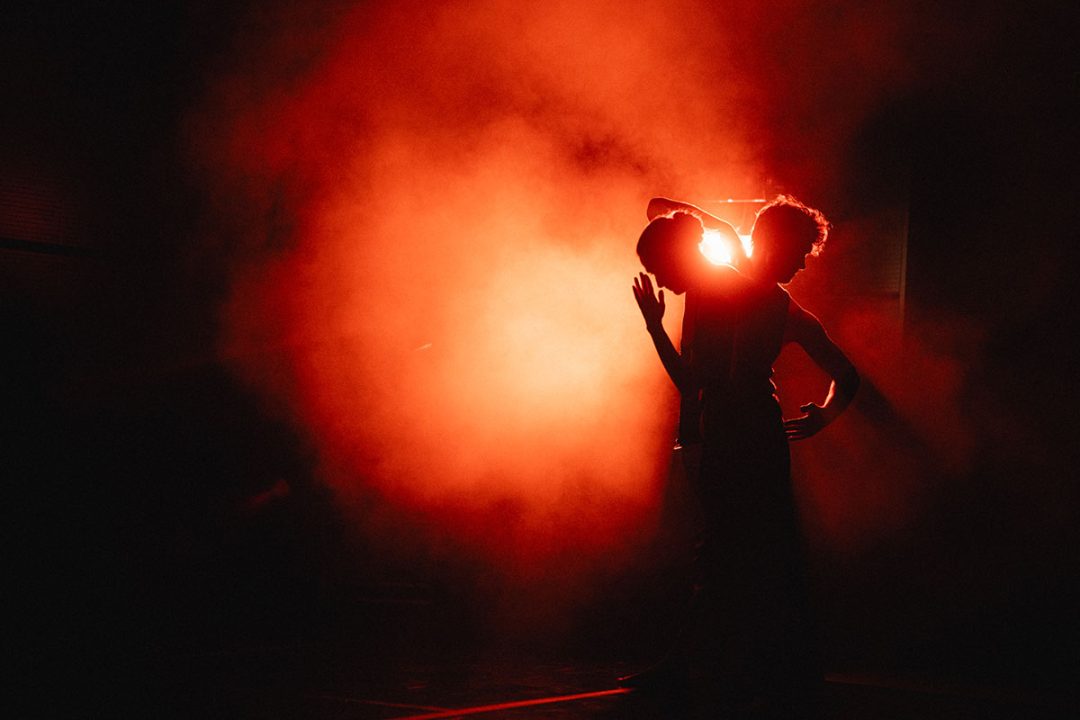
The festival opens with Latvian performance Oblicus by artist duo Ievakrish (Ieva Gaurilčikaitė and Krišjānis Sants). Two barefoot dancers step onto an otherwise empty stage. Wearing khaki trousers and fishnet tops they give a verbal introduction to the piece. As if in a classroom, we are given an overview of what we are about to witness. The meaning of ‘oblicus’ in Latin, what kinds of letters will be read aloud, and the principles of the choreographic score.
They then kneel down on either side of the stage and intimately (yet into a microphone) recite two love letters to each other. Love letters tend to collapse individuality: whether gifted, written, read from a book or seen in a gallery, they often sound strangely universal. These are no different.
The second part is the dance. As announced earlier, oblicus is neither parallel nor converging. Clear, linear, geometric lines are drawn throughout the stage by the dancers’ limbs. Although they never touch, invisible layers of arms and legs are stacked upon each other. The two rhythms differ slightly, Gaurilčikaitė is quicker to start and more fluid in her body language. Sants contrasts that with sharper movements that find their clear endings through the piece. Yet they constantly adjust to one another. Even though they might be slightly out of sync, they play to the same tune.
Orange light lives a life of its own. The lighting ignores the dancers’ movements, switching on and off at seemingly awkward moments. At times it illuminates only half a body; at others, empty space. This odd decision brings me back to the statement that the dancers started with: ‘this is our contemporary love story’ – it is fragmented and incomplete, but somehow steady. We have reached the end of the performance that was introduced to us in the beginning.
Blackout. But, the audience hears shuffling. Orange lights now light up in a form of flashlights that the dancers are holding. Still dancing, still tracing the space with choreographic lines. The dancers reappear naked. Their nudity feels neither provocative nor symbolic, only unexpectedly intimate.
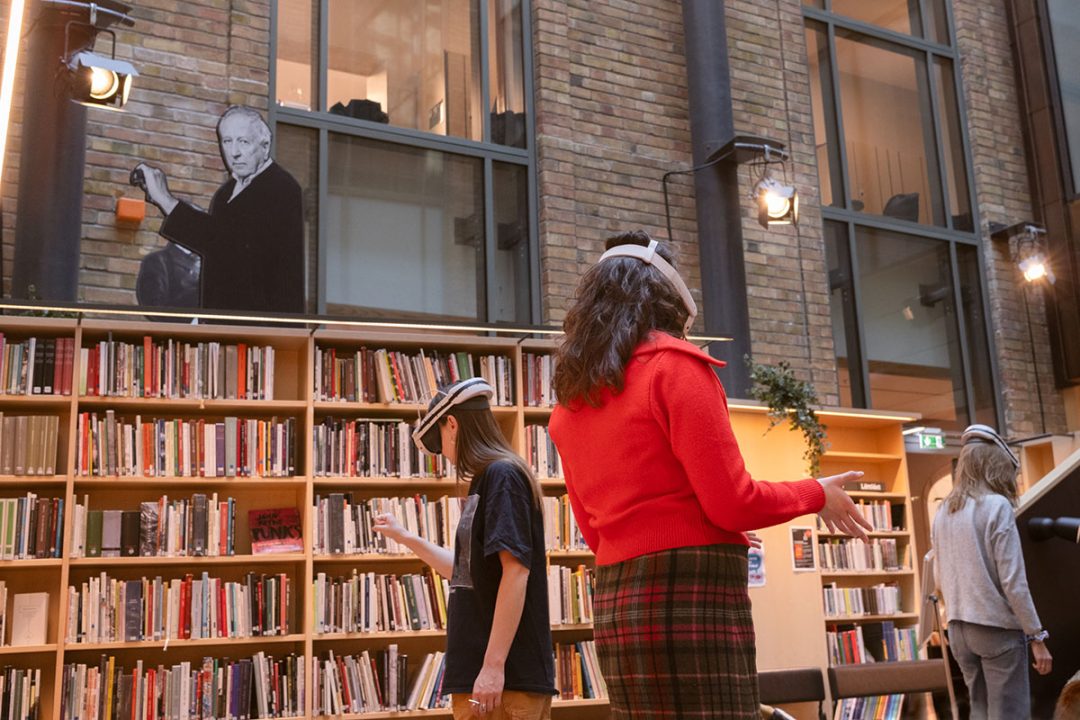
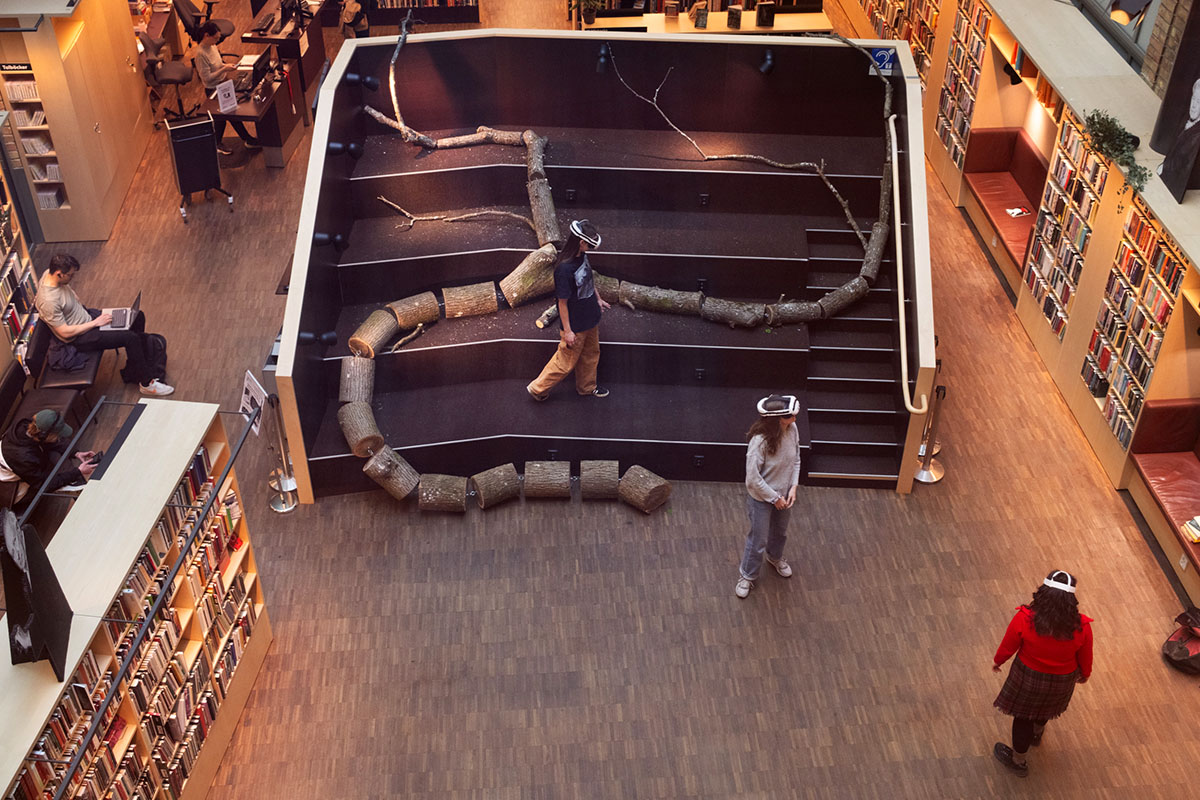
The Estonian entry for the festival is an interdisciplinary virtual reality piece. All three keywords I prefer to keep my distance from, yet on a Saturday morning I make my way to the huge Tranströmer Library. I marvel at the architecture and the many entrances that make the building feel unusually porous. Once in, I’m intrigued by the amount of people I see at 10 am reading, writing, working in the space. Their attention is fixed on whatever lies open in front of them.
Held in Human II: Rose in Your Brain by Liis Vares and Taavet Jansen takes place in the centre of the library in a small area beneath a ceiling that stretches across several floors. I enter a black and white world where my fingertips draw dotted lines across the space, where poetry and scattered thoughts drift before my eyes, and where my feet take steps on top of words.
I notice that a woman near me has stopped her reading and is watching my movements. I smile at her instinctively. I forget that I’m wearing the VR glasses and she probably thinks I can’t see her. She shies away from my smile, looking back to her book. For this brief moment, I become a performer rather than an audience. The gap between the two roles was bridged so seamlessly, I didn’t even have the time to hesitate.
A yellow sign ‘Hold me’ descends from the ceiling. I grab it and look at it intently. I feel warmth radiating between my hands and become briefly startled by the body’s willingness to believe the illusion. And just like that everything fades away. Vares approaches me to take off the glasses. I don’t find the words to give back to the artists. But thankfully they guide me to a typewriter where I can type some thoughts. From VR to typewriter there are only a few steps, and the two balance each other unexpectedly well.
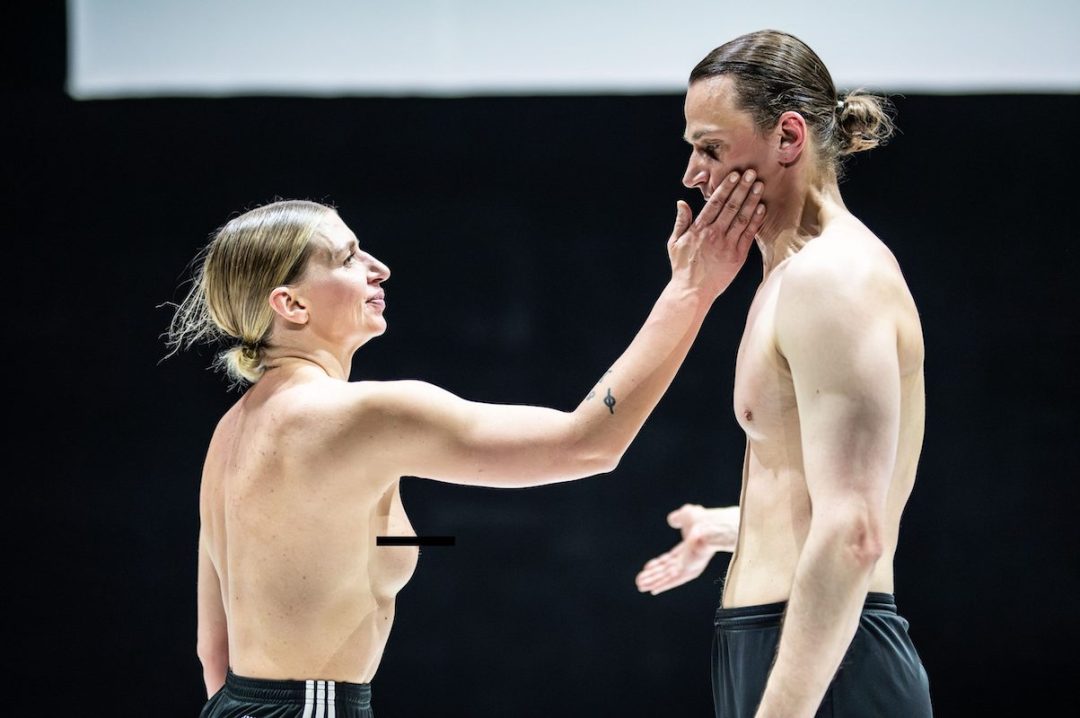
The festival’s final performance is CLAP & SLAP by Lithuanian artist Agnietė Lisičkinaitė and Belarusian artist Igor Shugaleev. Through the repetitive actions of clapping and slapping, the work maps contemporary geopolitical tensions across the Baltic and eastern European region.
Who bears responsibility for the war in Ukraine? What should one individual do within larger political machinery? What does collective responsibility actually mean? The audience watches the dancers slap their backs while these questions slowly accumulate. The repeated smacking gradually turns the performers’ backs bright red, transforming rhythm into visible damage.
Bush Hartshorn, the dramaturge of the piece, injects a much-needed layer of humour via video. He teaches the audience to clap through words resembling nursery rhymes. We are encouraged to clap – to give a rhythm to the dancers’ slapping. Once we stop, so do the dancers, but then they get really close and almost threaten us to start again. It is a sobering experience to understand how quickly rhythm overrides individual hesitation.
The piece ends with two anthems, the Lithuanian national anthem and a Belarusian religious hymn that transformed into a signature anthem during the 2020 anti-government protests. In many western European contexts, the work’s embrace of patriotic symbolism might feel uncomfortable or overly direct. Yet from a Baltic perspective – and especially under the ongoing shadow of Russian aggression – such gestures acquire a different urgency. Is it possible to not turn patriotic under the threat of a war? As one Ukrainian artist once told me, she always identified herself through her work, her relations and philosophies before February 2022. But since then, she has first and foremost become a Ukrainian, because she became a target.
Red targets remain visible on Lisičkinaitė and Shugaleev’s bodies as they sit down for an artist talk. ‘Everything is political,’ Lisičkinaitė says almost immediately, and this is omnipresent in the entire festival. Politics reveal themselves not only in explicit subject matter, but in the conditions surrounding the works: the precarious state of cultural funding in both the Baltics and Sweden, the choice of venues, and the positioning of a small Baltic platform within the larger framework of STHLM Dans. Baltic Take Over never attempts to separate aesthetics from circumstance. Instead, it insists that bodies, institutions and histories remain permanently entangled. ●
08–10.05.2026, Stockholm, Sweden
baltictakeover.com
See also Anna Kozonina’s text from Baltic Take Over 2025: springback.org/magazine/2025/07/baltic-takeover-2025