

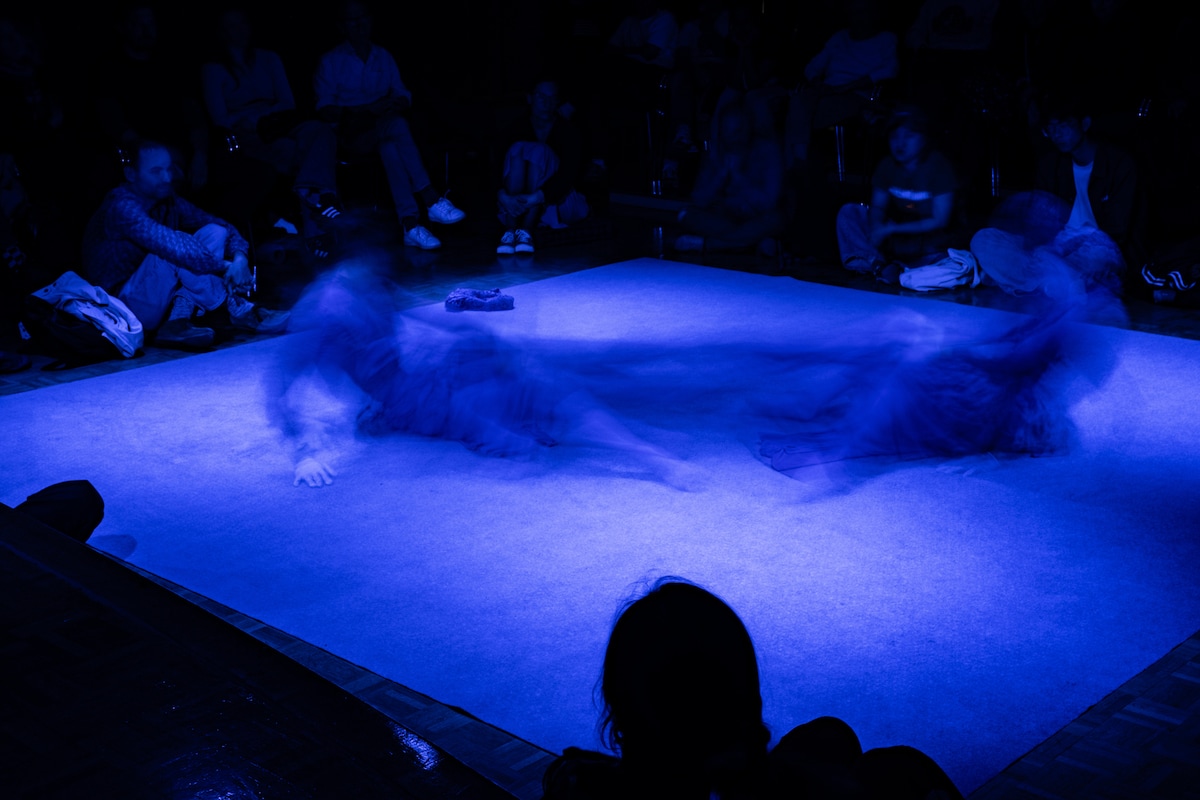
The audience is drawn into the blue – the colour that has no dimensions, that exists beyond dimensions, according to painter Yves Klein. Gathered on the floor around a large blue square rug, immersed in a deep blue light, we all become part of the performance. The music itself seems to sound blue. Yet our attention really is focused on the duo unfolding within that monochromatic square.
Dancers Piaera Lauritz and Brenda Boote-Bidal are at once two bodies and a single entity, bound together by their long blue dresses and a rope tied across their busts. As melodies by Hildegard von Bingen echo through the space – summoning the spirits of women forgotten or marginalised throughout history – the two performers engage in a relentless struggle, both together and against each other, trying to break free, to draw closer, to become one, to remain two.
Crash Test #7 – ICONICA is part of the ongoing ‘crash tests’ series that choreographer Paula Rosolen (Aerowaves Artist Twenty26 with NOICE/NOISE) developed further during her year-long residency in Paris at the Cité internationale des Arts, as a fellow of the Hessian Cultural Foundation. This residency allowed her to deepen her exploration of lighter, more flexible formats designed to be shown outside traditional theatrical spaces at the intersection of choreography and visual arts – like on that April day in the Maison Heinrich Heine in Paris. Developing these technically lightweight formats is both an artistic and a practical gesture. On the one hand, it allows Rosolen to move beyond the frontal relationship traditionally imposed by theatre architecture and to propose a different spatial interaction with audiences. On the other, it offers a way of escaping the institutional and financial constraints associated with larger stage productions.
Based in Frankfurt, where she founded her company Haptic Hide, Rosolen studied dance at the University of Music and Performing Arts in Frankfurt and graduated from the Institute for Applied Theatre Studies in Giessen. There, she was introduced to the principles of documentary theatre that strongly shaped her early artistic practice: rigorous field research, close archival studies, and interview-based creation processes.
Her first solo piece in 2010, Die Farce der Suche (The Farce of the Search), dedicated to Renate Schottelius – a leading figure in German Expressionist dance in Argentina, Rosolen’s country of origin – marked the culmination of her training and the emergence of her own choreographic language. She gradually expanded this artistic language over the years and through successive creations, soon moving away from the solo format toward vibrant group pieces infused with pop culture and the exuberant aesthetics of the 1980s.
A close attention to the body and its physical capacities lies at the heart of Paula Rosolen’s work – an interest already clearly present in Aerobics! – a ballet in 3 acts (2014), which earned her the first prize at the Danse Élargie competition at Théâtre de la Ville in Paris. There is no music: only the raw squeak of sneakers on the linoleum floor and the strained breathing of the dancers engaged in an uninterrupted hour-long performance somewhere between fitness training, endurance test and postmodern dance.
The same collective force of shared energy reappears in Punk?! (2018), a piece in which Rosolen was still performing on stage alongside the dancers she directed. Bodies collide, explode, and exist through a raw physical intensity supported by the music. A radically different atmosphere emerged in 2020 with Flags, with its seemingly sanitised staging that uncannily anticipated the aesthetic of pandemic-era distancing that would spread worldwide that same year. Five performers dressed in white jumpsuits, faces covered with masks, stand onstage. They look like pawns in a life-size game, waving their flags of different colours that can evoke countries, affiliations or codes.
Across her works, Rosolen moves through different atmospheres, periods and styles, exploring the traces and influences they leave on individual bodies and on the collective body formed on stage. Each of her pieces creates a complete world – encompassing set design, music creations and costumes – united by a sharply articulated physical vocabulary often rooted in sportive gestures and movements that appear deceptively simple yet highly expressive.
In her latest works, notably 16 BIT (2022), Rosolen has embraced a distinctly electro style, oscillating between retro and futuristic aesthetics. This choreography, like the previous ones, approaches contemporary society from its margins – through subcultures and communities driven by a persistent desire for freedom through art and collective experiences. Set to the mesmerising and dramatic track ‘Where Are You?’ by 16 BIT (1986), six dancers move across the stage. They are dressed in red or blue glittery jumpsuits paired with dark jackets with exaggerated shoulders that make them look like disco-style American football players. These costumes emphasise the athletic dimension of the choreography. The dancers perform dynamic, direct movements, firmly grounded, and pay tribute to techno culture and its historical significance especially in the USA and in Germany.
Paula Rosolen crafts choreographic worlds that are diverse yet coherent, experimental yet precise – and that leave us wanting to see more. ●