

Two men linger beneath a row of trees, their branches heavy with bright oranges. At first, they are indistinguishable from others gathering around them. But as their eyes begin to dart, their weight settles into one hip, and their arms gently rise to right angles, it becomes clear that something is about to happen.
This is Oltre, a short duet by Florence-based Collettivo Giulio e Jari (Giulio Petrucci and Jari Boldrini), in which they morph into sculptural, seemingly classical poses, befitting the courtyard of the 16th-century former convent they inhabit. Creating diagonal tensions across the body, the forms pull them into fluid, sequential motions, and propel them into wide orbits of each other and their verdant surroundings. Later, this meditative setup is disturbed by a dressage-like skipping sequence, and for those playing close attention, the surprising appearance of purple liquid streaking down one performer’s temples.
Oltre is the first work I see as part of the sixth edition of Le Danzatrici en plein air, and it’s a fitting introduction to the festival. Founded in 2020 by dancers Giulio De Leo and Erika Guastamacchia, Le Danzatrici is a month-long programme of dance presented in historical, outdoor spaces across the small city of Ruvo di Puglia, Italy. Like Oltre, many take place in the San Domenico convent. Others, like Corpo Grammaticale, a duet by dancers from Balletto Teatro di Torino (BTdT), are staged in the open-air atrium of the town’s Jatta Archeological Museum.
Dance in dialogue with space
Corpo Grammaticale’s improvised nature grants the dancers freedom to respond to features of the 17th-century palazzo housing the museum, rustling their fingers through potted plants that line the square and dodging pools of water left from a rainstorm. While some relational attempts feel somewhat twee – such as the opening track, Singing In The Rain, chosen due to the weather conditions – those that draw inspiration from the museum itself are more convincing. Bailey Kager’s airy lability and playful frolicking, for example, bear a striking resemblance to figures of prancing nymphs on the terracotta pots displayed in the rooms behind her.
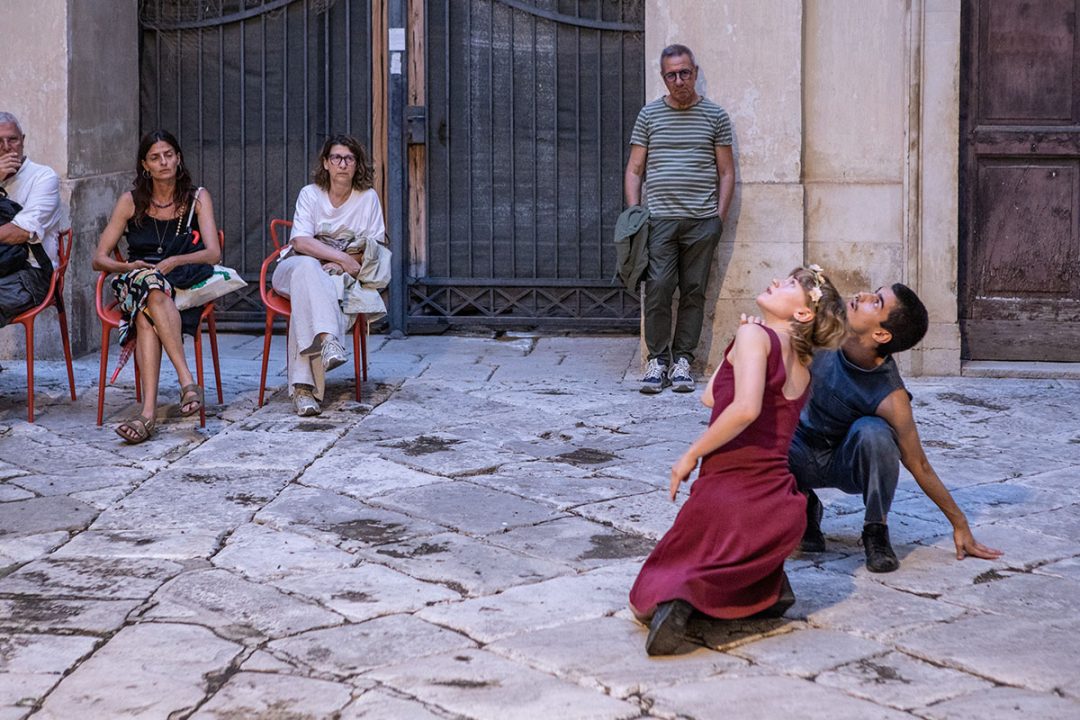
For the most part, Kager and her partner Ivo Oliveira Santos take turns to surge through the space, intently observing each other in a relationship that oscillates between flirtation, confrontation and trepidation. When they do come into contact, touch is mainly restricted to the upper body.
It’s a far cry from Collettivo Giulio e Jari’s Elysium. Performed the day before in the convent’s larger cloister, full-body entanglement is central to the group work’s movement language. Inspired by the work of watercolour artist Lou Benesch as well as imagery of the Elysium Planitia (a broad plain straddling the equator of Mars), Elysium starts with an otherworldly tableau. Performers enter the stage with lit incense sticks in their mouths, smoke trailing as they drift like spacecraft charting new territory.
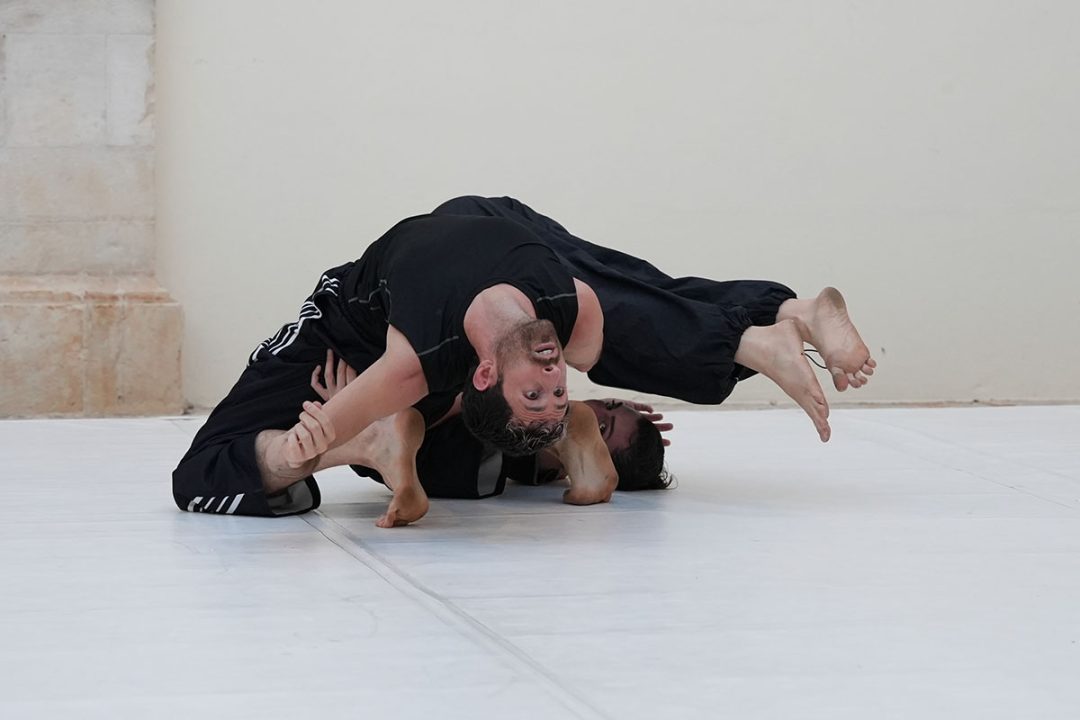
Yet it’s Elysium’s later scenes that are the most impressive. In duets, dancers’ bodies melt into one another, limbs intricately lacing as the pairs tumble as one organism through space. Rooted in the sharing of weight and an acute attunement to one another, these moments strongly resemble contact improvisation, yet must be meticulously rehearsed given the precise catches of heels, hands, and hips that enable their more acrobatic feats. At their best, the dancers achieve an illusory state of fusion, making it impossible to decipher one body from another.
Internal architectures
Not every work at Le Danzatrici enters into dialogue with its surroundings. Alessio Maria Romano’s Petit #1 and Petit #2 draw audiences into the closed systems of their own game-like structures. Performed back to back by Compagnia Arearea and BTdT respectively, the two quartets see dancers improvise from a vocabulary of repeating movements and phrases according to a set of rules.
The exact parameters of Petit #1 remain covert. To a soundtrack of rolling piano notes, the four dancers constantly switch partners while glancing over their shoulders at the duet they are missing out on, making the work feel less like a playful game than an envy-fuelled ménage à quatre. The rules of Petit #2 are also cryptic, but some elements are vocalised: the dancers call out their own and each other’s names as prompts to action, like a series of human Twister commands that descend into playful duets. (The names, incidentally, do not correspond to the performers, but to the phrases they prompt.)
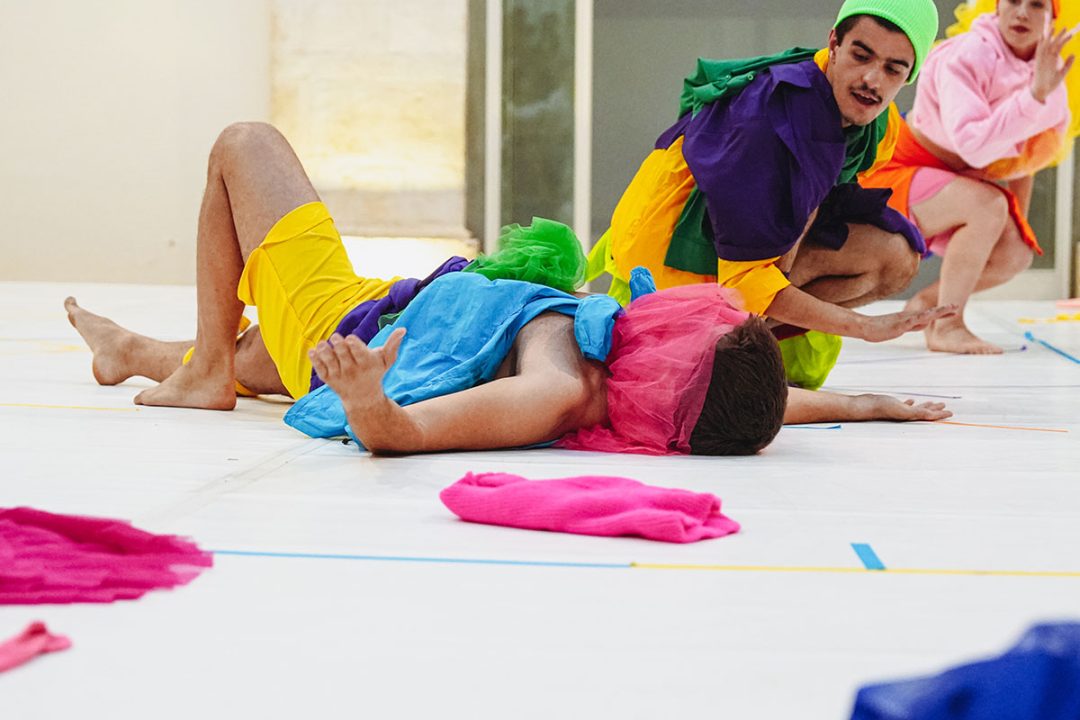
Petit #2 is at its most engaging when the performers’ concentration and effort become visible, as does their agency to reject the prompts. ‘I’m Ivo, right?’ one dancer asks, struggling to keep up with the work’s shifting logic. ‘I’m not ready yet,’ another says defiantly. A third dancer sits alone, one arm outstretched in invitation. ‘Bailey to Luka,’ she repeats, like a lighthouse continually casting its beam out to sea, only for no answer to return.
Connecting with Ruvo’s residents
As a festival, Le Danzatrici truly comes into its own when it engages not only with Ruvo’s architecture, but also its inhabitants. This is the case for works presented by Luxembourgish choreographer Jill Crovisier, in the second of her three years at the festival’s Artist in Focus. This year, Crovisier transmitted her 2023 solo Tight Dress to festival co-director Guastamacchia – an intensely psychological work in which the performer snaps between dance languages and emotional states, wrestling with her floral dress like a constricting skin she’s outgrown – and also presented Papusi Corpo, the result of research for an upcoming duet for young audiences exploring the effect of masks on the dancing body, developed here with ten local youth participants. Wearing vintage floral dresses, shirts, bowties and beautiful yet oddly unsettling papier-mâché animal heads handcrafted by a group of nearby high school students, the performers physically explore the characteristics of the creatures they’ve been assigned. A rabbit jolts skittishly as the rest of the group points and laughs; a strong-armed ram determinedly drags herself along the floor; the entire group comes together beneath a white sheet to create the rippling body of a sheep – a more elaborate, abstract version of a two-person pantomime donkey.
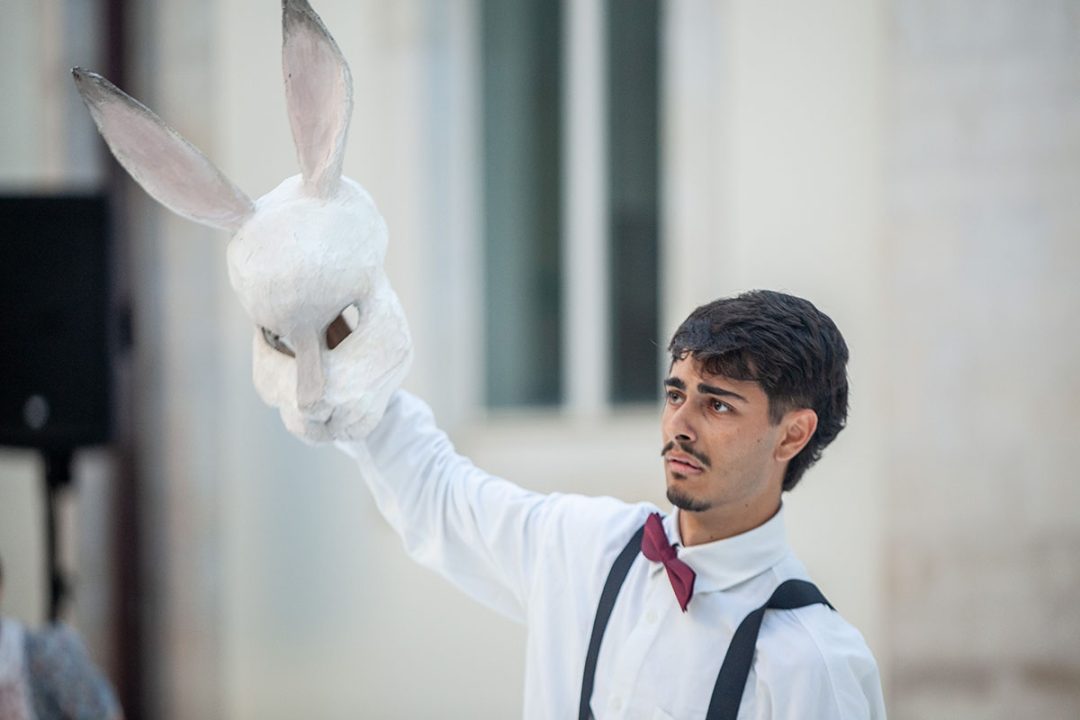
Considering many of the participants have never danced before, the degree of emotion they can produce through movement is outstanding. While scenes are fragmented and have little time to develop (as might be expected from a research sharing), some deeper themes do begin to emerge. A catwalk scene in which the cast struts across the cloistered stage, and a solo in which the rabbit wrestles with his mask, raise questions about the metaphorical masks we wear. Are they chosen or forced upon us? Undoubtedly, Ruvo’s young performers have given Crovisier much to feed into her new creation, due to premiere in Luxembourg this November.
Dance and daily life
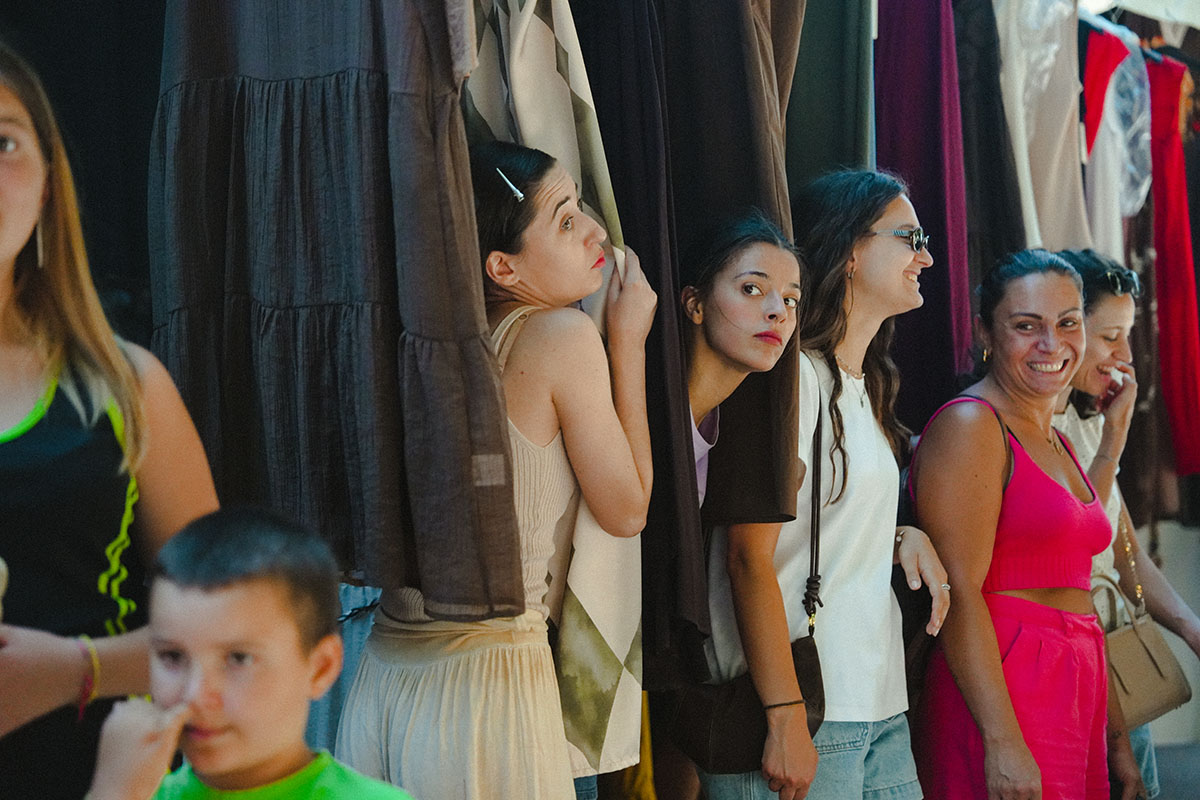
While the young dancers of Papusi Corpo actively responded to an open call, the vendors and shoppers at the Saturday market in Ruvo’s Piazza Dante unwittingly became performers in Compagnia Arearea’s performance Intruders. Setting off down a row of market stalls with cartoonish, bouncy walks, a trio of dancers weave between curious customers, flourishing hands above heads and playing peekaboo through hanging dresses.
One stall-owner shouts after the performers as they juggle his potatoes; at first annoyed, his face soon softens into a cheeky smile. He’s not the only one to play his part: mature men are initially shocked as the dancers join their roadside people-watching, yet later mime flicking their non-existent hair and bowing as audiences gather and clap. A footwear stall owner joins in the fun with a jolly jig; a woman links arms with one of the dancers as they promenade down the street.
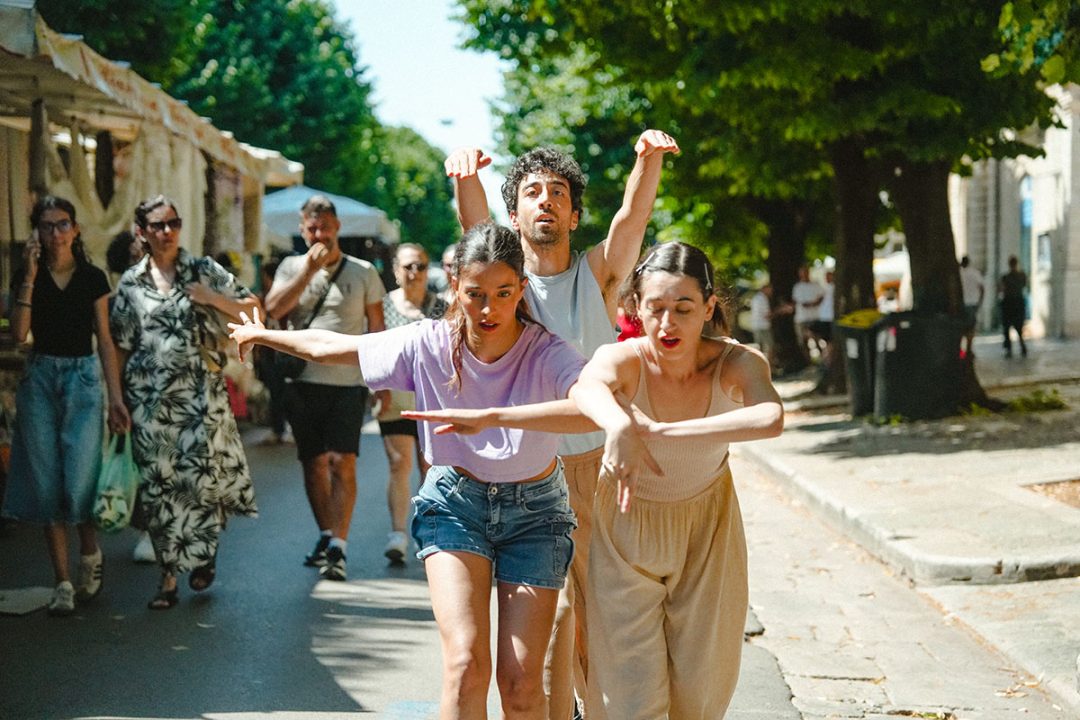
It’s a challenge to keep following the dancers in this busy setting, but that is beside the point: their movements aren’t the stars of the show; the surroundings and the colourful characters that populate them are. Intruders is the final piece I see at Le Danzatrici, and it encompasses everything an outdoor dance festival in a small town should: using movement to shine a light on the beauty and curiosity in the world around us that we might often miss – the beautiful dance of everyday life. ●
Emily May’s trip to Ruvo was provided by Le Danzatrici
11.06.2026 – 11.07.2026, Ruvo, Italy