

Celebrating its thirtieth anniversary, New Baltic Dance returned this year with a question rather than a promise: ‘WHAT’S NEXT?’ Extending from 26 February to 29 April, the festival avoids clear answers. Instead, it presents bodies caught in transition: exhausted by systems, searching for home, resisting technology, or moving collectively towards uncertainty. Throughout the programme, the body becomes both a battlefield and a place of refuge.
Olivier Dubois’ Tragédie (New Edit) feels like a test of endurance. Originally created in 2012, the work returns more than a decade later without losing its weight or urgency. Sixteen naked dancers move continuously across the stage. Their walking recalls running tracks, a catwalk, or even a conveyor belt. The rhythm never disappears. It only accelerates and mutates.
‘
The more the choreography strips away personality, the more human the performers become
Monotony dominates at first. One audience member whispers: ‘Is the whole performance like this?’ Yet exhaustion becomes Dubois’ method. Gradually, the bodies lose individuality and resemble a mechanical mass. Paradoxically, the more the choreography strips away personality, the more human the performers become.
Slowly, the system starts to fail. The dancers stop abruptly, look at one another and fall out of rhythm. The precise structure begins to glitch. Order collapses into chaos. Bodies scatter, form groups and search for intimacy, before returning once again to temporary structure. Dubois explores the border between control and collapse. Who becomes the puppet here: the dancers, or us, trapped within endlessly repeated routines?
Light becomes another performer. Overhead beams manipulate shadows and bodies like an additional naked dancer. By the end, Tragédie resembles a civilisation passing through collapse in order to rediscover its humanity.
If Dubois explores the body within a system, Robyn Orlin’s In a Corner the Sky Surrenders (unplugging archival journeys… #3) (for Volmir <3) turns towards fragility and the longing for home. Brazilian-French performer Volmir Cordeiro lives inside a cardboard box filled with light, music and fragments of domestic life. Nearby, train tracks and a miniature train evoke lives suspended in permanent temporariness.
‘
The boundary between performance and survival constantly dissolves
Yet the inside of the box surprises with warmth and beauty. What appears fragile from the outside slowly becomes a shelter. Cordeiro cooks imaginary meals, dances to the rhythm of domestic life and flirts with both the audience and the space around him, while the cardboard structure transforms into a home, a swimming pool or a stage.
The boundary between performance and survival constantly dissolves. Cordeiro speaks in English, French and Portuguese, asks ‘Am I beautiful?’, then kisses both himself and his temporary home. The work is permeated by saudade – the Portuguese feeling of longing and nostalgia. Home no longer exists as a geographical place, but as a fragile emotional state. Orlin reminds us that all homes are temporary – some simply reveal their fragility more visibly than others.
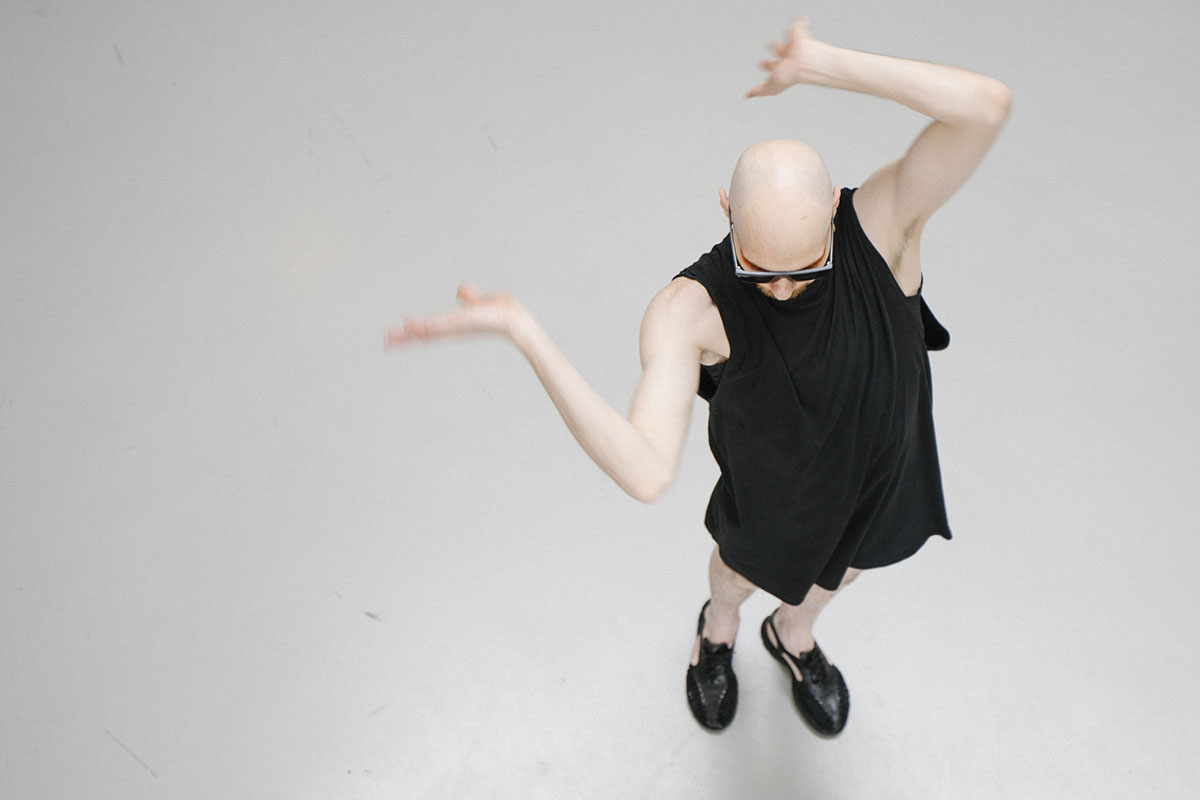
Volmir Cordeiro’s solo performance Street moves these themes into public space. Together with percussionist Washington Timbó, he transforms the gallery into a shifting social choreography. Wearing sunglasses despite the daylight, he walks among the audience asking: What are you looking at? How are you?
The performance develops through gestures as much as dance: smoking, wiping away sweat, handshakes, signs of anger or tenderness. Cordeiro alternates between speaking and dancing to the rhythm of the drums, until it becomes unclear who controls whom – the performer the music, or the music the performer.
The audience follows him throughout the entire piece. Spectators move between spaces and eventually step outside. The performance never truly stops. Street suggests that, in public space, the body constantly becomes a performance itself: observed, judged and shaped by the gaze of others. In the end, only the rhythm of the drums and collective movement remain.
Among the festival’s more intense works, SUPERTHING by Lithuania’s Šeiko Dance Company and Finland’s Dance Theatre Minimi arrives with particular tenderness. A more mature generation of Lithuanian and Finnish dance artists appear on stage like a living archive of contemporary dance itself – bodies carrying decades of experience and memory. Watching them perform never feels neutral. These are artists who have shaped entire generations of dancers and choreographers.
SUPERTHING unfolds slowly and delicately, allowing the audience to remain inside each moment. The performers wear individually constructed costumes that feel almost inseparable from their stage personas – part shelter, part burden, part memory. Visually, the work occasionally evokes both a final supper and an endless climb uphill. The performance never attempts to shock or overwhelm. Instead, it quietly reflects on what remains after loss, and what we choose to carry forward. Gradually, isolated figures begin moving together, as if the performance slowly discovers connection as a form of survival. Rather than intensity, the work offers stillness.
Australian company Chunky Move’s U>N>I>T>E>D shifts the festival towards a technological vision of the future. Six dancers attach mechanical devices to their bodies – sleeves, shoes and wearable constructions – while the choreography moves between street dance, ritual and technological demonstration.
At times, the visual language overpowers the dramaturgy. Repetitive movements become exhausting, while the technological additions appear less interested in liberating the body than in restricting it. The work constantly raises the question: do technologies truly expand human possibility, or merely create new limitations? In the final section, one performer seems absorbed into the world of machines, while the others remain without their constructions, trapped within a future where unity becomes increasingly difficult to sustain.
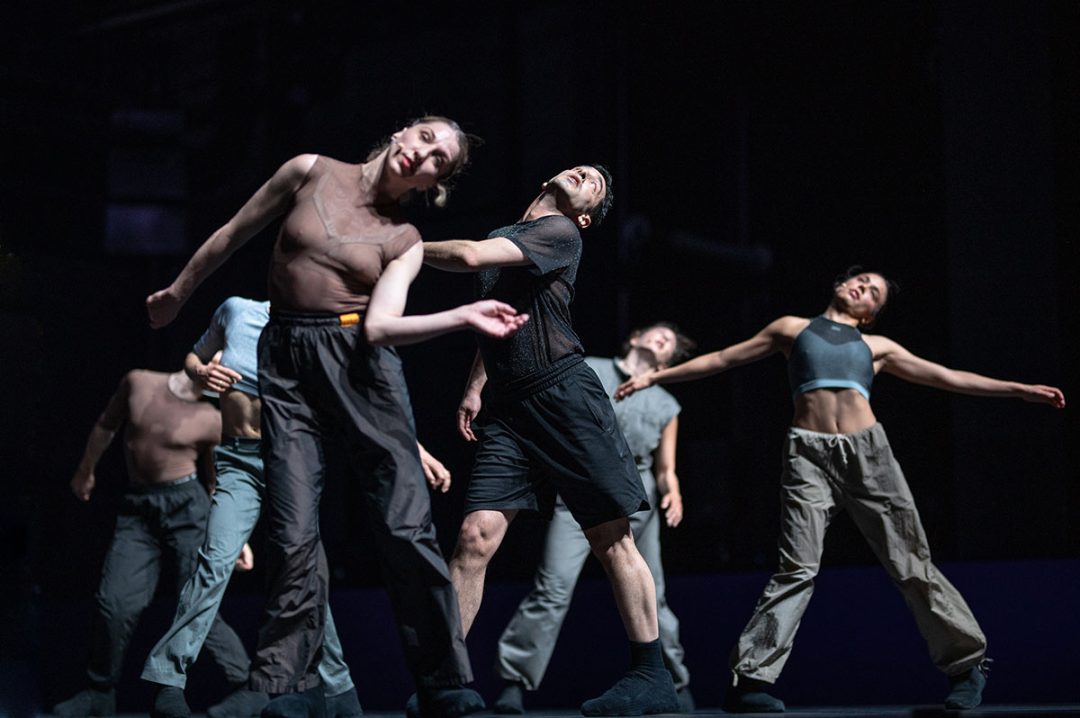
The festival closes with Christos Papadopoulos’ My Fierce Ignorant Step (also reviewed here). Ten dancers move like drifting particles. Small turns of the head and micro-movements spread through the group as if sound itself were travelling through their bodies. Unlike Dubois’ chaos, Papadopoulos builds tension through accumulation. Movements grow more complex, voices louder and rhythm more intense. Military marches, TikTok aesthetics, Irish dance moments, marching band traditions emerge throughout the performance. The dancers resemble an army formed not by ideology, but by rhythm and collective memory. Light becomes another choreographic element. Sudden flashes resemble thunder, while light emerging from behind the audience turns the entire space into part of the performance.
The title My Fierce Ignorant Step remains impossible to fully decode, yet this uncertainty becomes its strength. ‘My’ feels deeply personal, as if speaking about an individual relationship with movement and with the present moment itself. ‘Fierce’ recalls the energy of contemporary pop culture and online performance – confidence, theatricality and the desire to be seen. Meanwhile, ‘ignorant’ does not suggest stupidity, but rather a refusal to maintain complete control or to fully understand the direction ahead. Finally, ‘step’ becomes not only a dance movement, but a collective step forward.
Throughout its thirtieth edition, New Baltic Dance repeatedly returns to the fragile relationship between bodies, people, the audience and the stage. Whether through Dubois’ collapsing system, Orlin’s temporary homes, Cordeiro’s public choreography, the stillness of SUPERTHING, Chunky Move’s technologised bodies, the delicate negotiations of balance in IevaKrish’s OBLICUS [covered here] or Papadopoulos’ collective pulse, the festival suggests that contemporary existence becomes increasingly difficult to sustain alone.
Perhaps this is why one phrase from the festival brochure lingers after the performances end: ‘let’s keep in touch’. Not as sentimentality, but as necessity. ●
26.02.2026 – 29.04.2026, Lithuania