

Memorable 122.4km of Santarcangelo Festival
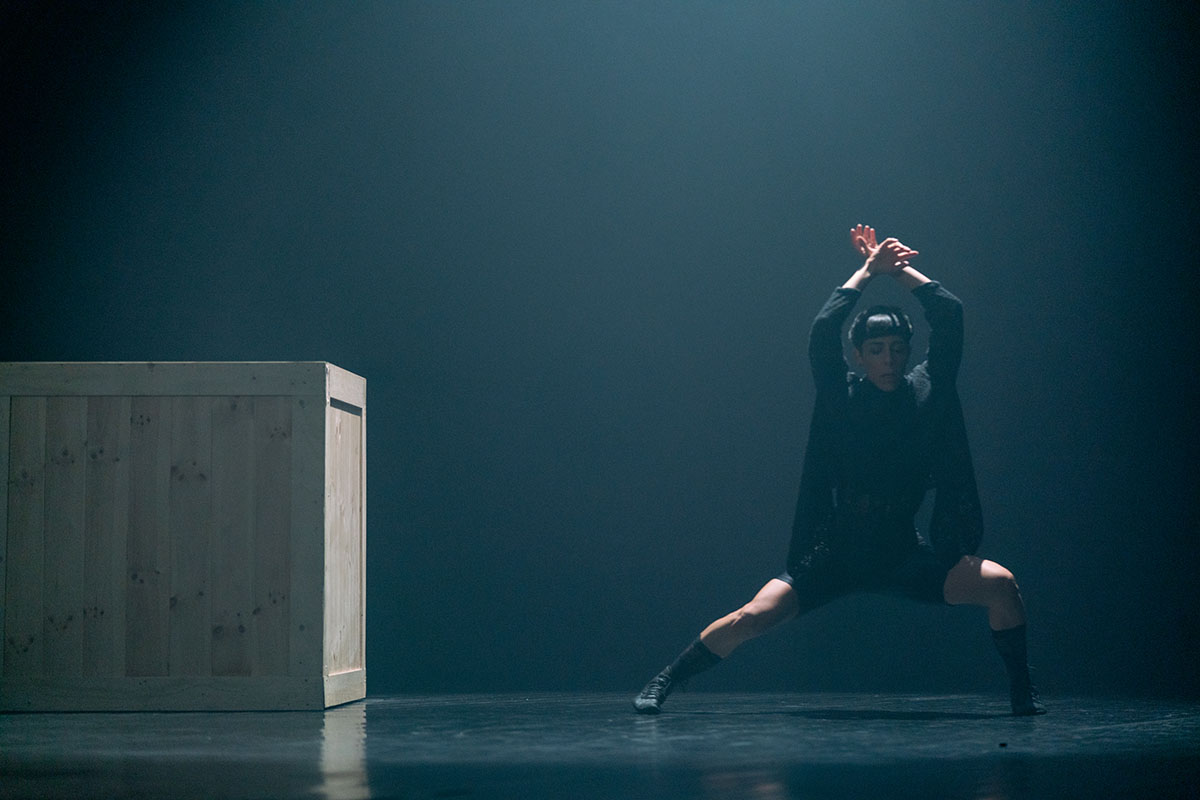
Yuck Miranda’s Homem Novo places its trust in the body, while allowing props and archival material to carry equal narrative weight. The performance opens with the Mozambican choreographer kneeling before a mound of sand. As documentary footage recalls the post-independence re-education camps where people were forced to become ‘new men’, Miranda slowly scatters sand along the edges of the stage, bringing this violent history into the audience’s immediate proximity. The work quietly asks who has the authority to define what it means to be a ‘good citizen’.
His costume extends this tension. A single high heel suggests a body suspended between two worlds, while asymmetrical trousers and an animal-print top visualise an unstable, contested identity. The way Miranda moves – fluid, yet charged with restraint – reveals an intense inner struggle, as if liberation and discipline continuously inhabit the same body. Although the fragmented musical structure occasionally weakens the performance’s emotional flow, its embodied political statement remains striking.
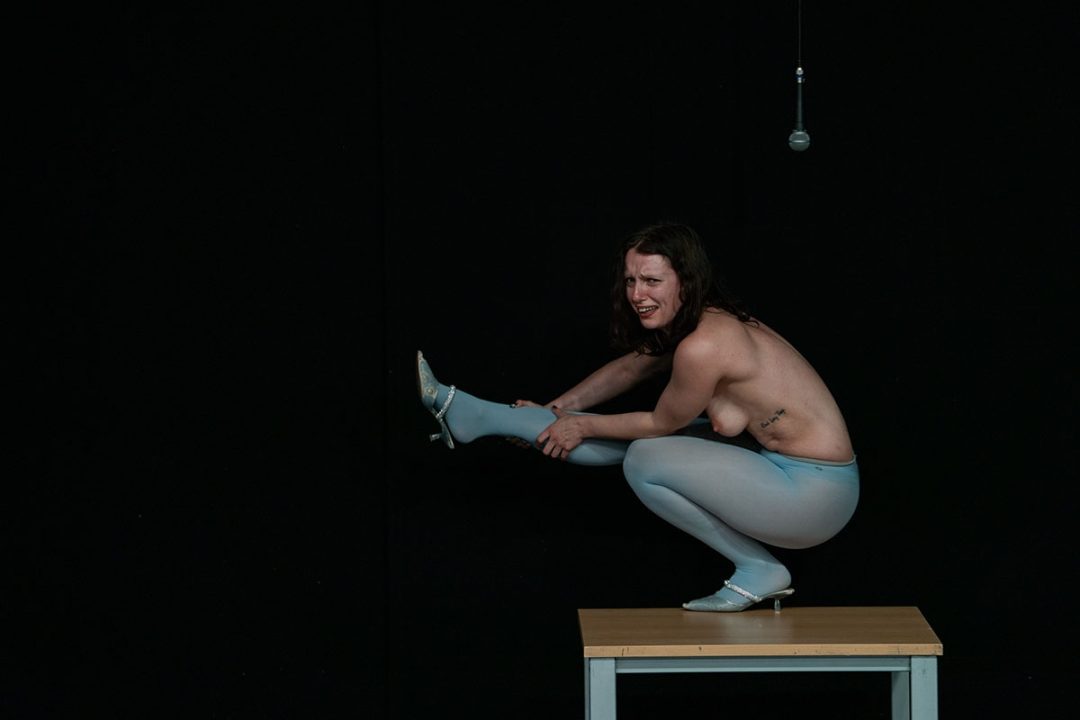
Voice becomes one of the programme’s recurring motifs. Lisa Laurent’s The Wizard Is Not Real opens with relentless crying that initially risks exhausting both performer and audience. Using only a table, microphone and her body, Laurent gradually expands the performance into the audience. At first, the exaggerated display of grief borders on the grotesque, yet the performance slowly reveals another layer. Crying evolves into choreography, then into rhythm, before finally becoming a collective score as Laurent conducts the audience into a shared chorus of sobs. Here, bodily sounds become theatrical language, while one of the performance’s many questions asks why another person’s emotional collapse so often provokes laughter. Although not every section sustains the same intensity, its unsettling humour ultimately proves more compelling than any attempt to offer the audience emotional release.
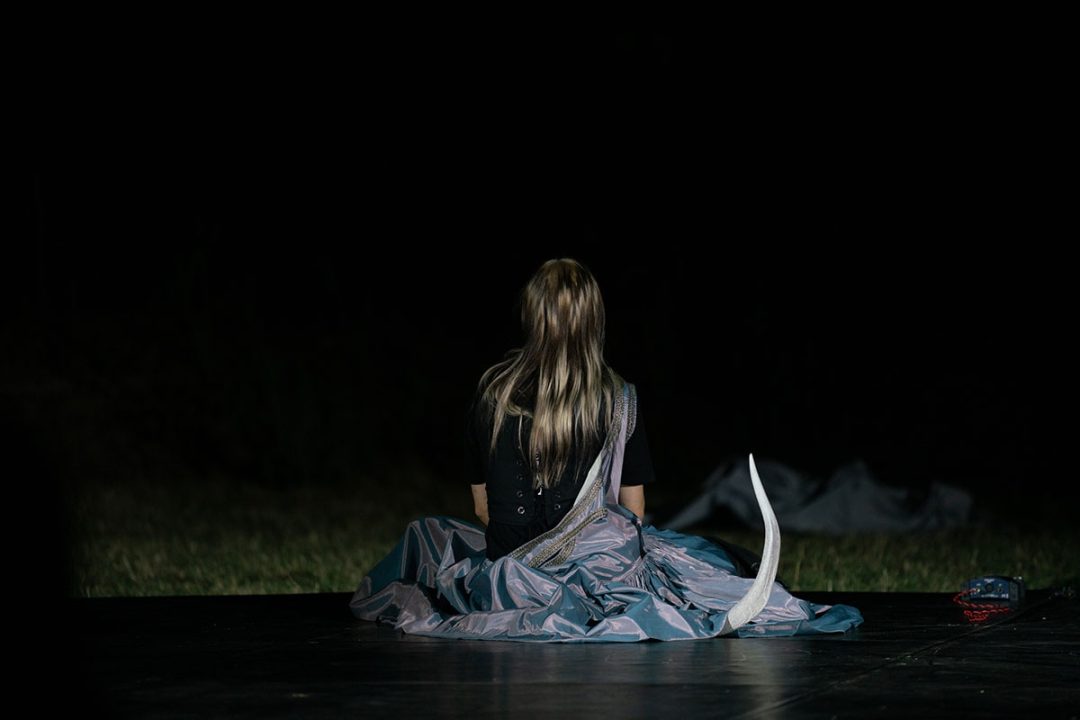
This dialogue between body and voice continues in Violetta Cottini’s Fey (studio), one of the festival’s quietest works. Performed outdoors after sunset, the piece creates a liminal space where infrared imagery, humming, animal calls and the sounds of the surrounding park merge into a single atmospheric landscape. On the stage, a seated creature slowly rotates before gradually crossing the space. Yet the eye is constantly drawn away by more than five screens of varying sizes arranged around the perimeter of the stage. Woodland and horned animals on surrounding screens compete with the live body. Just as the creature seems about to reveal itself, it retreats into the forest, leaving only its image behind on the screens – we never see its face. The performance’s restrained atmosphere rewards patient spectators, although its deliberately elusive dramaturgy occasionally keeps emotional engagement at arm’s length.
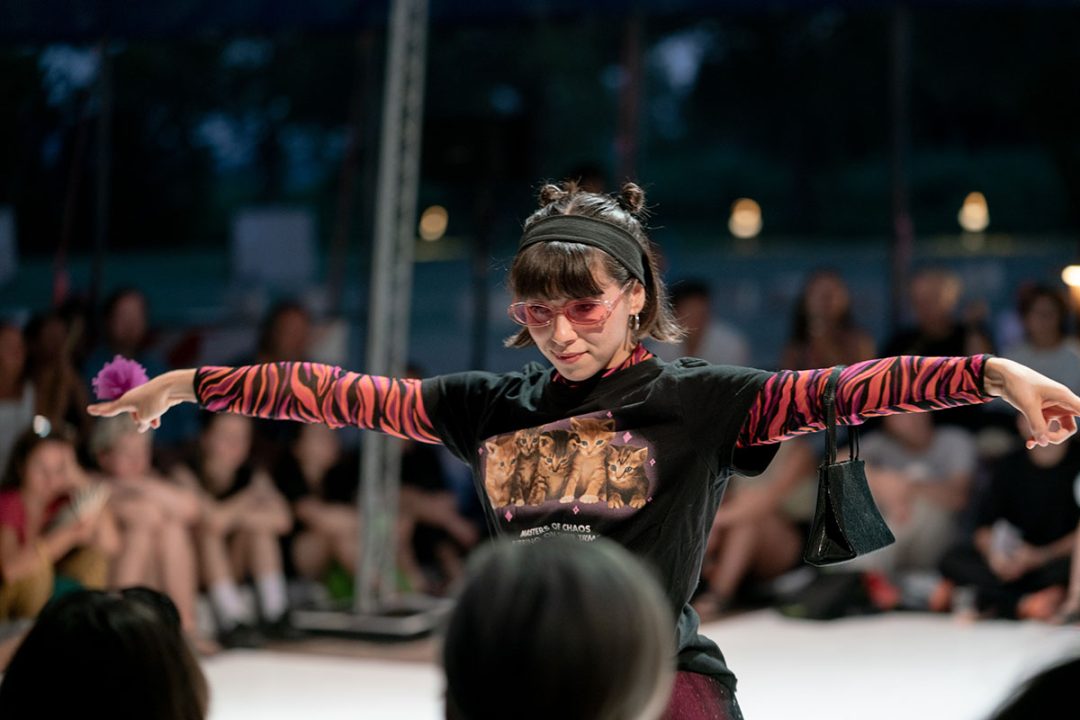
Giorgia Lolli’s Body Sweats (for Elsa), performed together with Vittoria Caneva, Elena Grappi and Maria Chiara Vitti, pays tribute to radical avant-garde artist Baroness Elsa von Freytag-Loringhoven through dance, poetry, Dada, pop culture and kitsch. Wendy Williams’ declaration, Marilyn Monroe’s invitation and Lady Gaga’s famous account of an endless cycle of clubs, planes and performances all become part of this deliberately chaotic collage. The abundance of references reflects the Baroness’s eccentric personality, yet eventually they begin to compete with one another, leaving the performance little room to breathe. Despite the performers’ impressive precision, they lack the inner conviction to fully embody the Baroness. One of the performance’s most memorable moments comes when all four performers cry out simultaneously: the historical narrative briefly gives way to the body, and the carefully constructed intellectual framework finally acquires genuine emotional weight.
Katerina Andreou and Mélissa Guex’s Shout Twice also explores screaming, yet here sound itself becomes both its greatest strength and its limitation. Structured as a concert, the work radiates extraordinary energy. Both performers move with phenomenal precision, stamina and intensity; watching them, one almost wishes to inhabit their bodies and experience that energy from within. Some surrender to its momentum, while others remain observers. When the relentless sonic barrage finally gives way to quieter, almost cosmic soundscapes, silence unexpectedly becomes the performance’s most transfixing moment.
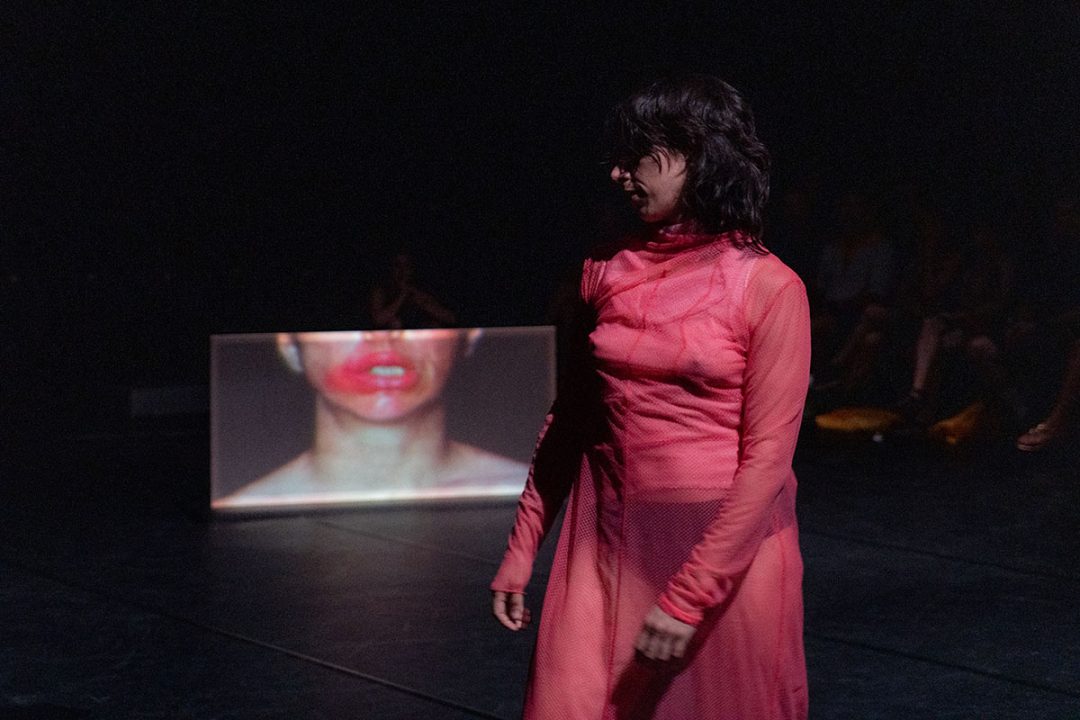
Sara Sguotti’s Rossocrepa offers one of the festival’s most compelling explorations of the female body. The audience is welcomed by a pool of liquid spread across the floor, evoking amniotic fluid and immediately inviting us into something deeply intimate. Large-scale projections of skin, scars and cellulite combine with meticulous lighting to create one of the festival’s strongest visual environments. Wearing a sheer red dress to the sound of Lady in Red, Sguotti quietly asks what becomes of sexuality after motherhood and associated bodily transformations. Hands entering the mouth, lullaby-like fragments of songs hummed under her breath, and increasingly convulsive movement evoke a trauma that resists articulation. Here, multimedia never overwhelms the choreography; instead, it intensifies it, making Rossocrepa one of the festival’s most visually coherent works.
Francesca Pennini and CollettivO CineticO’s Abracadabra approaches disappearance from an entirely different angle. Before the dancer appears, projected text, a recorded voice and instructions invite the audience not to watch but to imagine. ‘Don’t worry about understanding’, the piece repeatedly insists. By the time Pennini finally enters, roughly halfway through the piece, one is still left wondering whether the voice heard until then actually belongs to this body.
Here, choreography is created by more than the dancer alone. Light, smoke, box, balloons, partner in crime Angelo Pedroni’s stage actions and the audience’s constantly stimulated imagination all become equal performers. Smoke, balloons and the final illusion reinforce the work’s proposition that theatre creates reality through shared imagination. With its meticulously crafted aesthetic, Abracadabra recalls Vittorio Pagani’s Superstella. It stands as one of Santarcangelo’s most accomplished works.
Questions of unstable identity also shape Katerina Andreou’s solo BSTRD [also covered in Springback here and here]. Performed on a raised platform in the city’s main square, Andreou embarks on an almost uninterrupted dance marathon, moving across club, jazz and contemporary vocabularies. Music changes, T-shirts disappear, lipstick is reapplied, yet the dancing never stops. This relentless flow of movement expresses a constantly shifting identity more eloquently than any theoretical argument could. Although the performance frequently approaches the point of repetition, Andreou’s extraordinary stamina keeps the audience’s attention.
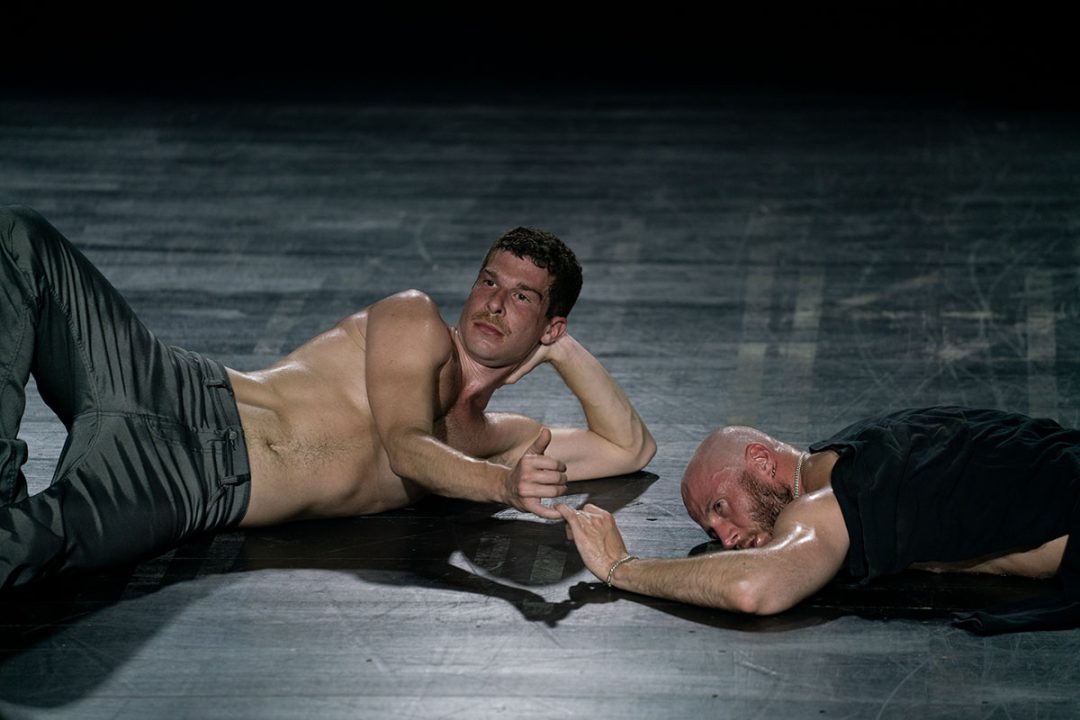
Queer desire finds its clearest expression in Cute & Awkward, created by Wojciech Grudziński together with dancer Lucas Lagomarsino. The two performers are in constant motion, passing one another and observing each other from different points in the space, yet every possible encounter momentarily suspends time for the audience – we hold our breath, waiting to see what will happen next. They dance not for us but for each other, as though in a club where others watch from the corner of an eye, unwilling to intrude. The choreography intertwines motifs from traditional Polish dance, markers of queer culture and fetish aesthetics, while references to Warsaw’s legendary Fantom club firmly situate the work within a specifically Polish queer history.
A staircase becomes a key dramaturgical device: with Grudziński positioned above and Lagomarsino below, the space begins to articulate a shifting power dynamic. At first, the relationship suggests clearly defined top and bottom roles, but these gradually reverse. The seemingly submissive figure takes the initiative, while the dominant body unexpectedly reveals vulnerability. There seems to be no love between them – only raw, animal desire. Although the projected text is obscured by the sheer volume of stage smoke, the work’s overriding impression remains unmistakable: one of sexual awakening and exhilaration.
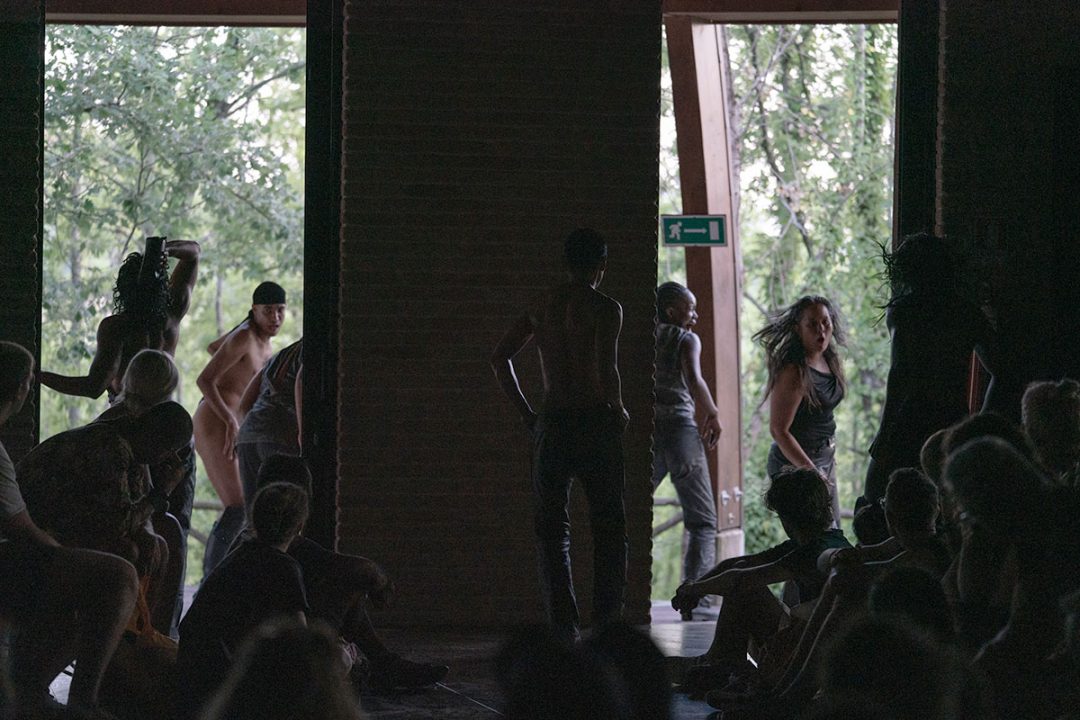
Harald Beharie’s Undersang [also covered in Springback here] extends queer world-building beyond the theatre itself. A one-hour bus ride followed by a thirty-minute forest walk to the performance site becomes an inseparable part of the work, recalibrating the audience’s perception long before the performers appear. Inside, seven bodies create an ecosystem of throat sounds, whispers and uncanny physical forms. Gradually, it begins to feel as though we, too, have become part of a wild kiki community – a gathering of close friends for conversation, laughter and gossip – except that here, togetherness is forged not through words, but through voices, breath and shared presence. Despite its length, the final silence – when applause hesitates – becomes its strongest gesture.
Melissa Guex, Alberto Malo and Louis Schild’s Loud Goodbye unfolds as a tender ritual of farewell. Guex’s movement responds continuously to the live concert score, while the music, in turn, reacts to her choreography, the two evolving as equal partners in dialogue. The performance evokes the metaphor of a swan song, transforming farewell into a singular, deeply resonant event. Although the interplay between music and movement remains elegant, its emotional register feels comparatively restrained after several of the festival’s more formally ambitious works.
Takeaway
By the festival’s end, the 122.4 kilometres walked between venues feel inseparable from the performances themselves. Bodies cry, scream, disappear, desire and dance; audiences keep moving towards the next encounter. In Santarcangelo, meaning emerges somewhere between one body and another, one space and the next.
—Dmitrijus Andrušanecas
What is a solo beyond the individual?
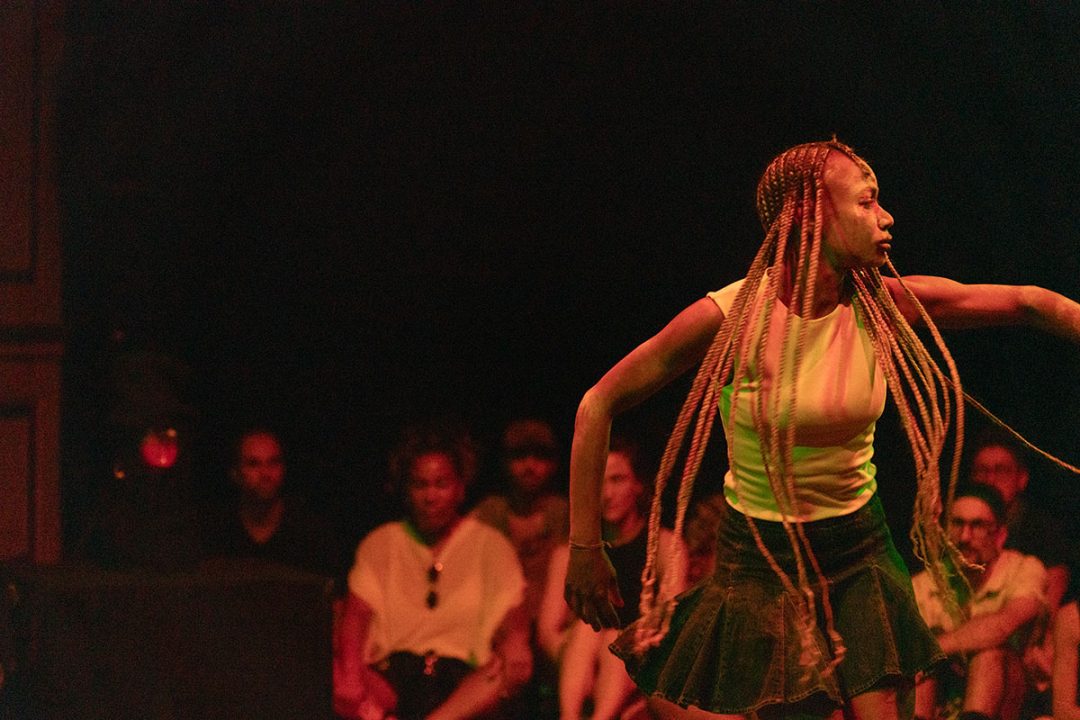
In Teatro Petrella, a small 1870 theatre in Longiano, Ndoho Ange sits, nearly still, eyes glazed over, a layer of clay painted on her face. Her movements are soon to transform from minimalist to beastlike – a journey through which her performativity takes up more and more space. Whether it’s her ability to change from near-slow motion to muscular and explosive, or her expressive lipsyncing that does the trick, the white sculptures on the walls of the theatre seem to shrink to almost nothing. This dramaturgical effect is hypnotising, yet it’s the music – and the context it’s placed into – that makes the work truly visceral. ‘You Don’t Love Me (No, No, No)’ broke the charts in 1994, but Dawn Penn’s first version was 27 years old already then, and the song traces back further, through Willie Cobbs (1960) and Bo Diddley (1955), and possibly even earlier. Here, history comes alive through Deepnathy’s sound design, which reiterates the track, again and again, from slow reggae to fast trance. Through repetition, thoughts of love grab hold of me: love as something universal, beyond the individual; how fractured a society lacking love can become. While audience engagement gets physical through Ange sharing clay with the audience, the immersion runs deeper; through witnessing Ange surrendering her body entranced by the music, post-colonial awareness is offered, one movement at the time. So yes, Welcome to my jungle really does become a ‘contemporary ritual’, reminding us of the pain of the past while never letting go of the present.
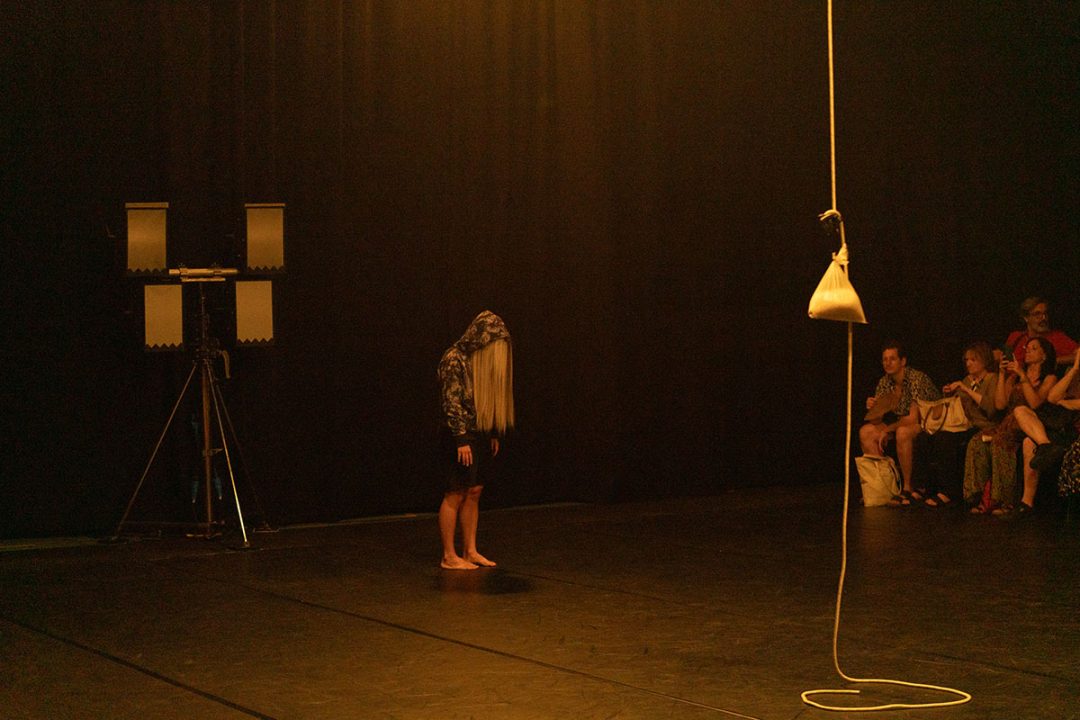
Catol Teixeira steps slowly from the corner of the sport hall, their face obscured by a long blonde wig spilling out of their hoodie; each movement radiating precision. Here, each step is placed carefully, with a body control that extends all the way through each toe joint. A recorded child’s voice repeats ‘I never cry’, as Teixeira gets rid of the face covering, appearing reborn on the floor, bare chested with a head of tousled short hair. Their direct gaze pierces the audience’s as they move with catlike ease around the space, counterclockwise, through carefully choreographed sequences, their presence continuously shifting between fragile and powerful. Towards the end Teixeira puts on a harness, attaches themselves to a rope and slowly lifts off, floating in the air – and for a while they seem able to let go of self image, letting go of control. And even though ODE continues, this aerial sequence becomes the one moment that truly transcends, creating an illusion of the world slowing down while Teixeira’s body accelerates.
In his first solo work, Machito, Martin Soria takes inspiration from Las Machitas, a group of women who have challenged the strict gender binary of the Andean dance Caporales. He appears outside the circus tent and approaches the crowd gradually, one step at the time, accompanied only by the sound of his bell-adorned cowboy boots. In a territorial marking of the space, cowboy hat in hand, he moves among the audience, slowly removing layers of clothing, including the large, colourful trousers, until a short palette-embroidered skirt is revealed. At one point, an audience member is invited to sit on one knee while Soria, joyously smiling, flicks the skirt in his face. In the finale, Soria steps up on a platform and lets his long, bell-adorned hairband swing around and around like a dominatrix. Despite occasionally misjudging the space, resulting in a few accidental contacts, his message is clear: Soria’s cheeky and cheerful energy has rubbed off on the audience, who, as he leaves the tent, are left dancing on, with an empowered sense of joy and freedom of self-expression.
Takeaway
Santarcangelo platforms subversive artistic voices in a time when art and culture are threatened by conservatism and far-right politics. In general, well thought-out curatorial choices of location accompany each work, offering a complimentary dramaturgical layer.
—Ingeborg Zackariassen
For the first part of Springback’s coverage at Santarcangelo Festival 2026, see Ariadne Mikou’s article ‘Beneath the ‘deep pressures’ of the present’.
Dmitrijus Andrušanecas’s text was also published in Lithuanian by Nemunas magazine, along with additional performance coverage from Santarcangelo Festival.
3–12.07.2026 Santarcangelo, Italy